
The sun rises slowly over Seongsan Ilchulbong, painting the volcanic crater in shades of amber and rose while mist clings to the cliffs below. A thousand kilometers north, inside a quiet wooden hall in the mountains of Gyeongsang Province, over 80,000 hand-carved wooden blocks have survived seven centuries of fires, wars, and monsoons without a single case of insect damage or warping. These aren’t isolated curiosities — they’re two of the UNESCO World Heritage Sites in South Korea, a collection of 16 places recognized by the United Nations as holding “outstanding universal value” to humanity.
If you’ve ever wondered which historical sites in Korea are truly worth your time — not just popular with tourists, but formally recognized as irreplaceable pieces of human heritage — this guide answers that question completely. We’ll walk through every UNESCO-designated site in South Korea, explain what makes each one significant, and give you the practical details you need to actually plan a visit: locations, best seasons, transportation, and insider tips drawn from how these sites are experienced in 2026.
Whether you’re a K-drama fan who recognized Changdeokgung’s Secret Garden from a beloved series, a history enthusiast tracing the Joseon Dynasty, or simply planning your first trip to Korea, this is the most comprehensive resource you’ll find on the subject.
What Are UNESCO World Heritage Sites — And Why Does South Korea Have So Many?
Before diving into the list itself, it’s worth understanding what this designation actually means — because it’s easy to assume “UNESCO site” is just a fancy label for “popular tourist attraction.” It’s far more rigorous than that.
The UNESCO World Heritage Convention, Briefly Explained
The World Heritage Convention was established in 1972 by the United Nations Educational, Scientific and Cultural Organization (UNESCO) to identify and protect places of “outstanding universal value” — locations so significant to human history, culture, or natural science that their loss would represent a loss for all of humanity, not just the country in which they’re located.
To be inscribed on the list, a site must meet at least one of ten official selection criteria. Criteria i through vi apply to cultural heritage (architecture, monuments, historic town centers, sites of major historic events), while criteria vii through x apply to natural heritage (exceptional natural beauty, significant ecosystems, geological formations, or habitats for threatened species). Some properties, known as “mixed sites,” qualify under both cultural and natural criteria.
This distinction matters when you’re planning a trip, because it shapes what kind of experience you’ll actually have. A cultural site like Jongmyo Shrine offers a meditative walk through Confucian ritual architecture. A natural site like Jeju’s volcanic landscape offers hiking trails, lava tube caves, and coastal cliffs. Knowing which type of site you’re visiting helps you set the right expectations — and pack accordingly.
Cultural vs. Natural vs. Mixed Heritage: How Korea’s Sites Break Down
Of South Korea’s 16 UNESCO World Heritage Sites, the overwhelming majority — 15 of them — are cultural heritage sites. Only one, the Jeju Volcanic Island and Lava Tubes, is inscribed purely for its natural characteristics. This ratio tells you something important about what Korea is celebrated for on the world stage: not sweeping wilderness (though the country has plenty of natural beauty), but an unusually well-preserved, continuous record of East Asian civilization — royal palaces, Buddhist temples, Confucian academies, and burial sites spanning more than two thousand years.
Why South Korea’s Heritage Density Is So Unusual
South Korea is roughly the size of the U.S. state of Indiana, yet it holds 16 UNESCO World Heritage Sites — one of the highest concentrations per capita of any country in Asia. This isn’t a coincidence. It reflects a rare combination of factors: a continuous, unbroken line of dynastic rule (the Joseon Dynasty alone lasted over 500 years, from 1392 to 1910), a deep cultural emphasis on record-keeping and preservation, and — despite the devastation of Japanese colonization and the Korean War — a national commitment to restoring and protecting what survived.
Understanding this context transforms how you experience these sites. You’re not just looking at old buildings; you’re seeing the deliberate, centuries-long effort of a nation to preserve its own memory.
The Complete List of UNESCO World Heritage Sites in South Korea (2026)
As of 2026, South Korea has 16 UNESCO-inscribed properties, spanning cultural, natural, and archaeological heritage. Here is the complete, up-to-date list, organized by category.
Cultural Heritage Sites (15 Total)
- Seokguram Grotto and Bulguksa Temple (Gyeongju) — inscribed 1995
- Haeinsa Temple Janggyeong Panjeon (Mount Gaya) — inscribed 1995
- Jongmyo Shrine (Seoul) — inscribed 1995
- Changdeokgung Palace Complex (Seoul) — inscribed 1997
- Hwaseong Fortress (Suwon) — inscribed 1997
- Gyeongju Historic Areas (Gyeongju) — inscribed 2000
- Gochang, Hwasun, and Ganghwa Dolmen Sites — inscribed 2000
- Royal Tombs of the Joseon Dynasty (Seoul and Gyeonggi Province, 40 tombs across 18 locations) — inscribed 2009
- Historic Villages of Korea: Hahoe and Yangdong — inscribed 2010
- Namhansanseong (Gyeonggi Province) — inscribed 2014
- Baekje Historic Areas — inscribed 2015
- Sansa, Buddhist Mountain Monasteries — inscribed 2018
- Seowon, Korean Neo-Confucian Academies (nine academies) — inscribed 2019
- Gaya Tumuli (Gyeongsang provinces) — inscribed 2023
- Petroglyphs Along the Bangucheon Stream (Ulsan) — inscribed 2025, the most recent addition
Natural Heritage Sites (1 Total)
- Jeju Volcanic Island and Lava Tubes — inscribed 2007, South Korea’s only natural World Heritage Site
This list represents inscriptions between 1995 and 2025, and it continues to grow — South Korea maintains an active tentative list, including sites like Mt. Soraksan Nature Reserve, which may be formally inscribed in future years.
Top UNESCO Sites for First-Time Visitors: A Deep Dive
With 16 sites spread across the country, most travelers can’t visit everything in a single trip. This section highlights the most accessible, visually striking, and historically significant sites — the ones that deliver the greatest impact for the time you invest.
Gyeongbokgung and Changdeokgung Palace Complex (Seoul)

Seoul is home to five grand palaces built during the Joseon Dynasty, but Changdeokgung is the one carrying UNESCO World Heritage status, inscribed in 1997 for its exceptional integration with the natural landscape. Unlike the more symmetrical, formal layout of nearby Gyeongbokgung, Changdeokgung’s architects worked with the terrain rather than against it — palace buildings curve around hills, ponds, and mature forest rather than imposing a rigid grid.
The undisputed highlight is the Huwon, or Secret Garden — a sprawling royal retreat of pavilions, lotus ponds, and centuries-old trees that was once reserved exclusively for the royal family. Because UNESCO status comes with strict visitor caps to protect the site, Secret Garden tours require advance booking, and tickets can sell out days ahead during peak cherry blossom and autumn foliage seasons.
Quick facts:
- Location: Jongno District, central Seoul
- Best season: Spring (April) for blossoms, autumn (late October–November) for foliage
- Access: Anguk Station, Seoul Subway Line 3
- Note for K-drama fans: Changdeokgung and its Secret Garden have appeared as filming locations in numerous historical dramas, making it a popular stop for culture-focused travelers
Seokguram Grotto and Bulguksa Temple (Gyeongju)
Built in the 8th century during the height of the Silla Kingdom, this paired site represents one of the finest examples of Buddhist art and temple architecture in East Asia. Bulguksa Temple houses two National Treasures — the Dabotap and Seokgatap stone pagodas — while Seokguram Grotto, a short but scenic hike up Tohamsan Mountain, contains a monumental seated Buddha statue considered one of the most technically accomplished Buddhist sculptures in the world.
The two sites are typically visited together, and both are easily reached as a day trip from Busan, making this one of the most logistically convenient UNESCO pairings in the country.
Quick facts:
- Location: Gyeongju, North Gyeongsang Province
- Best season: Spring (cherry blossoms) or autumn
- Access: Roughly 1 hour by car/bus from Busan; 2.5 hours from Seoul via KTX to Singyeongju Station
- Insider tip: Arrive early morning to avoid tour bus crowds at Seokguram Grotto
Haeinsa Temple and the Tripitaka Koreana (Mount Gaya)

This is arguably the most quietly astonishing UNESCO site in the country. Deep within Gayasan National Park, the Janggyeong Panjeon depositories house the Tripitaka Koreana — the world’s most complete collection of Buddhist scriptures, carved onto more than 80,000 wooden printing blocks in the 13th century. What makes this site remarkable isn’t just the scale of the undertaking, but the ingenuity of the storage halls themselves: 15th-century architects designed a natural ventilation and humidity-control system so effective that the wooden blocks remain intact today, with minimal warping or insect damage, despite centuries without modern climate control.
Quick facts:
- Location: Mount Gaya, South Gyeongsang Province
- Best season: Autumn, when the surrounding national park turns brilliant red and gold
- Access: Bus from Daegu (roughly 1.5–2 hours)
- Why it matters: A rare case where the storage architecture is as significant as the artifacts it protects
Jeju Volcanic Island and Lava Tubes
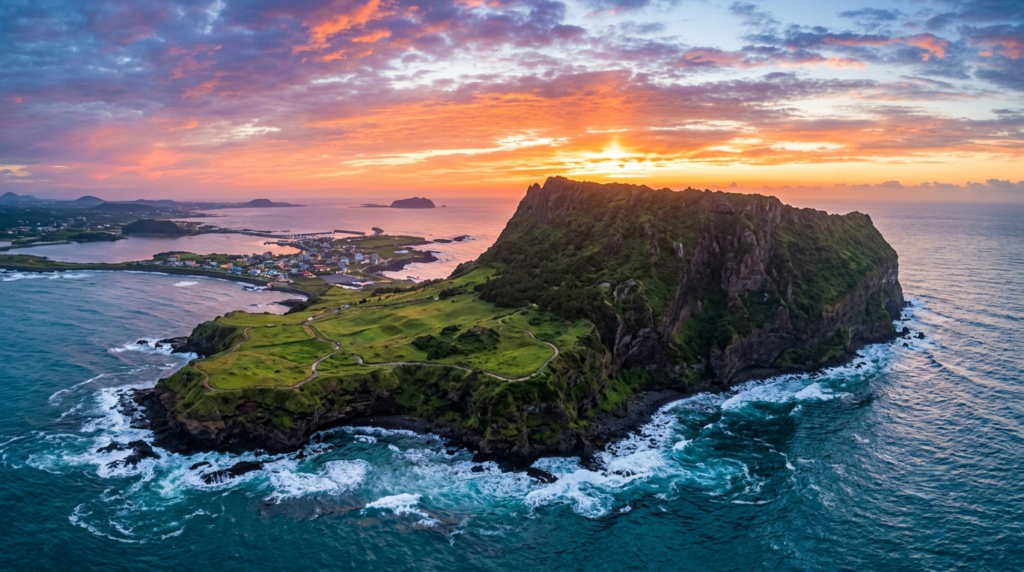
South Korea’s only natural UNESCO World Heritage Site, Jeju Island offers a completely different experience from the palace-and-temple circuit. The designation covers three components: Hallasan (Korea’s tallest mountain, a dormant volcano), the Geomunoreum Lava Tube System (one of the most well-preserved lava tube networks in the world), and Seongsan Ilchulbong, a dramatic tuff cone rising from the sea, famous for sunrise views.
Quick facts:
- Location: Jeju Island (roughly 1-hour flight from Seoul)
- Best season: Spring (Jeju Fire Festival) or autumn for hiking
- Highlight: Manjanggul Cave, home to the world’s largest lava column
- Ideal for: Travelers wanting to pair heritage sites with outdoor adventure
Hwaseong Fortress (Suwon)

Built in the late 18th century by the scholar-engineer Jeong Yak-yong, Hwaseong Fortress stretches 5.52 kilometers and represents a fascinating fusion of traditional Korean military architecture with early Western engineering concepts. The fortress includes four main gates, artillery towers, and observation posts, and — unusually for a defensive structure of its age — was also designed as a center for education and culture.
Quick facts:
- Location: Suwon, Gyeonggi Province
- Best season: Year-round; especially atmospheric in early morning light
- Access: Roughly 40 minutes from Seoul by train
- Ideal for: A manageable half-day trip that doesn’t require overnight travel
Hahoe and Yangdong Historic Villages

For travelers wanting to see Confucian culture as a living tradition rather than a museum piece, these two villages — Hahoe near Andong and Yangdong near Gyeongju — offer preserved clusters of traditional hanok homes, Confucian study halls, and family shrines, many still inhabited by descendants of the original clans.
Quick facts:
- Location: Andong (Hahoe) and Gyeongju (Yangdong)
- Best season: Spring or autumn for the surrounding rural scenery
- Highlight: The Byeongsan Seowon nearby, considered one of the most beautifully situated Confucian academies in Korea
How to Plan Your UNESCO Heritage Trip in South Korea
Knowing which sites exist is only half the equation — turning that knowledge into an actual itinerary is where most travelers get stuck. Here’s how to approach it practically.
Best Time of Year to Visit
Korea’s four distinct seasons dramatically affect the heritage-site experience:
- Spring (April–May): Cherry blossoms frame palace complexes and Confucian academies beautifully; this is peak season, so book Secret Garden tickets and accommodations well in advance
- Autumn (late October–November): Widely considered the best season for heritage travel — comfortable temperatures and vivid foliage, especially at Haeinsa and around Gyeongju
- Summer: Hot and humid, though useful for Jeju’s coastal and lava tube sites, which stay relatively cool underground
- Winter: Fewer crowds and a starkly beautiful backdrop at palace sites, though some outdoor trails (Jeju, Namhansanseong) may have limited access
Getting Around: KTX and Regional Transport
South Korea’s high-speed KTX rail network makes multi-site heritage trips far more feasible than in most countries. Seoul to Gyeongju (via Singyeongju Station) takes roughly 2.5 hours; Seoul to Busan takes under 3 hours. For Jeju, domestic flights from Seoul’s Gimpo Airport take about an hour. Within cities, most UNESCO sites — particularly in Seoul — are accessible directly by subway.
Suggested Itineraries
3-Day Seoul Heritage Loop (ideal for first-time visitors with limited time)
- Day 1: Changdeokgung Palace and Secret Garden, Jongmyo Shrine
- Day 2: Hwaseong Fortress day trip to Suwon
- Day 3: Namhansanseong hike and fortress exploration
5-Day Seoul–Gyeongju–Jeju Circuit (comprehensive heritage tour)
- Days 1–2: Seoul (Changdeokgung, Jongmyo, Royal Tombs)
- Day 3: KTX to Gyeongju (Bulguksa, Seokguram Grotto, Gyeongju Historic Areas)
- Day 4: Haeinsa Temple day trip
- Day 5: Flight to Jeju (Lava Tubes, Seongsan Ilchulbong)
If you’re traveling in cooler months, pairing this itinerary with a broader look at what South Korea offers in November or planning around peak seasonal windows can help you avoid overcrowding at the most popular sites.
What’s New for 2026 Visitors

Korea’s Cultural Heritage Administration has rolled out several technology-driven upgrades that meaningfully improve the visitor experience this year:
- AI Heritage Guides: QR codes at major sites launch multilingual AI avatars that answer specific historical questions in real time
- AR Reconstruction Walks: At Hwaseong Fortress, augmented reality tablets let visitors see structures “restored” as they were before wartime destruction
- Digital Stamp App: Visitors can collect digital stamps at each UNESCO site, redeemable for museum discounts and even KTX fare reductions
- Templestay Digital Detox Programs: Several Sansa mountain monasteries now offer structured, AI-guided meditation retreats for international visitors
These additions make 2026 an especially rewarding year to visit, particularly for travelers who want a deeper, more interactive understanding of what they’re seeing.
UNESCO Sites and Korean Culture Beyond the Architecture
For many readers of this site, Korean heritage sites hold appeal that goes beyond history alone — they’re woven into the modern cultural landscape that draws people to K-dramas, K-pop, and contemporary Korean storytelling in the first place.
How These Sites Inspired K-Drama and Film Settings
Korea’s historical dramas — a genre known as sageuk — rely heavily on UNESCO-protected locations for authenticity. Changdeokgung’s Secret Garden has served as a backdrop in numerous period productions, its untouched Joseon-era landscaping offering filmmakers a setting that requires no artificial staging. Hwaseong Fortress, with its dramatic gates and watchtowers, frequently appears in productions depicting court intrigue and military history. Even contemporary productions occasionally use Gyeongju’s ancient tumuli and temple grounds to ground fictional storylines in a tangible sense of historical place.
For fans who first encountered these locations on screen, visiting in person adds a layer of meaning that pure sightseeing doesn’t provide — you’re not just seeing a set, you’re standing in the actual space where centuries of real history unfolded.
Traditional Ceremonies Still Performed Today
Unlike many heritage sites globally that exist purely as static monuments, several of Korea’s UNESCO sites host living traditions. The most notable is the Jongmyo Daeje, a royal ancestral ritual held every May at Jongmyo Shrine, complete with traditional ritual music (Jongmyo Jeryeak) that UNESCO separately recognizes as Intangible Cultural Heritage. Watching this ceremony offers a rare chance to see centuries-old Confucian ritual practiced exactly as it was performed under the Joseon Dynasty — not a reenactment, but a continuation.
Connecting Heritage Travel With Modern Korean Culture
Heritage travel and pop-culture tourism aren’t separate interests in Korea — they overlap constantly. A visitor might spend a morning at Bulguksa Temple, an afternoon exploring a hanbok rental experience near a historic palace, and an evening watching a K-pop-influenced light show in Seoul’s modern districts. This blending of old and new is, in many ways, the defining character of Korean tourism today, and it’s part of what makes these UNESCO sites so rewarding to explore alongside the country’s contemporary cultural exports.
Frequently Asked Questions
How many UNESCO World Heritage Sites are in South Korea?
South Korea has 16 UNESCO World Heritage Sites as of 2026, consisting of 15 cultural sites and 1 natural site (Jeju Volcanic Island and Lava Tubes).
What is the newest UNESCO World Heritage Site in South Korea?
The most recent addition is the Petroglyphs Along the Bangucheon Stream in Ulsan, inscribed in 2025. These Neolithic rock carvings are among Korea’s oldest surviving depictions of human-animal interaction.
Which UNESCO sites are easiest to visit from Seoul?
Changdeokgung Palace Complex and Jongmyo Shrine are located directly within Seoul and accessible by subway. Hwaseong Fortress (Suwon) and Namhansanseong are both under an hour away by train or bus, making them ideal half-day trips.
Is Jeju Island the only natural UNESCO site in South Korea?
Yes. Of the 16 designated sites, Jeju Volcanic Island and Lava Tubes is the sole natural heritage site; all others are classified as cultural heritage.
Do you need tickets in advance for Changdeokgung’s Secret Garden?
Yes. Because of strict UNESCO-mandated visitor caps designed to protect the site, Secret Garden access requires a timed-entry ticket, and these frequently sell out during cherry blossom and autumn foliage seasons. Booking several days to a week ahead is strongly recommended.
What’s the best season to visit Korea’s heritage sites?
Autumn (late October through November) is widely considered ideal, offering comfortable weather and vivid foliage, particularly around Haeinsa Temple and Gyeongju. Spring (April) is equally popular for cherry blossoms but requires earlier advance booking due to crowds.
Final Thoughts: Planning Your Heritage Journey Through Korea
South Korea’s 16 UNESCO World Heritage Sites represent far more than a checklist for history buffs — they’re a window into five millennia of continuous culture, from Neolithic rock carvings to Joseon-era royal palaces still standing exactly where they were built centuries ago. Whether you’re drawn by architectural mastery, spiritual history, dramatic natural landscapes, or simply the desire to stand in the same spaces that inspired the Korean stories and shows you love, these sites offer an experience that rewards both the casual traveler and the dedicated culture enthusiast.
With the practical details in this guide — locations, seasons, transportation, and 2026’s new technology-driven visitor tools — you now have everything needed to build an itinerary that goes beyond surface-level sightseeing and into genuine cultural immersion.
If you’re mapping out the rest of your trip, you might also want to explore what South Korea offers in November for a season-specific planning angle, or dive deeper into regional destinations like Jindo Island to round out your itinerary beyond the UNESCO circuit.