
There’s a particular kind of hush that falls over Korea’s coastline in the final hour before dark. Fishing boats slow their engines. Cafés along the shore fill with couples angling their phones toward the horizon. And somewhere on the West Sea, the sun begins its slow, deliberate drop into the water, painting the sky in shades most travelers never expect from this part of the world. If you’ve ever wondered where to catch the best sunset in South Korea, the answer isn’t one single place — it’s a whole coastline of them, each with its own personality, season, and story.
South Korea rarely gets credit as a sunset destination. Its neighbor Japan dominates golden-hour photography feeds, and within Korea itself, most tourism marketing leans hard into sunrise — from the New Year’s crowds at Ganjeolgot Cape to the dawn hikers atop Seongsan Ilchulbong, literally named “Sunrise Peak.” But this actually works in your favor. Korea’s real sunset spots — the west coast tidal flats, the volcanic cliffs of Jeolla Province, the quiet beaches near Incheon Airport — are far less crowded than their sunrise-famous counterparts, and arguably more dramatic. This guide brings together verified, up-to-date information on where, when, and how to experience the best sunsets Korea has to offer in 2026, whether you’re a serious photographer, a K-drama fan chasing familiar coastlines, or simply someone who wants to end a travel day the right way.
Why South Korea Is a Hidden Gem for Sunset Watching
Geography That Creates Dramatic Skies
The secret to Korea’s sunset appeal lies in its shape. The country’s western coastline faces directly into the Yellow Sea (also called the West Sea), which means the sun sets over open water along nearly the entire western half of the peninsula — something the east coast, facing Japan across the East Sea, simply cannot offer. This is why nearly every officially recognized sunset destination in Korea sits on the west or southwest coast: Taean, Buan, Gunsan, Incheon, and the islands scattered along the Yellow Sea are all positioned for that unobstructed, sun-into-the-ocean view.
Beyond the coastline, Korea’s geography adds texture most sunset destinations lack. Volcanic sea cliffs turn red as the light lowers. Tidal mudflats reflect the sky like a mirror at low tide. Mountain ridgelines around Seoul silhouette against the fading light, giving the country’s sunsets a layered, almost cinematic quality that’s genuinely distinct from tropical beach sunsets elsewhere in Asia.
Seasonal Sunset Beauty — How Sunsets Change Across the Year
Korea’s four distinct seasons mean no two months of sunset-watching look the same:
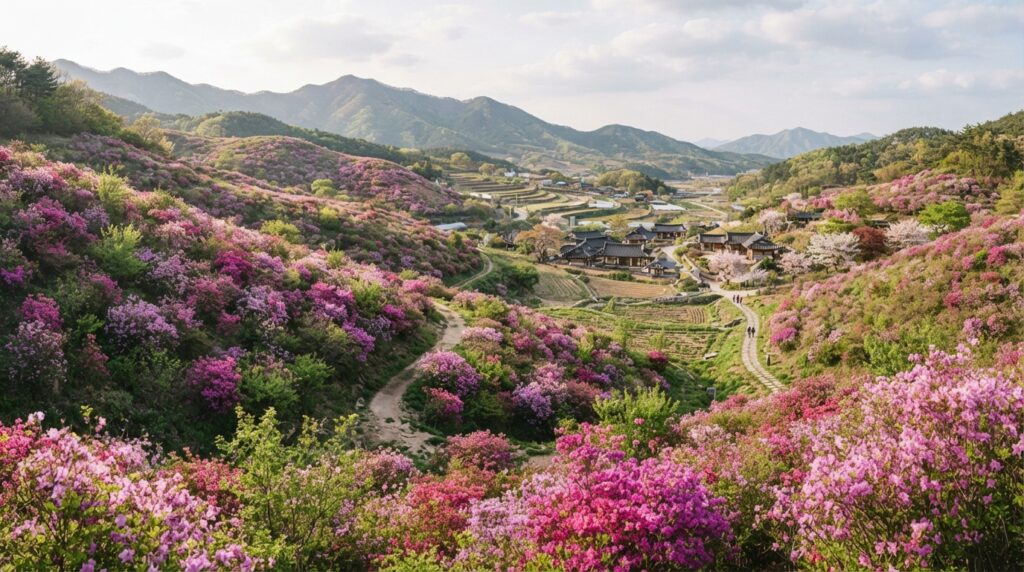
- Spring (March–May): Softer, hazier skies with pastel pink and lavender tones, often paired with cherry blossoms or canola fields in the foreground.
- Summer (June–August): The longest daylight hours of the year, with the latest sunsets landing close to 7:50–8:00 PM around the June solstice — perfect for after-dinner sunset chasing.
- Autumn (September–November): Widely considered the best season for sunset photography. Clear, dry air produces the sharpest, most saturated colors of the year, especially against autumn foliage.
- Winter (December–February): The shortest days, with sunsets as early as 5:15–5:30 PM, but also some of the most vivid reds and oranges thanks to cold, clean air.
Cultural Significance — Sunsets in Korean Tradition and Modern Pop Culture
While sunrise gets the ceremonial spotlight in Korean tradition — New Year’s Day crowds gather at places like Ganjeolgot and Seongsan Ilchulbong to welcome the first light of the year — sunset holds its own quieter, more romantic place in Korean culture. It’s the backdrop for countless K-drama farewell scenes, first-meeting moments, and quiet emotional turning points. Wolpo Beach in Pohang, for instance, became instantly recognizable to fans after appearing in a pivotal sunset scene in the hit series Hometown Cha-Cha-Cha — proof that Korea’s golden hour has been quietly stealing scenes for years.
Best Time of Year and Day to See a Sunset in South Korea
Best Seasons for Sunset Watching
If you’re planning a trip specifically around sunset photography or viewing, autumn (late September through November) offers the most reliable combination of clear skies and vivid color. Spring is a close second, especially in April and May before summer humidity sets in. Summer sunsets are beautiful but can be muted by haze and higher humidity, particularly during the monsoon season (late June to July). Winter delivers short but often spectacular, high-contrast sunsets — ideal if you don’t mind the cold and want to combine sunset-watching with fewer crowds.
Approximate Sunset Times by Season (Seoul-Based Reference)
| Season | Approximate Sunset Time |
|---|---|
| Winter (Dec–Jan) | 5:15 PM – 5:45 PM |
| Spring (Mar–May) | 6:15 PM – 7:20 PM |
| Summer (Jun–Aug) | 7:30 PM – 7:58 PM |
| Autumn (Sep–Nov) | 5:30 PM – 6:45 PM |
Note: These are general Seoul-area estimates for planning purposes. Exact sunset times shift by a few minutes daily and vary slightly by region — always check a live sunset calculator for your specific destination and travel date before heading out.
Golden Hour vs. Blue Hour — What Photographers Should Know
For photographers, the sunset moment itself is only part of the equation. Golden hour — the roughly 60 minutes before sunset — bathes the coastline in warm, soft light ideal for portraits and landscape shots. Blue hour, the 20–30 minutes immediately after the sun dips below the horizon, brings a cooler, moodier palette that’s perfect for silhouettes, city skylines, and long-exposure shots of lighthouses or piers. The best sunset locations in this guide reward visitors who stay through both phases rather than leaving the moment the sun disappears.
Top Sunset Destinations in South Korea
This is the heart of the guide — the specific, verified locations where South Korea’s sunsets are genuinely worth planning a trip around. Each one is officially recognized, locally beloved, or both.
Kkotji Beach, Taean (Chungcheongnam-do)

Kkotji Beach holds a special distinction: it’s officially ranked among the top sunset-viewing spots in the country by the Korea National Park Service. Located on the Taean Peninsula along the West Sea, Kkotji is known for its dramatic pine-covered rock formation just offshore, which becomes a striking silhouette as the sun drops behind it. The beach is easily reached by car from Seoul (roughly two hours) and remains relatively uncrowded outside of peak summer weekends.
Insider tip: Visit at low tide — the exposed sandbar leading toward the rock formation creates one of the most photographed foreground compositions in Korean coastal photography.
Chaeseokgang & Jeokbyeokgang Cliffs, Buan (Jeollabuk-do)
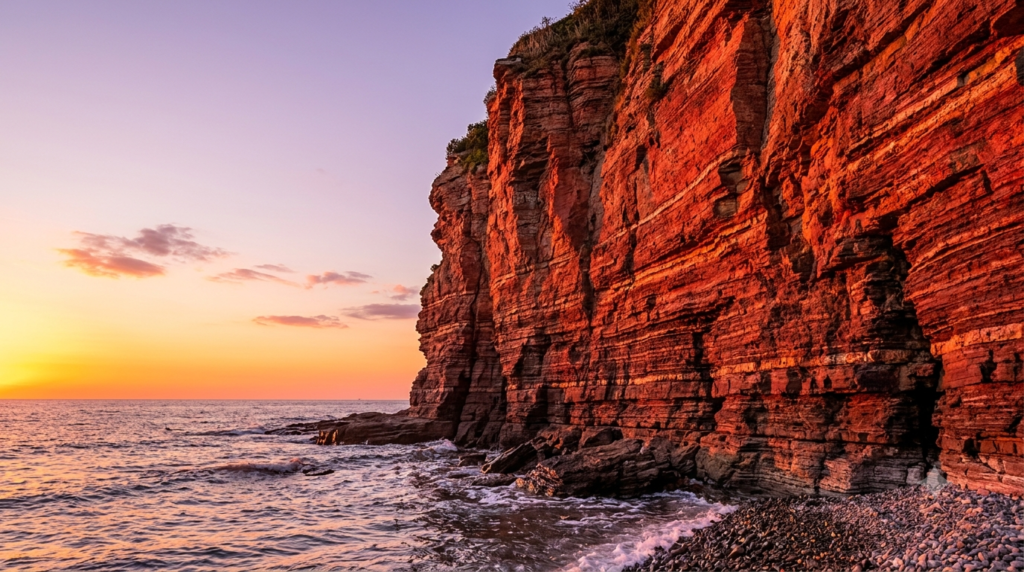
These two neighboring cliff formations on the Byeonsan Peninsula are famous for a specific reason: as sunset approaches, the layered volcanic rock face of Jeokbyeokgang (“Red Cliff River”) genuinely glows red, amplified by the setting sun. Chaeseokgang’s stacked, book-like rock strata create an equally striking, more textured backdrop. This pairing is officially recognized as one of Korea’s premier sunset destinations.
Insider tip: Check tide charts before visiting — Chaeseokgang’s most photogenic cliff base is only accessible at low tide.
Seonyudo Island, Gunsan (Jeollabuk-do)
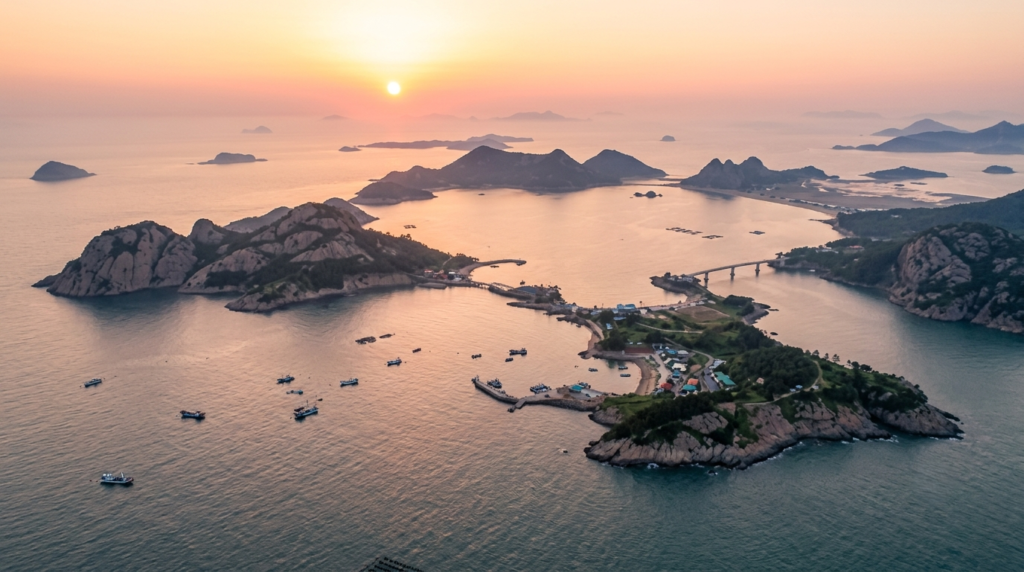
Not to be confused with the small Han River park of the same name in Seoul, this Seonyudo is a genuine island escape off the west coast near Gunsan. Boat rides around the surrounding islet cluster at sunset are a local highlight, with the sun setting between the silhouettes of smaller neighboring islands. It’s a full-day trip from Seoul (around 3.5 hours by car), making it best suited to travelers doing a broader Jeollabuk-do road trip.
Insider tip: Combine your visit with nearby Chaeseokgang for a two-stop, one-day west coast sunset itinerary.
Daebudo Island, Ansan (Gyeonggi-do)

The closest genuine “island drive” sunset experience to Seoul, Daebudo is popular precisely because it doesn’t require a full-day commitment. The nearby Soraepogu Ecological Park, once one of Korea’s largest natural sea-salt production sites, now offers a striking view of sunset light reflecting across its old salt pans — a completely different visual from a typical beach sunset.
Insider tip: Time your visit around 45–60 minutes before sunset and drive the coastal loop road slowly; several unmarked pull-offs offer unobstructed westward views.
Eurwangni Beach, Incheon
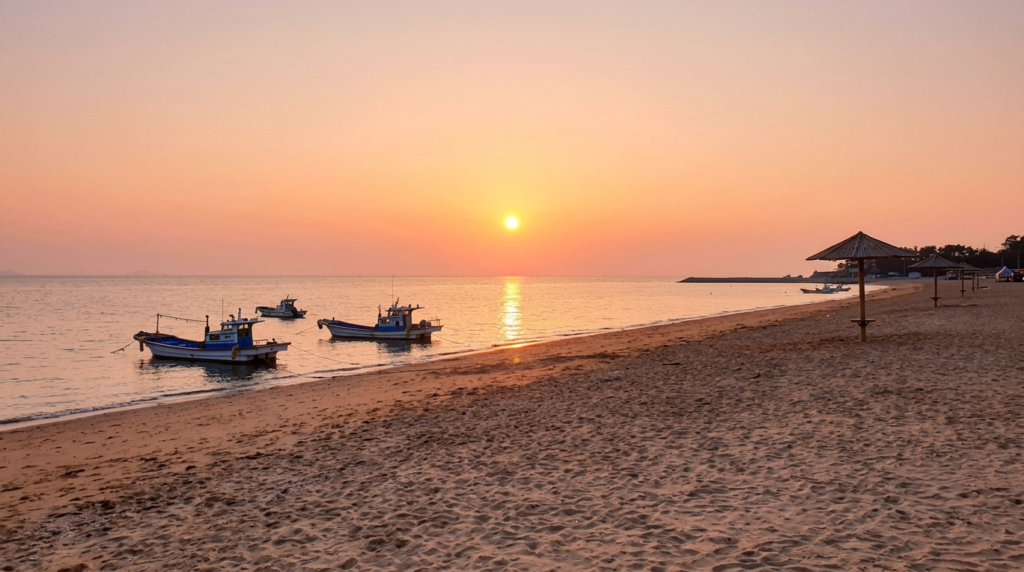
If you’re flying in or out of Incheon International Airport, this is the single most convenient sunset destination in the country — just 20–30 minutes from the airport by bus. Eurwangni is consistently described by visitors and travel guides alike as one of the capital region’s most reliable sunset beaches, with the added bonus of grilled clam restaurants lining the shore for a post-sunset dinner.
Insider tip: Perfect for long layovers — you can watch the sunset and still make a late-evening or early-morning international flight.
Seonyudo Park, Seoul

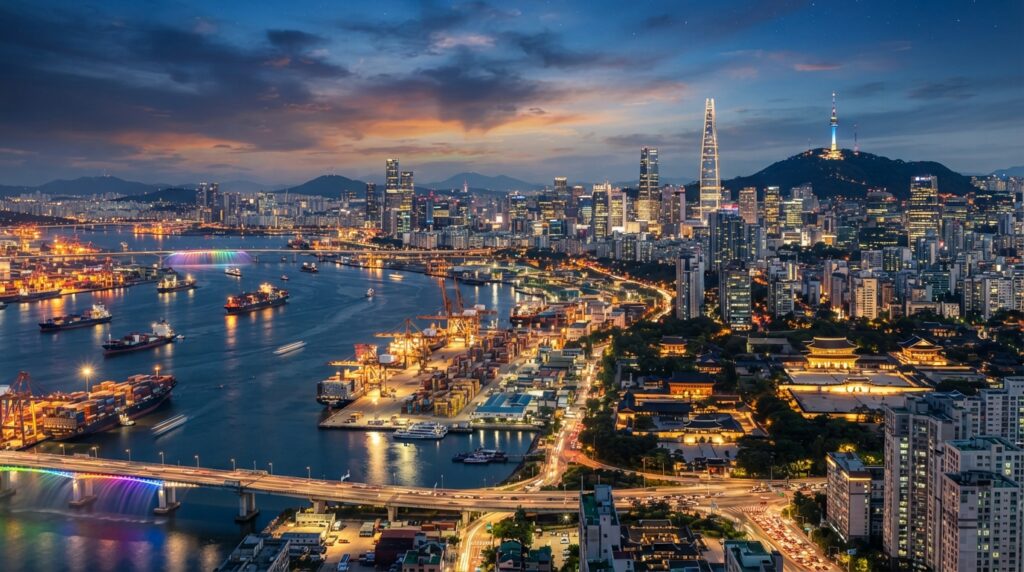
For travelers without a car or extra travel day, Seoul itself delivers a genuinely excellent sunset experience. Seonyudo Park, a former water treatment facility on an island in the Han River, has been reimagined as an ecological park where industrial concrete structures glow amber in the evening light. The park’s arched footbridge aligns dramatically with the setting sun, framed by the Yeouido skyline in the distance.
Insider tip: Arrive via Seonyudo Station (Line 9, Exit 2) about an hour before sunset to secure a spot on the bridge itself.
Dadaepo Beach, Busan

Busan’s most celebrated sunset destination, Dadaepo sits at the estuary where the Nakdong River meets the sea, on the western edge of the city. Locals and visitors alike consistently rank it as Busan’s best sunset beach, and from April through October, the beach’s “Sunset Fountain of Dreams” — a record-setting musical fountain — performs choreographed shows timed around the evening hours. The nearby Amisan Observatory offers an elevated, panoramic alternative to the beach-level view.
Insider tip: Walk the Molundae coastal trail to the Sunset Observation Deck for a quieter, elevated vantage point away from the main beach crowds.
Sunset Spots Featured in Popular K-Dramas
For fans who want their sunset-chasing to double as a pilgrimage, a handful of real Korean locations have become instantly recognizable thanks to their on-screen moments.
Wolpo Beach, Pohang — Hometown Cha-Cha-Cha

Wolpo Beach, the real-life stand-in for the fictional seaside village of Gongjin, hosts one of the series’ most emotional sunset scenes, where lead character Hye-jin lets her guard down for the first time against a glowing evening sky. The beach retains its laid-back, under-the-radar fishing-village atmosphere, making it feel authentic rather than staged — even with fans regularly stopping by to recreate the scene.
How Fans Can Recreate These Scenes Today
Pohang’s local government has embraced its drama-tourism appeal, installing signage around Cheongha-myeon that maps out filming locations, including Wolpo Beach, the nearby red lighthouse at Cheongjin breakwater, and Sabang Memorial Park. A sunset visit to Wolpo Beach pairs naturally with an early-morning stop at nearby Homigot, one of Korea’s most famous sunrise points — giving drama fans a full golden-hour-to-golden-hour day in one coastal city.
How to Photograph a Korean Sunset Like a Pro

Best Camera Settings for Golden Hour
For DSLR and mirrorless shooters, a few adjustments make a real difference at Korea’s coastal sunset spots:
- Aperture: f/8–f/11 for sharp landscape shots with strong depth of field, especially when shooting cliff formations like Chaeseokgang
- ISO: Keep it low (100–200) since golden hour still provides ample light
- Shutter speed: Slow it down (1/2 to 2 seconds, with a tripod) at tidal locations like Kkotji Beach to smooth out water movement around exposed rock formations
- White balance: Set manually rather than using auto white balance — Korea’s sunsets often shift from warm orange to cool pink within minutes, and auto settings can flatten those transitions
Smartphone Photography Tips
Modern smartphones handle Korean sunsets well, but a few habits improve results significantly:
- Tap to expose for the sky, not the foreground, to avoid a blown-out sun
- Use portrait mode sparingly at sunset — the depth sensor can struggle with silhouettes
- Turn off flash entirely, even in “auto” mode, as it can trigger unnecessarily in low light
- Shoot in your phone’s RAW or “Pro” mode if available, especially at high-contrast spots like Dadaepo Beach
Composition Ideas Using Korea’s Unique Landscapes
Korea’s sunset spots offer built-in compositional anchors that generic beach sunsets don’t:
- Silhouette layering at Kkotji Beach, using the offshore pine rock as a foreground anchor
- Reflective symmetry on tidal flats and salt pans like those at Daebudo, where wet sand mirrors the sky
- Leading lines along Chaeseokgang’s stacked rock strata, which naturally draw the eye toward the horizon
- Urban contrast at Seonyudo Park, pairing rusted industrial structures against the Yeouido skyline
Practical Travel Tips for Sunset Chasers
Getting Around — Public Transit, Car Rentals, and Ferry Schedules
Most of Korea’s top sunset destinations are reachable without a car, but timing matters:
- Seoul-based spots (Seonyudo Park, Han River) are fully subway-accessible
- Incheon-area beaches (Eurwangni) are reachable by airport bus in 20–30 minutes
- West coast destinations (Kkotji, Chaeseokgang, Seonyudo Island) are best reached by rental car, since bus connections from Seoul can take 3+ hours with transfers
- Busan’s Dadaepo Beach is directly accessible via Metro Line 1
If you’re renting a car for a west coast sunset trip, aim to arrive at least 90 minutes before sunset to account for parking and walking time to the actual viewpoint.
What to Pack for Coastal and Mountain Sunset Trips
- A light windbreaker, even in summer — coastal evening winds pick up quickly once the sun starts to drop
- A tripod or phone stabilizer for low-light and blue-hour shots
- A headlamp or phone flashlight for the walk back after dark, especially at trail-based spots like Molundae in Busan
- Tide charts (check via the KHOA — Korea Hydrographic and Oceanographic Agency — app or website) for any location involving mudflats or exposed rock, since several of Korea’s best sunset views require low tide access
Safety Tips for Tidal Areas and Cliffside Viewpoints
- Never walk far onto exposed tidal flats without checking the tide schedule — the West Sea’s tidal range is significant, and water can return faster than expected
- Stick to marked platforms at cliff locations like Chaeseokgang and Jeokbyeokgang; the rock can be slippery when wet
- Bring a charged phone and let someone know your location if you’re visiting more remote island spots like Seonyudo
Weather Apps and Tools for Accurate Sunset Timing
Because sunset times shift daily and vary by region, don’t rely on general seasonal estimates alone. Use a live sunrise/sunset calculator (such as timeanddate.com or a dedicated sun-tracking app) set to your exact destination, and check same-day cloud cover forecasts — Korea’s west coast can see localized haze that differs significantly from inland weather.
Combining Sunset Watching with Other Korean Travel Experiences
Pairing Sunset Trips with Local Food
Nearly every major sunset destination in this guide comes with a signature food experience: grilled clams along Eurwangni Beach, fresh seafood markets near Dadaepo, and seaside cafés dotting the Byeonsan Peninsula near Chaeseokgang. Building your evening around a post-sunset meal at these spots is a local tradition, not just a tourist add-on.
Nearby Cultural Sites Worth Visiting Before Sunset
- Near Buan/Chaeseokgang: Naesosa Temple, a short drive inland
- Near Pohang/Wolpo Beach: Homigot’s sunrise monument, ideal for a sunrise-to-sunset day trip
- Near Busan/Dadaepo: Gamcheon Culture Village, easily combined with an afternoon-into-evening itinerary
Suggested Itineraries
1-Day Seoul-Based Itinerary: Morning at Gyeongbokgung Palace → afternoon in Hongdae or Yeouido → sunset at Seonyudo Park → dinner along the Han River
Weekend West Coast Itinerary: Day 1 — drive to Taean, sunset at Kkotji Beach, overnight nearby; Day 2 — morning at Chaeseokgang, afternoon drive to Gunsan, sunset boat ride around Seonyudo Island
Frequently Asked Questions
What is the best month to see a sunset in South Korea?
Autumn (late September through November) generally offers the clearest skies and most vivid colors, thanks to lower humidity and cleaner air compared to summer.
Where is the most famous sunset spot in South Korea?
Kkotji Beach in Taean is officially recognized by the Korea National Park Service as one of the country’s top sunset destinations, though Dadaepo Beach in Busan and Chaeseokgang in Buan are equally celebrated regionally.
Is Ganjeolgot better for sunrise or sunset?
Sunrise. Ganjeolgot Cape is specifically famous as one of the first places on the Korean peninsula to see the sunrise each day, and it hosts the country’s largest New Year’s sunrise festival. It’s best saved for a dawn visit rather than a sunset trip.
Can you watch the sunset from Seoul?
Yes — Seonyudo Park on the Han River is one of the city’s most photogenic sunset spots, and several Han River parks and Namsan viewpoints also offer strong evening views without leaving the city.
Are there K-drama filming locations known for sunset scenes?
Yes. Wolpo Beach in Pohang, the real-life setting for Hometown Cha-Cha-Cha‘s fictional village of Gongjin, features a well-known sunset scene and has become a pilgrimage stop for fans.
What time does the sun set in South Korea in summer vs. winter?
Summer sunsets land close to 7:50–8:00 PM around the June solstice, while winter sunsets can occur as early as 5:15–5:30 PM in late December — a difference of roughly 2.5 hours across the year.
South Korea’s sunsets don’t get the same global spotlight as its sunrise traditions, but that’s exactly what makes them worth seeking out. From the officially ranked cliffs of Chaeseokgang to the quiet industrial beauty of Seonyudo Park, and from the record-setting fountain shows of Dadaepo Beach to the drama-famous shores of Wolpo Beach, Korea’s west and south coasts offer a genuinely diverse range of golden-hour experiences — most of them still refreshingly free of crowds.
Whether you’re planning a dedicated photography trip, a K-drama location pilgrimage, or simply want to end a day of sightseeing somewhere memorable, use the seasonal timing and location details in this guide to plan ahead. And if you’re exploring more of what South Korea has to offer this summer, check out our companion guides on travel in South Korea this June and other seasonal destinations across the peninsula.