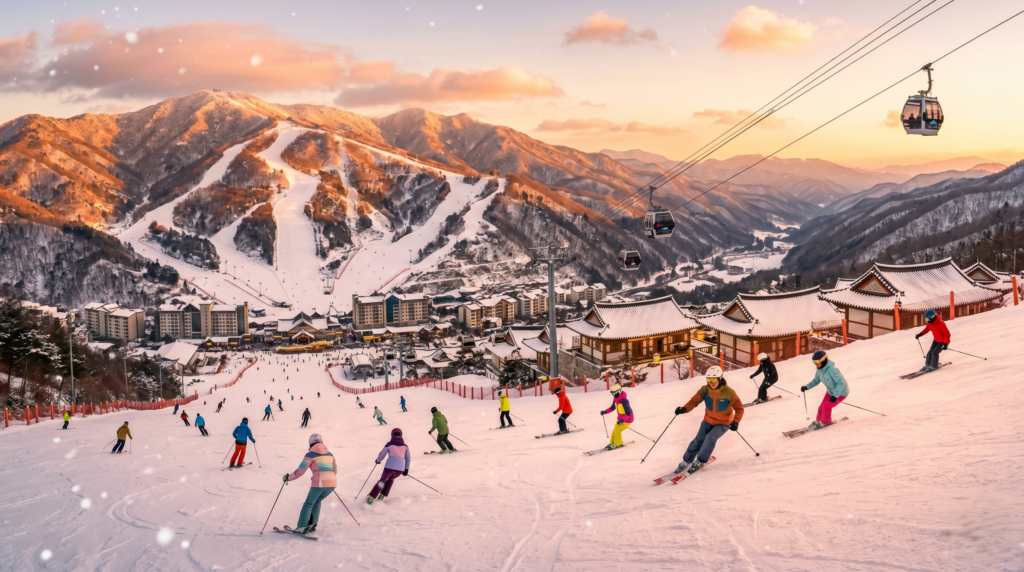
Picture this: you’re gliding down a pristine, snow-blanketed mountainside, the crisp Korean winter air rushing past your face, while the same breathtaking alpine scenery you’ve watched countless times in your favorite K-drama unfolds all around you. That moment — equal parts exhilarating and cinematic — is exactly what awaits you at the ski resorts in Korea.
Korea doesn’t always make the top of Western travelers’ winter bucket lists, but it absolutely should. South Korea’s ski resorts are among the most well-equipped, accessible, and culturally rich winter destinations in all of Asia. With a ski season stretching from December through February, reliable snowfall across the Gangwon Province mountain ranges, and a seamless blend of modern resort amenities with deep Korean cultural tradition, skiing in South Korea offers an experience you simply cannot replicate anywhere else.
And then there’s the K-drama factor — something no other skiing destination in the world can claim. Korea’s mountain resorts have served as the backdrop for some of the most iconic and emotionally unforgettable scenes in Korean television history, drawing fans from across the globe who want to walk — or ski — in the footsteps of their favorite characters.
Whether you’re a seasoned skier planning your next international adventure, a K-drama enthusiast ready to experience the magic in person, or a first-time visitor to Korea trying to plan the perfect winter itinerary, this complete guide covers everything you need to know. By the end, you’ll know exactly which resort suits your travel style, how to get there, what it costs, and how to make the most of every snow-covered moment.
Why Korea Is a Surprisingly Perfect Ski Destination
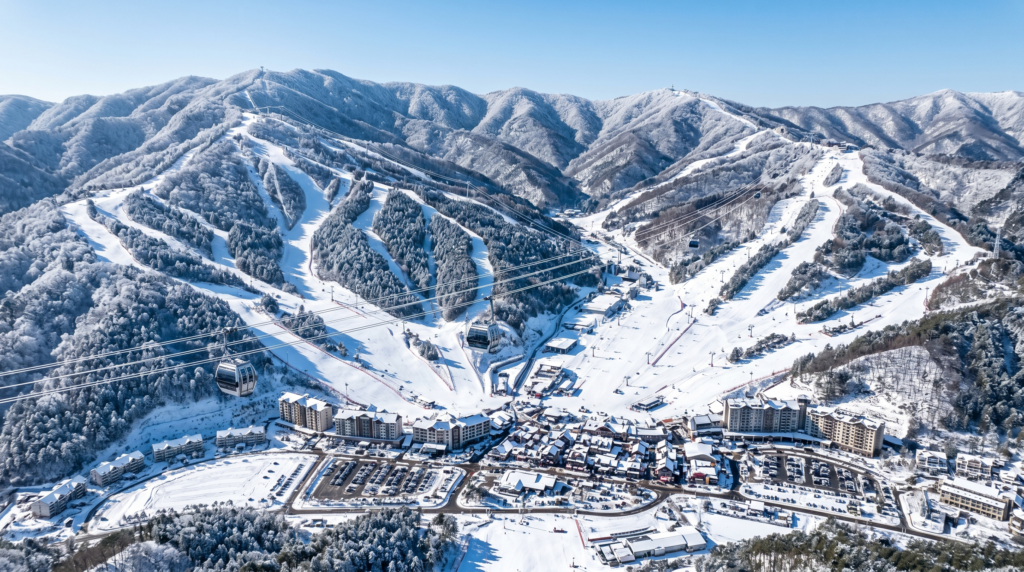
Ask most international travelers where to ski in Asia and they’ll immediately say Japan — Hokkaido, Niseko, Hakuba. Korea rarely enters the conversation. That’s a significant oversight, because South Korea quietly punches well above its weight as a winter sports destination, offering experiences that rival — and in some ways surpass — more famous skiing nations.
Geography & Climate That Deliver Real Snow
South Korea’s eastern mountain ranges, particularly in Gangwon Province, create ideal conditions for winter skiing. The Taebaek Mountains run along the spine of the Korean Peninsula, generating natural snowfall and cold temperatures that persist reliably from December through late February, with some resorts staying open into March.
The terrain is genuinely varied. You’ll find gentle beginner slopes perfect for first-timers alongside steep, challenging runs that satisfy experienced skiers. Elevations at Korea’s top resorts range from roughly 700 to over 1,400 meters, producing dry, powdery snow conditions that skiers and snowboarders love.
Compared to Japanese ski resorts — which often come with steeper price tags and complex rural logistics — Korea’s mountains offer comparable snow quality with significantly better infrastructure and ease of access.
World-Class Amenities at Every Price Point
Korean ski resorts are not rustic mountain hideaways. They are full-service resort complexes offering ski-in/ski-out accommodation, indoor water parks, ice skating rinks, five-star spas, international restaurants, and vibrant après-ski entertainment — all within a single destination.
What makes Korea especially compelling is the hot spring spa culture, known locally as jjimjilbang (찜질방). After a long day on the slopes, soaking in a natural hot spring or spending an evening at a traditional Korean bathhouse is not just relaxing — it’s a deeply cultural experience that no Alpine resort can offer.
Perhaps most impressive is accessibility. Unlike remote ski destinations that require domestic flights or multi-hour mountain drives, most of Korea’s top ski resorts are reachable from Seoul in just one to three hours via high-speed KTX train or express shuttle bus. For travelers based in the capital, a ski day trip is genuinely feasible — though an overnight or weekend stay is highly recommended to fully absorb the mountain atmosphere.
The Best Ski Resorts in Korea — Resort by Resort Breakdown
This is the heart of your planning process. Korea has more than a dozen ski resorts, but five stand out as the most exceptional — each offering a distinct character, skill-level suitability, and cultural experience. Here’s an authoritative breakdown of each.
1. Yongpyong Resort (용평리조트) — The Crown Jewel of Korean Skiing
Location: Pyeongchang, Gangwon Province
Distance from Seoul: Approximately 2.5 hours by KTX + shuttle
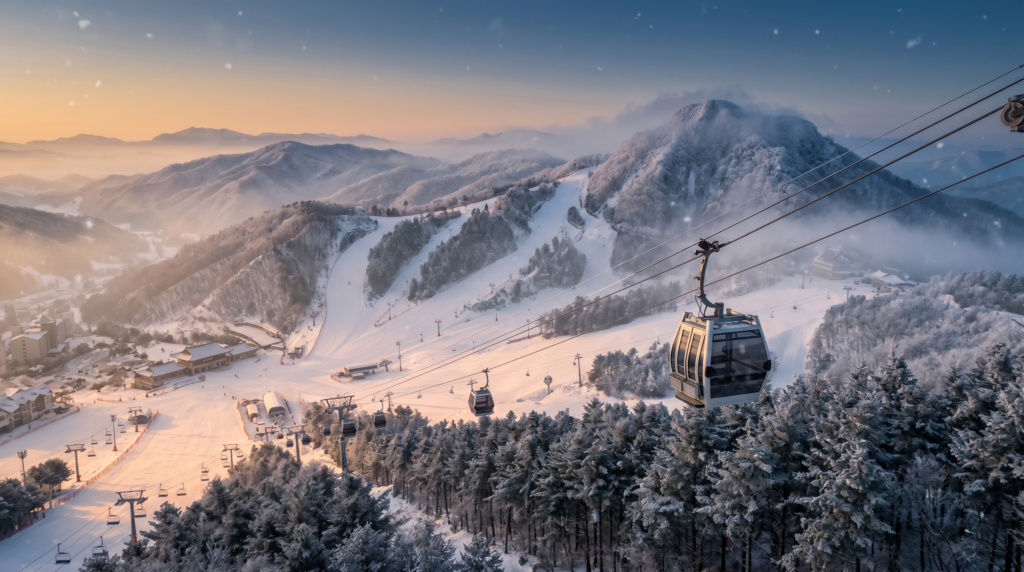
If there is one ski resort that defines Korean winter tourism, it is Yongpyong Resort. Established in 1975 and expanded significantly ahead of the 2018 PyeongChang Winter Olympics, Yongpyong is the largest and most celebrated ski resort in South Korea — and its reputation extends far beyond the country’s borders.
Yongpyong boasts 31 slopes spread across a wide range of difficulty levels, from gentle green runs ideal for beginners to challenging black diamond courses that test even experienced alpine skiers. The resort’s highest peak, Dragon Peak (발왕산), rises to 1,458 meters, offering panoramic views across the Gangwon mountain range that are genuinely awe-inspiring — whether you ski to the summit or take the gondola.
Speaking of the gondola: Yongpyong’s Dragon Peak Gondola ride is one of Korea’s most spectacular winter experiences even for non-skiers. The 3.7km cable car ascent through frosted pine forests and snow-draped peaks is nothing short of cinematic.
Facilities and amenities are comprehensive: multiple hotels ranging from budget to luxury, a shopping complex, Korean and international dining options, a ski school with English-speaking instructors, and equipment rental facilities that cater to international visitors with clear English signage.
Olympic Legacy: The slalom and giant slalom events of the 2018 Winter Olympics were held here, cementing Yongpyong’s international reputation and resulting in significant infrastructure upgrades that still benefit visitors today.
🎬 K-Drama Spotlight: Winter Sonata (겨울연가, 2002)
No discussion of Yongpyong is complete without mentioning Winter Sonata — the K-drama that, in many ways, launched the global Korean Wave (Hallyu) and put this resort on the international tourism map. Starring Bae Yong-joon and Choi Ji-woo, Winter Sonata filmed extensively at Yongpyong, using its snow-covered slopes and fairy-tale winter scenery as the backdrop for one of the most beloved romantic storylines in Korean drama history.
The drama’s impact was so profound — particularly across Japan, China, and Southeast Asia — that Yongpyong became a pilgrimage site for K-drama fans years before “K-drama tourism” became a recognized travel trend. Visitors still seek out the exact filming locations, take photographs at the iconic spots, and experience the romantic mountain atmosphere that made the drama so emotionally resonant.
Best for: Intermediate to advanced skiers, K-drama fans and Hallyu tourists, romantic couple getaways, travelers who want the full premium Korean ski resort experience.
Insider Tip: Book the Dragon Peak Gondola for an early morning ride — ideally just after sunrise — when the light hits the snow-covered peaks and the mountain is still quiet. It is, without exaggeration, one of the most beautiful winter sights in all of Korea.
2. High1 Resort — The Hidden Mountain Gem
Location: Jeongseon, Gangwon Province
Distance from Seoul: Approximately 2.5–3 hours by KTX + shuttle
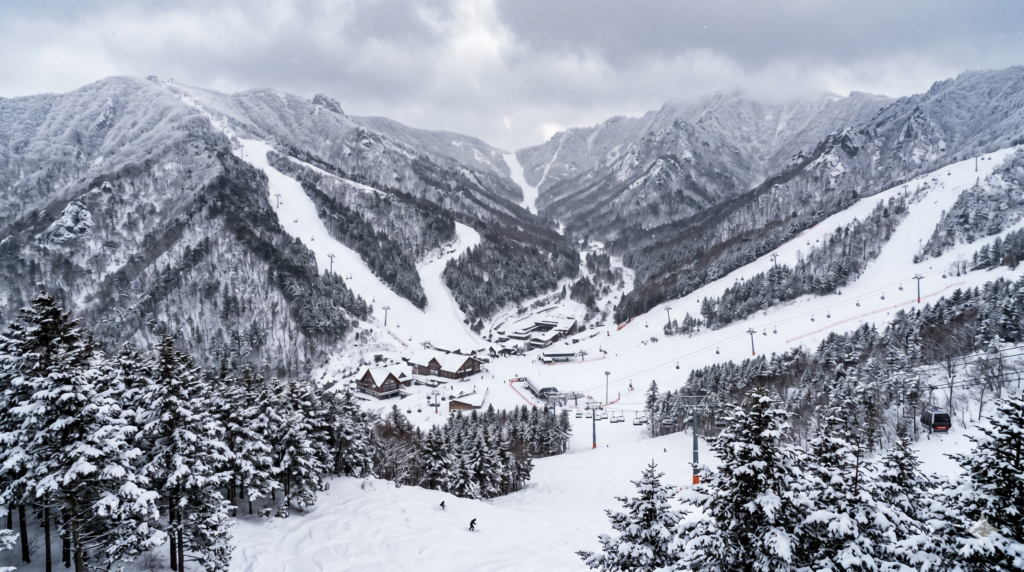
Nestled deeper into the Gangwon mountains than most of its competitors, High1 Resort is the choice for travelers who want serious skiing with fewer crowds and a genuine sense of mountain adventure. It’s less famous among international tourists than Yongpyong — which is precisely part of its appeal.
High1 features 19 slopes and holds a distinction that matters greatly to experienced skiers: it has the longest ski runs in Korea. The resort’s vertical drop and extended run lengths mean you can enjoy long, sustained descents rather than the frequent stops and lifts that characterize more compact resorts. The terrain skews toward intermediate and advanced difficulty, making it less ideal for complete beginners but highly rewarding for those with genuine ski experience.
One of High1’s most unique features is its casino resort complex — the High1 Grand Hotel Casino, which is legally accessible to non-Korean passport holders. This makes High1 a genuinely distinctive destination for adult travelers seeking a full entertainment resort experience alongside world-class skiing.
The High1 Sky Bike and Cable Car are also worth experiencing even if you don’t ski. The cable car system provides sweeping aerial views of the surrounding Jeongseon mountain range that rank among the most dramatic natural vistas in the Korean winter landscape.
Best for: Experienced and advanced skiers, travelers seeking less-crowded slopes, adults looking for a full resort entertainment experience, those interested in Korea’s more remote mountain regions.
Insider Tip: Even if downhill skiing isn’t your primary focus, the scenic cable car ride at High1 offers some of the most spectacular mountain views in Gangwon Province — well worth the trip on its own.
3. Vivaldi Park Ski World — Best for Families and First-Timers
Location: Hongcheon, Gangwon Province
Distance from Seoul: Approximately 1.5–2 hours by express bus or car
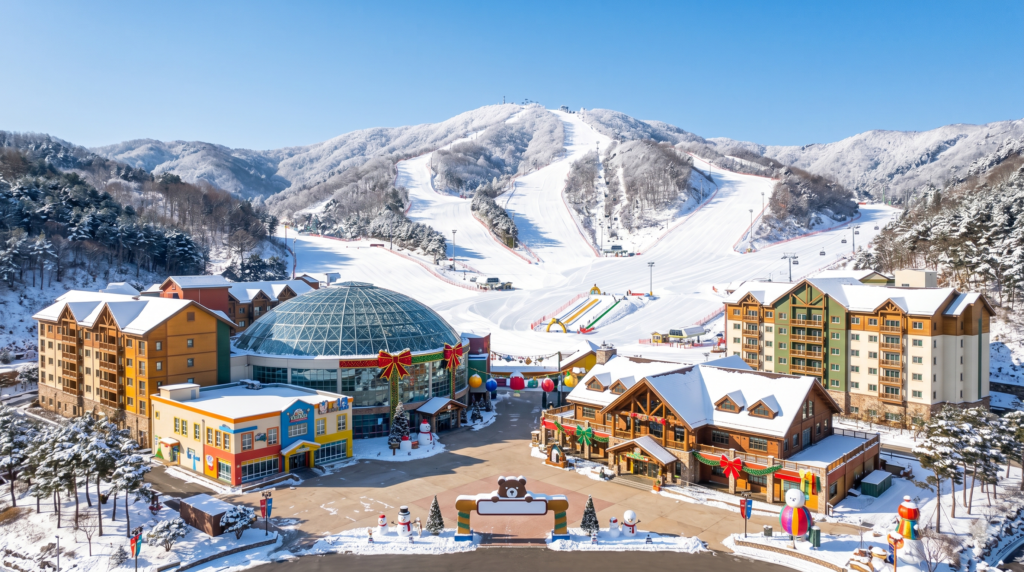
For families traveling with children, beginners approaching skiing for the first time, or group travelers with mixed ability levels, Vivaldi Park Ski World is the clear standout choice among Korea’s ski resorts. Its design philosophy prioritizes accessibility, variety, and fun — creating an environment where every member of a travel group can find something to enjoy, regardless of skiing ability.
Vivaldi Park features 21 slopes with a strong concentration of beginner and intermediate runs, served by comprehensive ski school programs that include English-language instruction. The resort’s rental equipment is modern and well-maintained, and the learning slopes are thoughtfully separated from faster runs, creating a safe and welcoming environment for those just finding their snow legs.
What truly sets Vivaldi Park apart from every other ski resort in Korea — and arguably in Asia — is the Ocean World Indoor Water Park, which operates year-round. Yes, you can ski in the morning on fresh mountain snow and spend the afternoon in a tropical wave pool. This extraordinary combination makes Vivaldi Park uniquely positioned as a winter resort that appeals genuinely to non-skiers, children, and anyone who wants their mountain vacation to include more than just slopes.
🎬 K-Drama Spotlight: That Winter, the Wind Blows (그 겨울, 바람이 분다, 2013)
Vivaldi Park served as a key filming location for this emotionally powerful drama starring Jo In-sung and Song Hye-kyo. The resort’s scenic winter landscapes — softly lit, quiet, and deeply atmospheric — provided the perfect visual setting for the drama’s themes of love, loss, and redemption. Fans of the series will immediately recognize several locations across the resort grounds.
Best for: Families with children, beginner skiers and snowboarders, mixed-ability travel groups, travelers who want resort amenities beyond just skiing.
Insider Tip: Ask about combo ticket deals that bundle ski lift passes with Ocean World access — these packages offer significantly better value than purchasing separately, and the water park alone justifies the trip for families traveling with younger children.
4. Bears Town Resort — Seoul’s Closest Ski Escape
Location: Pocheon, Gyeonggi Province
Distance from Seoul: Approximately 1 hour by car or express bus
When Seoul residents want to ski without committing to a full overnight trip, Bears Town Resort is frequently their first choice — and for good reason. Its position just one hour from the capital makes it the most accessible major ski resort for travelers based in Seoul, and its combination of manageable size, reasonable pricing, and solid facilities makes it a consistently popular option for weekend ski trips.
Bears Town features 12 slopes covering a range of beginner to intermediate difficulty levels, with night skiing options that extend the skiing day well into the evening — a particularly popular feature among young Korean skiers and weekend visitors who want maximum time on the slopes. The resort’s compact layout means shorter lift lines and less time navigating between runs, which suits casual skiers and day-trippers perfectly.
While Bears Town doesn’t match the scale or drama of Yongpyong or High1, it delivers a genuinely enjoyable ski experience at a price point that respects your travel budget.
Best for: Budget-conscious travelers, Seoul-based visitors on day trips, beginners and casual skiers, those with limited time who still want an authentic Korean ski experience.
Insider Tip: Visit on weekdays whenever possible. Weekend crowds from Seoul can make Bears Town noticeably busier than its size comfortably accommodates, while weekday visits are dramatically calmer and more enjoyable.
5. Elysian Gangchon Resort — Compact, Charming & Socially Vibrant
Location: Chuncheon, Gangwon Province
Distance from Seoul: Approximately 1.5 hours by ITX train or car
Elysian Gangchon is the smallest resort on this list, but what it lacks in scale it more than compensates for in atmosphere and charm. Enormously popular with Korean university students and young domestic travelers, Elysian Gangchon has developed a reputation as one of the most socially energetic and fun ski resorts in the country — a place where the vibe matters as much as the vertical drop.
The resort features 9 slopes that cater primarily to beginner and intermediate skiers, with well-maintained runs, a ski school, and modern equipment rental facilities. The compact layout creates an intimate mountain atmosphere quite different from the sprawling mega-resorts, and the surrounding Chuncheon valley scenery — particularly beautiful under winter snowfall — adds genuine natural character to the experience.
🎬 K-Drama Connection
Elysian Gangchon and the surrounding Chuncheon region have appeared in numerous Korean dramas and films over the years, benefiting from its proximity to Nami Island — one of Korea’s most famous Hallyu tourism destinations, itself immortalized in Winter Sonata. Combining a ski day at Elysian Gangchon with a visit to Nami Island is one of the most popular and rewarding winter day-trip combinations available from Seoul.
Best for: Young travelers and solo adventurers, those seeking a social ski atmosphere, travelers who want to combine skiing with Nami Island, budget-friendly short trips from Seoul.
Insider Tip: Plan your Elysian Gangchon visit as part of a combined itinerary with Nami Island. The two destinations are extremely close to each other and together create one of the most memorable and photographable winter days available anywhere near Seoul.
K-Drama Filming Locations at Korean Ski Resorts
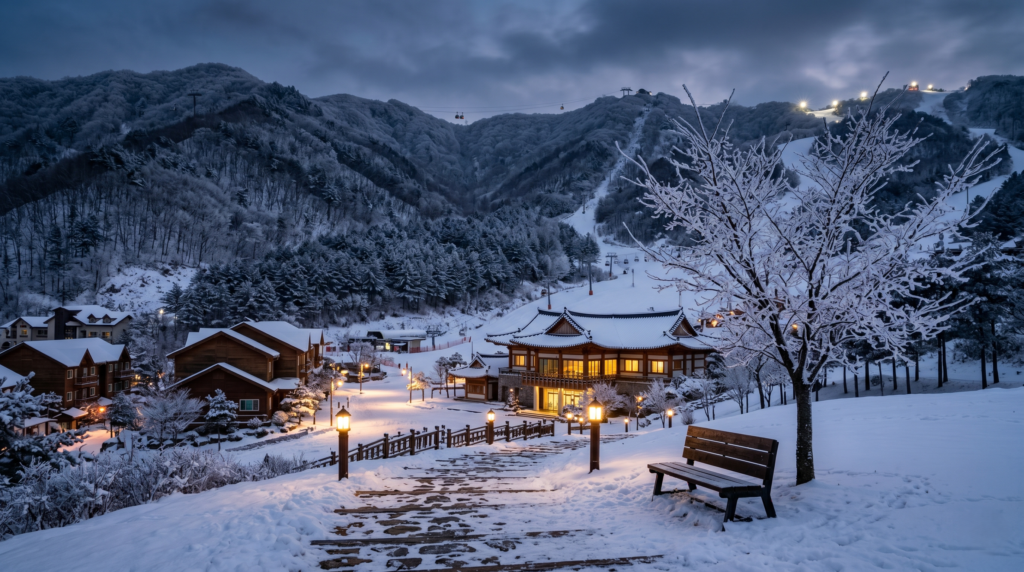
One of the most compelling and uniquely Korean aspects of visiting a ski resort in South Korea is the opportunity to step directly into the world of your favorite K-dramas. No other skiing destination on the planet offers this — the ability to stand on the same snow-covered ground where iconic scenes were filmed, to breathe the same mountain air that framed some of the most emotionally powerful moments in Korean television history.
This intersection of winter sports and Korean pop culture is not a minor footnote. It is, for a growing segment of international visitors, the primary reason they choose Korea over Japan, Switzerland, or Canada for their winter travel. Understanding which resorts were filmed where — and how to experience those locations authentically — adds an entirely new dimension to your Korean ski trip.
Why K-Dramas Love Ski Resorts
Korean drama writers and directors have long understood the narrative power of winter mountain settings. Snow-covered landscapes carry deep emotional symbolism in Korean storytelling — purity, isolation, romantic longing, transformation, and the passage of time. A ski resort provides all of these visual and thematic elements simultaneously: the sweeping white mountain vistas, the intimate warmth of a lodge fireplace, the vulnerability of characters learning something new, and the natural beauty that makes romantic moments feel inevitable.
Beyond symbolism, ski resorts offer Korean production teams practical advantages: controlled environments, stunning natural backdrops, and the kind of picture-perfect winter scenery that photographs beautifully and stays in viewers’ memories long after an episode ends.
The result is a decades-long tradition of Korean dramas using mountain ski resorts as pivotal settings — a tradition that has directly shaped international tourism patterns and turned several Korean resorts into globally recognized Hallyu landmarks.
K-Drama Filming Location Breakdown by Resort
| Resort | K-Drama | Year | Significance |
|---|---|---|---|
| Yongpyong Resort | Winter Sonata | 2002 | Iconic romance scenes; launched global Hallyu wave |
| Vivaldi Park | That Winter, the Wind Blows | 2013 | Key emotional sequences; dramatic winter scenery |
| Elysian Gangchon | Various youth dramas | Multiple | Campus romance; youthful energy sequences |
| High1 Resort | Various thriller/romance productions | Multiple | Dramatic mountain backdrop scenes |
| Yongpyong Resort | Winter Sonata (remastered & rereleased) | 2004 | Extended international broadcast; boosted tourism further |
Tips for K-Drama Fans Visiting Filming Locations
Visiting a K-drama filming location requires a little preparation to get the most out of the experience. Here’s what experienced Hallyu travelers recommend:
Use Naver Map, not Google Maps. In South Korea, Google Maps has significant gaps in accuracy and detail — particularly in mountainous and rural areas. Naver Map (네이버 지도) is the gold standard for Korean navigation. Download it before your trip, and use it to search for specific filming locations by their Korean names. Most major K-drama filming spots have been tagged and reviewed by fans on Naver.
Visit on weekday mornings. Popular filming locations — particularly at Yongpyong — attract steady streams of visitors on weekends. Arriving early on a weekday gives you the space, quiet, and lighting conditions needed for meaningful photographs and unhurried exploration.
Research specific scenes before visiting. Knowing exactly which scenes were filmed where transforms a general resort visit into a deeply personal experience. Watch (or rewatch) the relevant drama episodes before your trip and note the visual landmarks — specific buildings, gondola stations, slope angles, or tree lines — that you want to find in person.
Respect the resort environment. Filming locations exist within active, functioning ski resorts. Stay on designated paths, respect other guests’ space on the slopes, and follow all resort rules even while exploring drama locations.
Look for fan-made location guides. The global K-drama fan community has produced remarkably detailed location guides for major dramas — including precise GPS coordinates, before-and-after comparison photos, and seasonal visit recommendations. Platforms like Instagram, Pinterest, and dedicated Hallyu travel blogs are excellent resources for this kind of granular location information.
What to Expect on the Slopes — A Beginner’s Reality Check
For travelers who have never skied in Korea before, knowing what to expect practically — beyond the marketing brochure highlights — is genuinely valuable. Korean ski resorts have their own distinct rhythms, customs, and operational characteristics that differ meaningfully from European or North American ski destinations.
Ski Rental, Lessons & Lift Passes Explained
Every major Korean ski resort offers comprehensive on-site equipment rental, and the quality of rental gear at top resorts like Yongpyong and Vivaldi Park is genuinely good — regularly updated, well-maintained, and available in sizes that accommodate international visitors.
Here’s a realistic cost breakdown for a standard ski day at a major Korean resort:
| Item | Approximate Cost (KRW) | Approximate Cost (USD) |
|---|---|---|
| Full-day lift pass | ₩60,000 – ₩90,000 | $45 – $68 |
| Ski equipment rental (skis, boots, poles) | ₩30,000 – ₩50,000 | $23 – $38 |
| Snowboard rental | ₩35,000 – ₩55,000 | $26 – $42 |
| Beginner group lesson (2 hours) | ₩40,000 – ₩70,000 | $30 – $53 |
| Private lesson (1 hour) | ₩80,000 – ₩120,000 | $60 – $90 |
| Full day total (beginner estimate) | ₩130,000 – ₩210,000 | $98 – $158 |
Package deals — which bundle lift passes, equipment rental, and sometimes accommodation — are widely available and consistently offer better value than purchasing components separately. Check each resort’s official website before your visit, as seasonal promotions and advance booking discounts can reduce costs substantially.
English-language ski instruction is available at all five major resorts covered in this guide, though availability varies. Yongpyong and Vivaldi Park have the most robust English-language ski school programs; at smaller resorts like Elysian Gangchon, English instruction may require advance arrangement.
Korean Ski Etiquette You Should Know
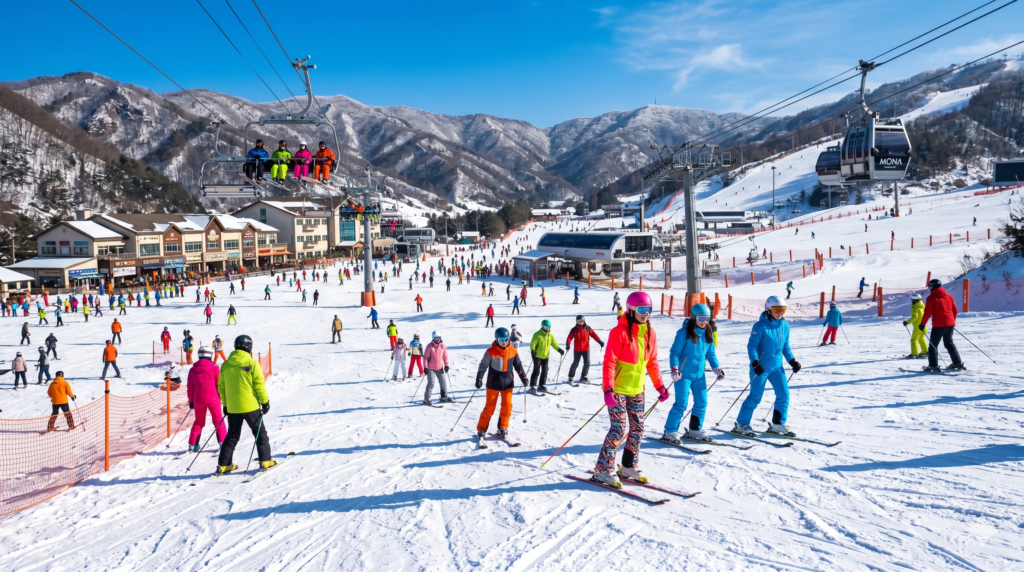
Skiing in Korea comes with a distinct cultural dimension that international visitors should understand before hitting the slopes. Koreans take ski resort visits seriously — as social events, fashion occasions, and leisure experiences — and certain norms govern how the slopes are shared and enjoyed.
Slope congestion is real, particularly on weekends. Korean ski culture is enormously popular domestically, and major resorts on weekend afternoons can feel genuinely crowded — particularly on beginner and intermediate slopes. This isn’t unique to Korea, but the concentration of Seoul’s enormous population near Gangwon’s resorts means weekend crowds can be notably dense.
Korean ski fashion is an experience in itself. South Korea has one of the world’s most fashion-conscious ski cultures. Resorts on weekends resemble outdoor fashion runways as much as sporting venues — colorful, coordinated ski outfits are the norm, and many Koreans invest significantly in premium ski apparel as a style statement. Don’t be surprised if you feel underdressed in your practical but unglamorous rental gear.
Busy periods to avoid: The weeks surrounding Korean school winter holidays (typically mid-January through early February) and the Lunar New Year holiday period (dates vary annually but fall in late January or early February) represent peak domestic tourism demand. If possible, schedule your visit outside these windows for a significantly more relaxed experience.
Lift line etiquette follows standard international conventions — queue in order, no cutting, be patient. Koreans are generally orderly and considerate on slopes and in lift lines.
Accessibility for International Visitors
Korea’s major ski resorts have invested meaningfully in international visitor infrastructure over the past decade, driven partly by the global attention generated by the 2018 PyeongChang Winter Olympics.
English signage is present at all major resorts, though comprehensiveness varies. Yongpyong leads in English accessibility, with bilingual signs throughout the resort, English-speaking staff at key service points, and an English-language website with online booking functionality. Vivaldi Park and High1 also maintain solid English accessibility standards.
Transportation from Seoul is genuinely straightforward. The KTX high-speed train from Seoul’s Cheongnyangni or Dongseoul stations connects to Jinbu Station (for Yongpyong) and other Gangwon destinations with journey times of approximately 70–90 minutes. Most major resorts operate dedicated shuttle buses from KTX stations to the resort base — a service that requires advance booking through the resort website or via Korean travel platforms.
For Bears Town and Elysian Gangchon, the ITX-Cheongchun commuter train line from Seoul’s Yongsan or Cheongnyangni stations provides convenient access to the Chuncheon and Pocheon areas, with resort shuttle connections available.
Beyond the Slopes — Korean Winter Experiences Worth Adding
The experience of visiting a Korean ski resort extends well beyond skiing itself. Korea’s winter culture is extraordinarily rich, and some of the most memorable moments of a Korean ski trip happen entirely off the slopes — in a steaming bathhouse, around a street food cart, or on a scenic day trip through the snowy Korean countryside.
Jjimjilbang (찜질방) — The Korean Spa Tradition After Skiing
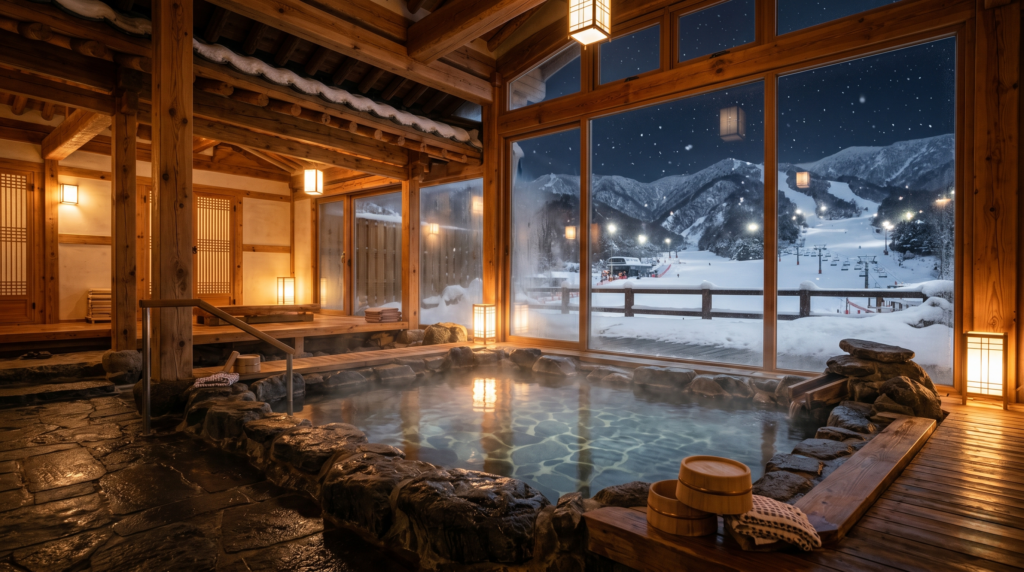
If there is a single non-skiing experience that every visitor to a Korean ski resort should have, it is spending an evening at a jjimjilbang — a traditional Korean public bathhouse and sauna complex.
Jjimjilbang are a deeply embedded part of Korean leisure culture, and the combination of a full day on the slopes followed by an evening in a hot spring bathhouse is one of the most physically satisfying and culturally authentic experiences available in Korea. The heat soothes tired ski muscles, the communal atmosphere offers a window into genuine Korean social life, and the whole experience costs a fraction of what a spa visit would run at a European mountain resort.
Most major ski resorts either have jjimjilbang facilities on-site or are located within easy reach of one. Yongpyong’s Dragon Valley Hotel offers spa facilities, while the broader Pyeongchang and Hongcheon areas have numerous traditional bathhouses within short driving distance of the main resort areas.
What to expect inside a jjimjilbang: gender-separated bathing areas with multiple pools at different temperatures (including outdoor hot spring pools at some locations), co-ed sauna rooms, a common sleeping and relaxation area where many Koreans spend the night on heated floors (ondol), and a small food service area offering traditional Korean snacks. The experience typically costs between ₩10,000 and ₩15,000 ($8–$11) for basic entry — exceptional value for what it delivers.
Winter Food Culture Around Ski Resorts
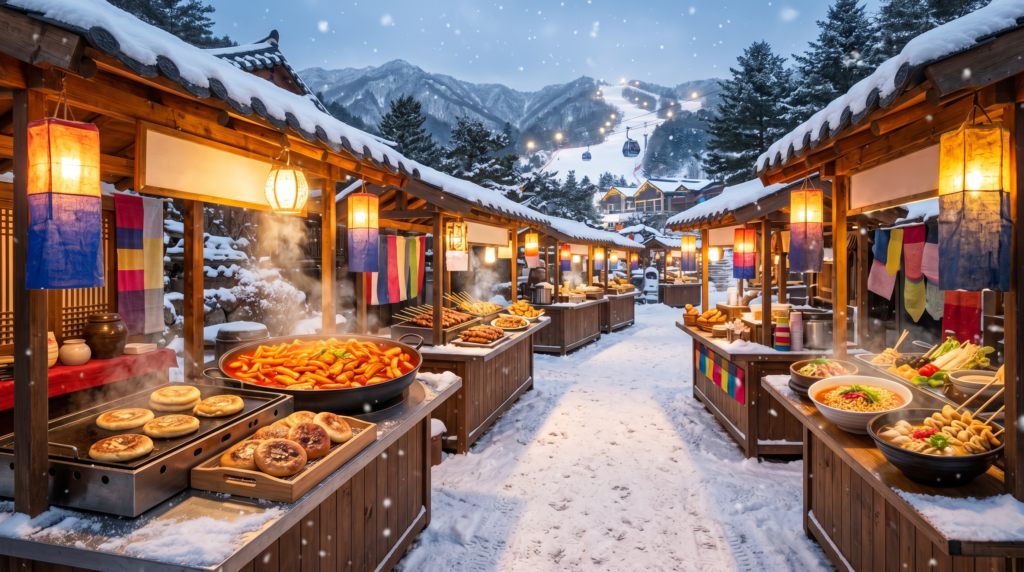
Korean winter food is its own category of extraordinary, and the areas surrounding Korea’s ski resorts offer some of the most satisfying cold-weather eating in the country. After a morning on the slopes, the appetite for Korean comfort food reaches a level of intensity that only physical exercise in mountain air can produce.
Essential winter foods to seek out near Korean ski resorts:
Hotteok (호떡) — Sweet Korean pancakes filled with brown sugar, cinnamon, and crushed nuts, cooked on a griddle until the outside is golden and crispy and the inside is warmly molten. Found at street carts throughout resort villages, they cost around ₩1,000–₩2,000 each and are arguably the perfect ski slope snack.
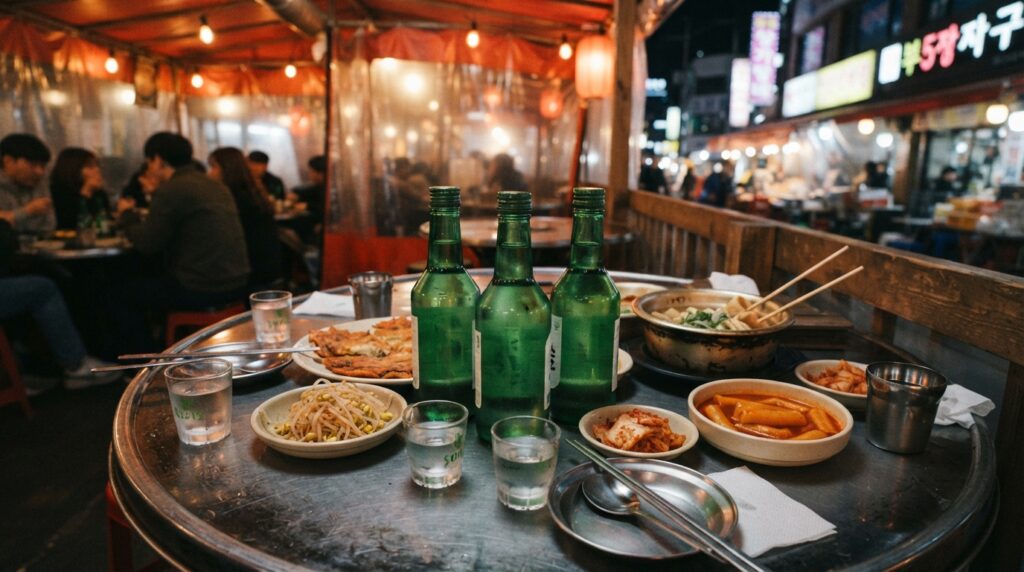
Tteokbokki (떡볶이) — Chewy rice cakes in a spicy-sweet gochujang sauce, often served with fish cakes and boiled eggs. A Korean winter street food staple that warms you from the inside out and costs almost nothing from resort village vendors.
Ramyeon (라면) — Korean instant ramen, elevated to an art form in the country of its perfection. Many ski resort lodges and convenience stores offer cup ramyeon prepared with boiling water — a beloved après-ski ritual for Korean skiers that is simultaneously humble and deeply satisfying.
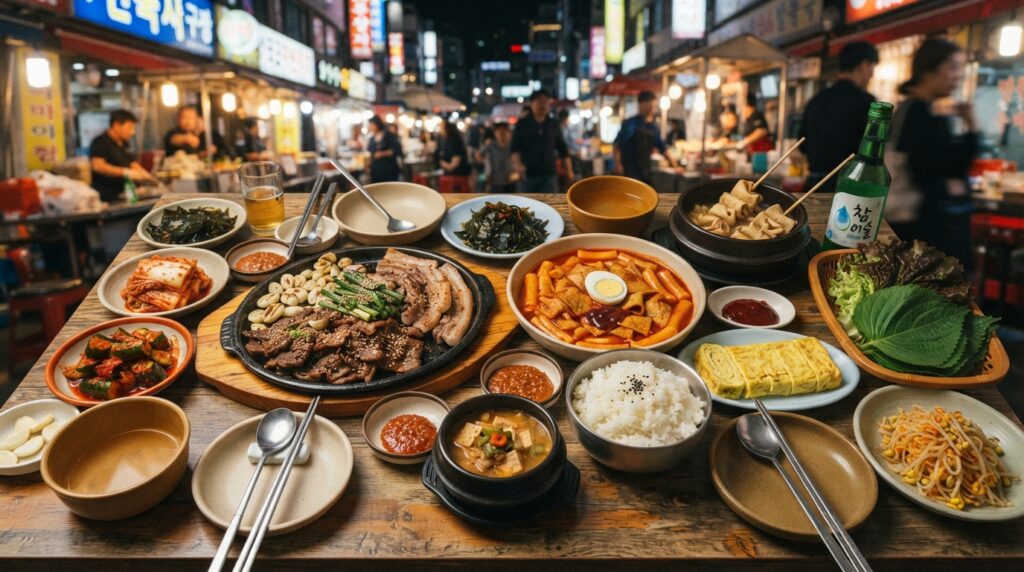
Korean BBQ (삼겹살, Samgyeopsal) — Grilled pork belly cooked at your table, wrapped in fresh lettuce with garlic, fermented kimchi, and ssamjang paste. Restaurants near ski resort towns offer full Korean BBQ experiences that make for exceptional group dinners after a day on the slopes.
Jeongseon Gondeure Namul Rice (곤드레 나물밥) — A regional specialty of the Jeongseon area near High1 Resort. This humble but deeply flavorful dish of rice steamed with local mountain herbs is a beloved part of Gangwon Province food culture and worth seeking out at local restaurants near the resort.
Resort food courts vs. nearby village restaurants: Resort food courts are convenient and offer good variety, but prices reflect the captive-audience reality of mountain dining. Venturing five to fifteen minutes from the main resort complex into the nearest village typically reveals significantly more authentic food at meaningfully lower prices — a worthwhile exploration for any curious traveler.
Day Trip Combinations Worth Planning
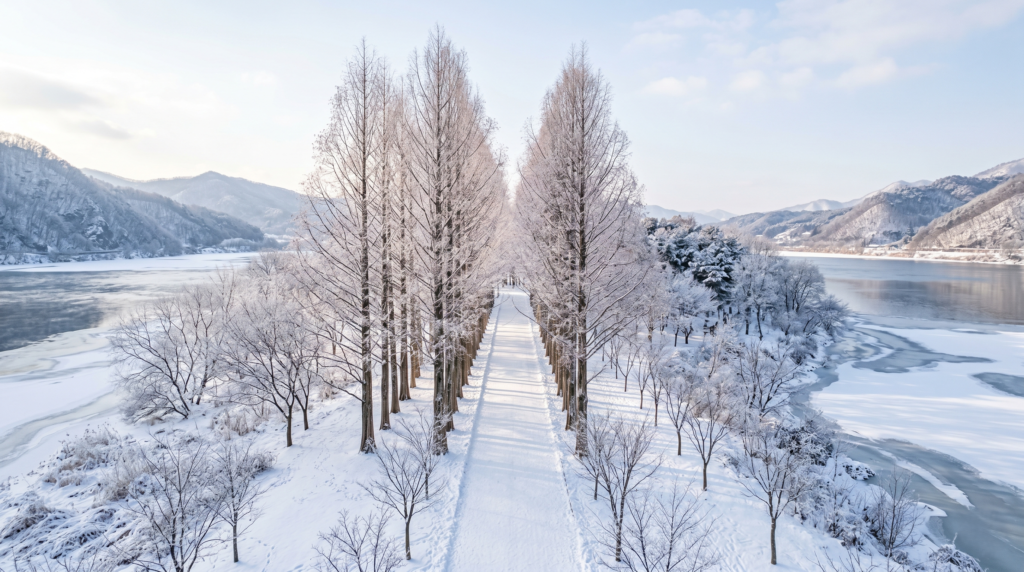
Korea’s ski resorts don’t exist in isolation — they’re positioned within one of the country’s most scenically beautiful regions, and combining a ski visit with nearby cultural or natural attractions transforms a good trip into an exceptional one.
Yongpyong + Odaesan National Park: Odaesan, one of Korea’s most revered national parks, sits in close proximity to Yongpyong Resort. In winter, its ancient temple complexes — particularly Woljeongsa Temple, with its famous fir tree avenue — become some of the most hauntingly beautiful landscapes in the country. A morning at Woljeongsa followed by an afternoon on Yongpyong’s slopes is a near-perfect Korean winter day.
Elysian Gangchon + Nami Island (남이섬): Nami Island is one of Korea’s most visited and photographed destinations — a small river island in the Han River system whose tree-lined paths and seasonal beauty have made it a global Hallyu icon since Winter Sonata was filmed there in 2002. In winter, Nami Island’s bare-branched tree avenues dusted with snow create an atmosphere of quiet, melancholic beauty that is deeply resonant. Combining an Elysian Gangchon ski day with a morning or afternoon at Nami Island is among the most popular and rewarding winter itineraries available from Seoul.
High1 + Jeongseon Traditional Market (정선 5일장): The town of Jeongseon, near High1 Resort, hosts one of Korea’s most authentic traditional markets on a rotating five-day cycle. The market offers regional produce, handmade goods, local street food, and a genuine window into rural Gangwon Province life that feels worlds away from Seoul’s modernity. Checking market dates in advance and building a visit into your High1 trip adds meaningful cultural depth to what might otherwise be a purely recreational ski visit.
How to Plan Your Korea Ski Trip — Practical Travel Guide
Understanding why Korea’s ski resorts are exceptional is one thing. Actually getting there, managing logistics, and budgeting realistically is another. This section cuts through the planning complexity and gives you the practical framework you need.
Best Time to Visit Korean Ski Resorts
The Korean ski season officially opens in late November or early December at most resorts and runs through late February or early March, depending on snow conditions. Within this window, timing your visit strategically makes a significant difference to your experience.
Peak season (late December – late January): Snow conditions are typically at their best, with consistent natural snowfall supplemented by snowmaking systems at all major resorts. The trade-off is that this period coincides with school winter holidays and the approach of Lunar New Year, bringing domestic tourism to its highest levels. Expect larger crowds, higher accommodation prices, and busier slopes.
Shoulder season (early December and February): Early December offers quieter conditions before the holiday rush, though snowfall can be less consistent in the very early part of the season. February — particularly mid to late February — often represents the sweet spot: reliable snow, thinning crowds as school holidays end, and more competitive accommodation pricing.
Snow conditions by month:
| Month | Snow Conditions | Crowd Level | Recommendation |
|---|---|---|---|
| December (early) | Variable | Low | Good for budget travel |
| December (late) | Excellent | High | Book well in advance |
| January | Peak conditions | Very High | Best snow, busiest period |
| February (early) | Excellent | High | Holiday crowd overlap |
| February (late) | Very good | Medium | Ideal balance |
| March | Declining | Low | Budget option, variable snow |
How to Get There From Seoul
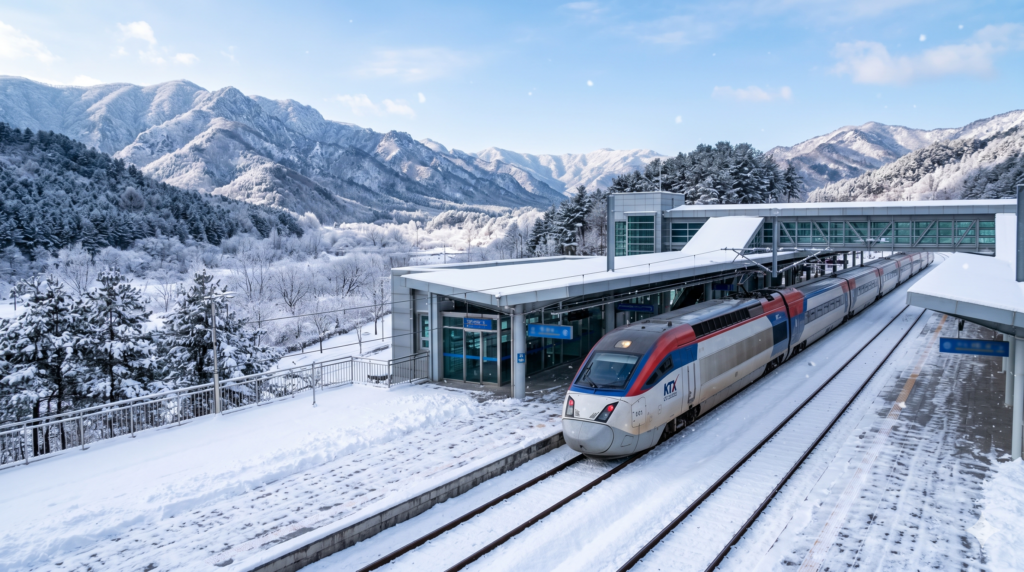
KTX High-Speed Train (Recommended): The KTX bullet train is the fastest, most comfortable, and most reliable way to reach Gangwon Province’s ski resorts from Seoul. Trains depart from Seoul Station, Cheongnyangni Station, and Dongseoul Terminal depending on your destination resort. Journey times to Jinbu Station (the gateway to Yongpyong) run approximately 70–80 minutes. From Jinbu Station, Yongpyong Resort operates a dedicated shuttle bus to the resort base.
Book KTX tickets in advance through the Korail website or app — seats on popular weekend morning trains to ski destinations sell out quickly during peak season.
Resort Shuttle Buses: All major resorts operate shuttle bus services from Seoul, typically departing from Dong Seoul Bus Terminal or Seoul Express Bus Terminal. These services are often the most economical transportation option and deliver you directly to the resort without the need for intermediate connections. Book through resort websites or Korean travel platforms like YanolJa or Interpark.
Driving: Self-drive is a viable option for travelers comfortable navigating Korean highways, though parking at major resorts on peak weekends can be congested. Highway conditions in winter require attention — snow chains may be mandatory on mountain access roads during heavy snowfall periods.
Budget Breakdown — What You’ll Actually Spend
Planning a realistic ski trip budget for Korea requires accounting for transportation, accommodation, lift passes, rental equipment, food, and incidental expenses. Here’s an honest breakdown across three traveler profiles:
Budget Traveler (per person, per day):
- Transportation: ₩30,000 – ₩50,000
- Lift pass + rental: ₩90,000 – ₩120,000
- Accommodation (hostel/guesthouse): ₩40,000 – ₩70,000
- Food: ₩20,000 – ₩35,000
- Daily total: ₩180,000 – ₩275,000 (~$136 – $207)
Mid-Range Traveler (per person, per day):
- Transportation: ₩50,000 – ₩80,000
- Lift pass + rental package: ₩120,000 – ₩160,000
- Accommodation (resort hotel, twin share): ₩100,000 – ₩180,000
- Food: ₩40,000 – ₩70,000
- Daily total: ₩310,000 – ₩490,000 (~$233 – $368)
Premium Traveler (per person, per day):
- Transportation: ₩80,000 – ₩120,000
- Ski package (all-inclusive lift, rental, lessons): ₩200,000 – ₩300,000
- Accommodation (resort luxury hotel): ₩250,000 – ₩500,000+
- Food + spa + entertainment: ₩100,000 – ₩200,000
- Daily total: ₩630,000 – ₩1,120,000 (~$473 – $841)
Money-saving strategies that actually work:
- Book weekday visits over weekends — lift pass prices at many resorts are 15–25% lower on weekdays
- Purchase lift + rental packages rather than separate tickets — bundling consistently delivers better value
- Eat at village restaurants rather than on-mountain food courts
- Book accommodation well in advance for peak periods — last-minute resort hotel rates are significantly inflated
- Consider staying in Chuncheon or Pyeongchang town rather than on-resort for lower-cost accommodation with easy shuttle access
Quick Comparison Table — Which Resort Is Right for You?
| Resort | Best For | Distance from Seoul | Difficulty Level | K-Drama Fame | Unique Feature |
|---|---|---|---|---|---|
| Yongpyong | Couples, Hallyu fans, all-round experience | ~2.5 hrs | Beginner – Advanced | ⭐⭐⭐⭐⭐ | Olympic venue, Dragon Peak gondola |
| High1 | Experienced skiers, adult travelers | ~3 hrs | Intermediate – Advanced | ⭐⭐⭐ | Longest runs in Korea, casino |
| Vivaldi Park | Families, beginners, groups | ~1.5 hrs | Beginner – Intermediate | ⭐⭐⭐⭐ | Indoor water park (year-round) |
| Bears Town | Budget travelers, Seoul day-trippers | ~1 hr | Beginner – Intermediate | ⭐⭐ | Closest major resort to Seoul |
| Elysian Gangchon | Young travelers, social atmosphere | ~1.5 hrs | Beginner – Intermediate | ⭐⭐⭐ | Near Nami Island |
Expert Tips for Getting the Most Out of Korean Ski Resorts
These practical recommendations come from the collective experience of frequent Korea winter travelers and reflect the kind of insider knowledge that transforms a good ski trip into a genuinely exceptional one.
✅ Book resort packages for maximum value. Lift pass, rental equipment, and accommodation bundled together consistently deliver 20–30% better value than purchasing individually. Every major resort offers packages — compare them on resort websites before booking anything separately.
✅ Arrive at the slopes early — slopes get busy by 10am on weekends. Korean ski culture runs on weekend energy, and major resorts can feel genuinely crowded by mid-morning on Saturdays and Sundays. Being on the first lift of the day is not just a preference — it’s the difference between wide-open runs and congested slopes.
✅ Download Naver Map before leaving Seoul. Google Maps is significantly less accurate and comprehensive in Korea’s mountainous regions. Naver Map provides precise navigation to resort areas, nearby restaurants, filming locations, and shuttle bus stops — it is an indispensable tool for independent travel in Korea.
✅ Carry Korean Won in cash. While major resort facilities accept credit cards, many smaller restaurants, street food vendors, and local shuttle services in resort towns operate on a cash-only basis. Having ₩100,000–₩200,000 in cash available at all times prevents frustrating situations.
✅ Layer strategically — Korean mountain weather changes fast. Mountain temperatures in Gangwon Province during peak ski season range from -5°C to -15°C (23°F to 5°F), with wind chill making exposed slopes feel significantly colder. A high-quality moisture-wicking base layer, an insulating mid-layer, and a waterproof outer shell are the standard three-layer system. Hand warmers (핫팩, available everywhere in Korea for around ₩500–₩1,000) are a beloved cold-weather accessory that you will appreciate deeply.
✅ Visit K-drama filming locations on weekday mornings for the best experience. Weekday mornings, particularly between opening and 10am, offer the quietest and most atmospheric conditions for exploring filming locations and capturing photographs without crowds.
✅ Stay overnight at least once for the full mountain experience. Day trips from Seoul are feasible and popular, but spending at least one night at or near a Korean ski resort unlocks experiences that day-trippers miss entirely: watching sunset over snow-covered peaks, experiencing the quiet magic of a mountain morning before the slopes open, and the deeply satisfying ritual of a post-ski hot spring soak followed by a relaxed resort dinner.
✅ Check the resort’s Korean holiday calendar before booking. Korean public holidays and school vacation periods create dramatic demand spikes at ski resorts. The Korea Tourism Organization website publishes annual public holiday dates — cross-referencing these with your travel plans takes five minutes and can save you from booking into the busiest and most expensive periods unintentionally.
Frequently Asked Questions About Ski Resorts in Korea
Q1: When is the best time to visit ski resorts in Korea?
The optimal window for visiting Korean ski resorts is late December through mid-February, when snow conditions are most reliable and resort facilities operate at full capacity. For the best balance of good snow and manageable crowds, early to mid-February — after Korean school holidays end but before spring shoulder season — is often the sweet spot that experienced winter travelers recommend.
Q2: Are Korean ski resorts suitable for complete beginners?
Absolutely. Vivaldi Park Ski World and Bears Town Resort are particularly well-suited for complete beginners, with dedicated learner slopes, comprehensive ski schools offering English instruction, and modern rental facilities. Even Yongpyong — Korea’s largest resort — has well-developed beginner areas alongside its more challenging runs.
Q3: Which Korean ski resort was featured in Winter Sonata?
Yongpyong Resort in Pyeongchang, Gangwon Province, was the primary filming location for Winter Sonata (겨울연가, 2002). This landmark drama — starring Bae Yong-joon and Choi Ji-woo — transformed Yongpyong into one of the most internationally recognized K-drama tourism destinations and remains a pilgrimage site for Hallyu fans more than two decades after its original broadcast.
Q4: How far are Korea’s ski resorts from Seoul?
Distance varies by resort: Bears Town is the closest at approximately one hour from central Seoul. Vivaldi Park and Elysian Gangchon are roughly 1.5 hours away. Yongpyong and High1 require approximately 2.5 to 3 hours via KTX train plus shuttle connection. All major resorts are reachable from Seoul as day trips, though overnight stays are highly recommended for the complete experience.
Q5: Do Korean ski resorts offer services in English?
Yes — major resorts like Yongpyong, Vivaldi Park, and High1 offer meaningful English-language support, including bilingual signage, English-speaking staff at key service points, and English-language booking options on official websites. The level of English support has improved significantly since the 2018 PyeongChang Olympics directed international attention toward Gangwon Province as a travel destination.
Q6: How much does a full ski day in Korea cost?
A realistic budget for a complete ski day — including lift pass, equipment rental, and meals — runs approximately ₩130,000 to ₩210,000 per person ($98–$158 USD) at a major resort. Package deals that bundle lift passes with rentals offer meaningfully better value. Accommodation adds ₩40,000 to ₩500,000+ per night depending on your chosen standard.
Q7: Can I ski in Korea without any prior experience?
Yes — Korean ski resorts are well-equipped for complete beginners. Beginner packages including equipment rental, a half-day group lesson, and a beginner-slope lift pass are available at all major resorts and represent an excellent way to experience skiing for the first time in a supportive, well-organized environment.
Q8: Is Korea’s ski season affected by climate change?
Like ski destinations worldwide, Korean resorts have experienced some variability in natural snowfall in recent years. However, all major resorts operate advanced snowmaking systems that supplement natural snow and maintain slope conditions throughout the season, providing reasonable reliability regardless of natural snowfall levels in any given year.
South Korea’s ski resorts represent one of travel’s most genuinely underappreciated secrets. In a single winter trip, you can carve down Olympic-grade slopes, stand in the exact spot where a beloved K-drama romance unfolded, soak your tired muscles in a centuries-old hot spring bathing tradition, and fill your evenings with some of the most satisfying winter food on the planet — all within a few hours of one of Asia’s most vibrant and accessible capital cities.
Whether you find yourself drawn to Yongpyong’s grand Olympic scale and K-drama heritage, the challenging long runs of High1, the family-friendly magic of Vivaldi Park, the budget-accessible convenience of Bears Town, or the youthful charm of Elysian Gangchon, Korea has a mountain experience waiting for you that perfectly matches your travel style, skill level, and sense of adventure.
The slopes are ready. The mountains are calling. And somewhere between the first lift of a cold Korean morning and a steaming bowl of ramyeon at day’s end, you’ll understand exactly why travelers who discover skiing in Korea so rarely choose anywhere else for their next winter adventure.