There is a kind of history that isn’t written in books but stitched, one silk thread at a time, into cloth that outlives the hands that made it. Korean embroidery is exactly that kind of history — a 2,000-year-old visual language sewn onto royal robes, temple offerings, and wedding garments, quietly recording rank, devotion, and emotion long before photography or print ever could. Known natively as jasu (자수), this needlework tradition has survived war, colonization, and industrialization, and today it’s experiencing a genuine revival among designers, cultural institutions, and a new generation curious about Korea’s artistic roots.
If you’ve ever wondered what makes Korean embroidery distinct from other East Asian needlework traditions — or why it’s suddenly appearing in modern fashion and museum exhibitions again — this guide will walk you through everything: its origins, its symbolism, its techniques, where it stands next to Chinese and Japanese embroidery, and where you can experience it firsthand today.
What Is Korean Embroidery? (Definition & Overview)
The Native Terms — Jasu and Chasu Explained
In Korean, embroidery is referred to by two closely related terms: jasu (자수) and chasu, both describing the art of decorating fabric with needle and thread. The craft’s origins are genuinely primitive — early artisans used needles fashioned from fish or animal bone to sew and decorate animal skins, bark, and leaves, long before silk became widely available on the peninsula. Over the centuries that followed, this utilitarian skill evolved into something far more refined: a discipline one historian has described as a method of cultivating beauty in every corner of daily life, from a farmer’s pouch to a king’s ceremonial robe.
What makes this history unusually rich is its documentary trail. Unlike many folk crafts that survive only through oral tradition, Korean embroidery left behind physical evidence — burial textiles, court records, and diplomatic gifts — that historians can still examine today, giving the craft a level of verifiable depth that few other decorative arts can claim.
Why It’s More Than Decoration — Embroidery as Cultural Language
Unlike embroidery traditions that developed primarily as home craft, Korean embroidery carried formal, almost bureaucratic weight. It denoted precise social rank, conveyed religious devotion, functioned as diplomatic currency between nations, and served as one of the few socially acceptable outlets for personal and emotional expression — particularly for women, whose public lives were often tightly restricted. To understand jasu, then, is to understand a silent, sewn record of Korean social, political, and spiritual life across dynasties. A single embroidered panel could simultaneously communicate someone’s job title, their religious devotion, and their personal grief — three layers of meaning in one piece of cloth.
The History of Korean Embroidery Through the Dynasties
Origins in the Three Kingdoms Period
Korean embroidery’s roots stretch back to the Three Kingdoms period (57 BC–668 AD), with physical evidence of the craft preserved in burial textiles and historical records from that era. According to the Samguk Sagi — one of Korea’s oldest surviving historical chronicles — embroidered cloth during this period was restricted to the aristocracy, meaning the right to wear embroidered garments was, quite literally, written into law as a marker of noble status.
This era also produced one of the more remarkable footnotes in East Asian textile history: historical Japanese records describe a Korean noblewoman from the kingdom of Baekje traveling to Japan around 340 BC and becoming a founding figure of Japanese embroidery there. While the precise dating in these accounts is debated by historians, the underlying claim — that Korean embroidery techniques from the Goguryeo and Baekje kingdoms were transmitted to Japan and shaped its early embroidery tradition — is well supported by the strong stylistic similarities scholars have identified between early Korean and Japanese work. It’s a useful reminder that jasu wasn’t an isolated tradition; it was, at times, an exported one.
Separately, the Samguk Sagi and Samguk Yusa chronicles record that a Silla Dynasty queen sent an embroidered diplomatic gift to the Tang Dynasty court — a panel combining dozens of embroidered Chinese characters praising the Tang emperor. Whatever the precise details, the episode illustrates something important: even in this early period, embroidery functioned as a form of international diplomacy, not just domestic decoration.
The Goryeo Dynasty — Embroidery Enters the Royal Court
During the Goryeo Dynasty (918–1392), embroidery moved decisively from folk craft into elite artistry. Decorative screens and personal items were embroidered for aristocratic households, and pieces were also donated to Buddhist temples as offerings — a practice that reflects how deeply embroidery was woven into both courtly life and religious devotion during this period. As textile and dyeing techniques advanced, embroidery became closely associated with aristocratic identity and refinement, prized for its vivid color schemes and striking, confident designs.
Interestingly, this golden age also produced its own backlash: there were periods when authorities placed formal restrictions on embroidered luxury goods, concerned that indulgence in such extravagant craftsmanship was becoming excessive among the nobility — an early example of sumptuary law responding directly to a craft’s growing prestige.
The Joseon Dynasty — Formalization and Rank
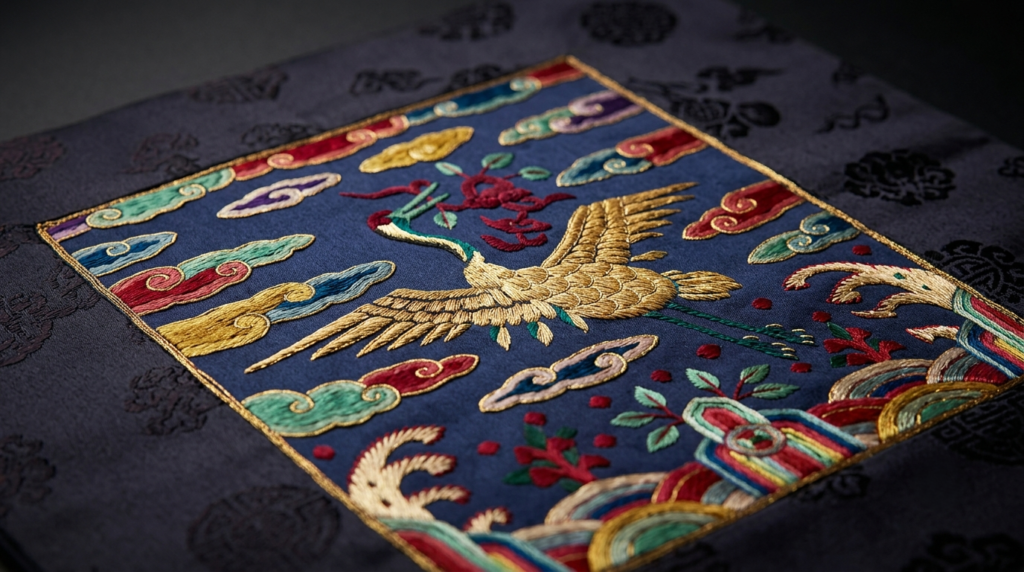
If Goryeo elevated embroidery to art, the Joseon Dynasty (1392–1910) turned it into official state infrastructure. The royal court established dedicated departments for craft and artistry within the palace bureaucracy, including Dohwa-seo (the bureau of painting), Chim-bang (responsible for sewing), and Su-bang (responsible specifically for embroidery) — formalizing needlework as a recognized professional discipline on par with court painting.
The most significant development of this era was the Hyungbae — an embroidered square insignia worn on the chest and back of official robes. Much like European coats of arms or military medals, the Hyungbae wasn’t decorative flourish; it was a strict, legally codified marker of civil and military rank, immediately legible to anyone at court. A tiger might signal a military general, while a crane denoted a scholar-official, meaning a single embroidered emblem could communicate someone’s entire position within the state hierarchy at a glance — no introduction necessary. To wear a Hyungbae was, in a very real sense, to wear one’s professional honor and duty woven directly into thread.
The Four Traditional Types of Korean Embroidery (Chasu)
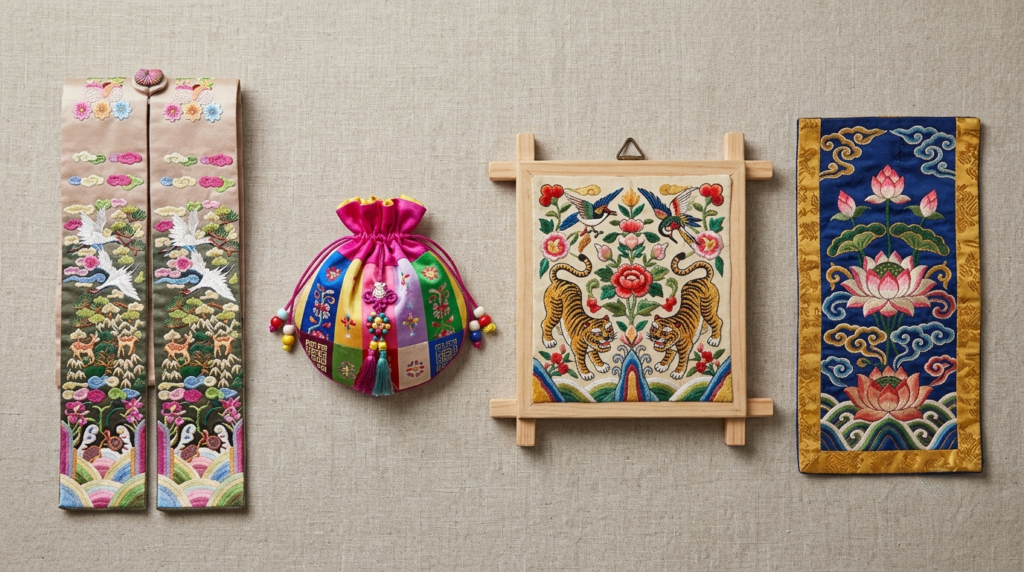
Historically, Korean embroidery has been classified into four distinct categories, each defined by function, audience, and context rather than technique alone.
Pokshik Chasu — Embroidery on Clothing
This is embroidery applied directly to garments — from everyday ceremonial court dress to the rank-defining Hyungbae insignia described above. It represents the most visible and socially significant category of jasu, since clothing embroidery was the version most people would actually encounter in daily public life, whether at court or during formal ceremonies like weddings.
Kiyong Chasu — Palace and Ceremonial Objects
This category covers embroidery decorating materials and objects used within the royal palace itself — folding screens, curtains, and ceremonial furnishings that decorated court life beyond clothing. Surviving examples include elaborate embroidered folding screens that once decorated royal private chambers, some of which were created by professional embroiderers working from preparatory drawings supplied by court painters — a genuine collaboration between two distinct artistic disciplines.
Kamsang Chasu — Artistic and Decorative Pieces
Kamsang chasu refers to embroidery created primarily as artistic work rather than functional decoration — pieces meant to be appreciated as standalone art, in the same way a viewer might appreciate a painting or a tapestry. This category blurs the line between craft and fine art, and it’s often where the most technically ambitious pieces originate, since they weren’t constrained by a garment’s shape or a screen’s frame.
Buddhist Chasu — Sacred and Temple Embroidery
Rooted in Buddhist devotional practice, this category includes embroidery created specifically for religious purposes — used to decorate statues of Buddha and adorn temple interiors, continuing a tradition of embroidered donations to Buddhist institutions that dates back at least to the Goryeo period. These pieces often carried the weight of personal devotion; donating an embroidered work to a temple was considered a meaningful act of religious merit, not simply decoration.
Symbolism in Korean Embroidery — Reading the Stitches
The Obangsaek Color System (Five Directional Colors)

Color in Korean embroidery was never arbitrary. Traditional pieces drew from obangsaek, the five traditional Korean colors, each tied to a cardinal direction, a natural element, and a virtue. For the most ceremonial or important pieces, gold and silver threads were sometimes woven in alongside these base colors to elevate a work’s status and visual brilliance, marking it as suitable for royal or ritual use rather than everyday wear.
Understanding obangsaek is essential to reading a piece of jasu correctly. A skilled viewer wouldn’t just admire the color combination on a Hyungbae or a ceremonial screen — they would recognize the deliberate symbolic logic behind why those specific colors were chosen for that specific object, the same way a modern reader recognizes the meaning behind a national flag’s color choices. This is part of what separates genuine expertise in Korean embroidery from surface-level appreciation: the palette itself is a text to be read, not just a visual effect to be enjoyed.
Common Motifs and Their Meanings

Certain images recur throughout Korean embroidery, each carrying centuries of accumulated symbolic weight:
- Tigers — a revered figure in Korean folklore, symbolizing strength, courage, and protection against evil spirits, frequently appearing in both embroidery and traditional Korean painting (ho-hwa), often rendered in a stylized rather than realistic manner
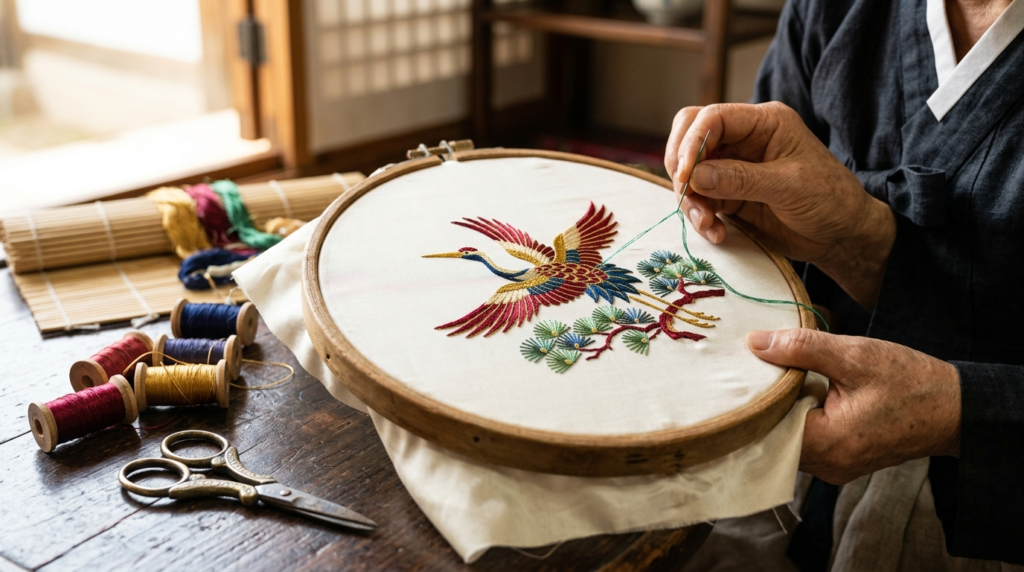
- Cranes — associated with scholarly rank and wisdom, as reflected directly in their use on Hyungbae insignia designating civil officials rather than military ones
- Magpies — traditionally paired with tigers in Korean art specifically to symbolize good news and incoming fortune, a pairing distinctive enough that it’s used as a stylistic signature of Korean (rather than Chinese or Japanese) animal motifs
- Lotus flowers and Buddhist iconography — common in Buddhist chasu, representing spiritual purity and enlightenment, echoing the same symbolism found in Buddhist temple architecture and statuary across Korea
- The Ten Symbols of Longevity (sipjangsaeng) — a recurring motif set including cranes, deer, pine trees, and clouds, symbolizing wishes for a long and prosperous life; one of the most celebrated surviving examples is an embroidered mattress bearing this motif, considered among the oldest surviving embroidered works in Korea and now held in a Seoul museum collection
Embroidery as Emotional Expression for Joseon-Era Women
Perhaps the most quietly powerful dimension of Korean embroidery is its role as an emotional and psychological outlet. Toward the latter half of the Joseon Dynasty, as conservative interpretations of neo-Confucian teaching became dominant, women across all social and economic classes faced increasingly rigid restrictions on nearly every aspect of daily life. Embroidery became one of the few sanctioned spaces where personal expression remained possible — a needle and thread standing in for words that couldn’t otherwise be spoken aloud.
This wasn’t merely symbolic hardship turned into craft; it was a documented form of quiet resistance and identity-building. Museum curators and textile historians have specifically framed surviving Joseon-era embroidered works — particularly bojagi (wrapping cloths), sewing tools, and folding screens — as tools that allowed women to assert creative identity within a society that otherwise constrained their public expression. Young girls learned patience, morality, and aesthetic discipline through the practice of jasu from an early age, while adult women used it to record love, loss, loyalty, and longing in stitched form, often as gifts for family members rather than for public display.
Notably, embroidery wasn’t exclusively a women’s domain, either — some historians point to it as a broader metaphor for creative empowerment that crossed gender lines within Joseon society, even though the surviving record is dominated by women’s work. Some completed pieces bear the initials or names of their makers, defying the anonymity typically expected of women’s domestic labor in this period; many others were left unsigned entirely, quietly dedicated to a loved one, an ancestor, or the divine.
Materials and Techniques Behind the Craft
Silk Threads, Gold Thread, and Traditional Needles
The material evolution of Korean embroidery mirrors its social rise. What began with needles carved from fish and animal bone, used to work animal skin and plant bark, eventually gave way to fine silk and ramie fabric — the materials most closely associated with Korean embroidery today. Dyed silk threads produced the vivid, saturated color schemes the craft is known for, while gilded threads were reserved for ceremonial and royal pieces, adding both visual brilliance and an unmistakable marker of status that anyone at court would immediately recognize.
Signature Stitching Methods Passed Down Through Generations
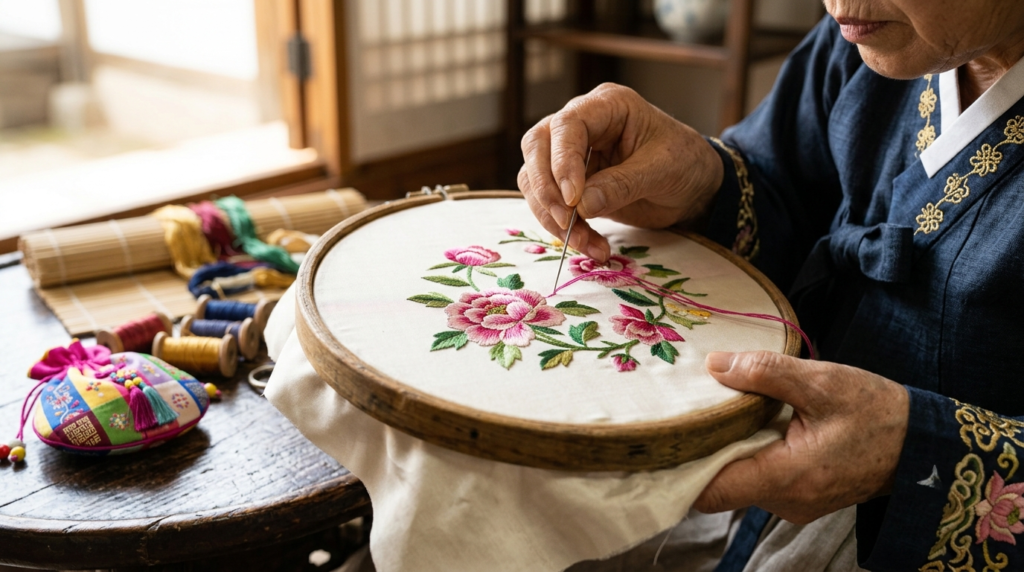
Korean embroidery relies on a defined set of core stitching techniques, each suited to a different visual effect:
- Jiksu (straight stitch) — produces a clean, even edge and often serves as the structural starting point for more complex designs
- Saseulsu (chain stitch) — creates interconnected loops resembling chain links, allowing for fluid, curved lines well suited to organic forms like vines, clouds, or waves
- Pyeongsu (flat stitch) — uses parallel rows of straight stitches laid vertically, horizontally, or diagonally to fill solid areas uniformly, producing the smooth, glossy finish that makes floral and geometric motifs appear so vivid
To execute these techniques with the necessary precision, fabric was stretched taut across a dedicated embroidery frame known as a jasu teul, which maintained even tension across the whole piece — preventing puckering and ensuring each stitch lay exactly as intended, whether flat against the fabric or deliberately raised for texture.
The technical distinction between royal and folk embroidery was visible in execution quality, not just subject matter. Pieces made by professional court embroiderers versus those made by individual households were distinguishable by the twist and tension of the silk thread and the density of gold thread used — a level of technical precision that separated amateur domestic work from recognized master craftsmanship, much the way a trained eye can distinguish hand-finished tailoring from off-the-rack clothing today.
How Korean Embroidery Compares to Chinese and Japanese Traditions
For readers exploring East Asian textile art more broadly, it’s worth understanding where jasu sits alongside its regional neighbors, since the three traditions are often confused with one another despite meaningful differences.
Chinese embroidery is the oldest of the three, with roots tracing back roughly 3,800 years to the Shang and Zhou dynasties. It’s traditionally organized by regional schools — Suzhou, Hunan, Sichuan, and Guangdong embroidery each have distinct motif and color conventions — and is philosophically grounded in Confucian, Taoist, and Buddhist symbolism, with techniques like satin stitch and couching remaining relatively stable over centuries.
Japanese embroidery, known as shishu, developed later and was historically shaped by cultural exchange with China, particularly during the Sui and Tang dynasties, though Korean influence — via the Baekje kingdom — also played an early, documented role in its formation. Japanese embroidery tends to emphasize seasonal nature imagery and a spiritual, meditative approach connected to broader aesthetic traditions like the tea ceremony, often favoring asymmetry and a sense of impermanence over the more literary symbolism found in Chinese work.
Korean embroidery occupies a distinct middle position: it shares technical DNA with both neighboring traditions — Korean and Japanese embroiderers, for instance, historically collaborated with professional painters for master designs in similar ways — but it developed its own defining features that set it apart, most notably the Hyungbae rank-insignia system (which has no direct equivalent in Chinese or Japanese court dress), the obangsaek five-color symbolic palette, and the specific tiger-and-magpie pairing rarely seen outside Korean art. Where Chinese embroidery leans toward philosophical and literary symbolism and Japanese embroidery leans toward seasonal and spiritual themes, Korean embroidery is distinguished by its close entanglement with formal social rank and its unusually well-documented role as emotional expression for Joseon-era women specifically.
Master Artisans and the Preservation of Jasu
The Role of Jasujang (Master Embroiderers)
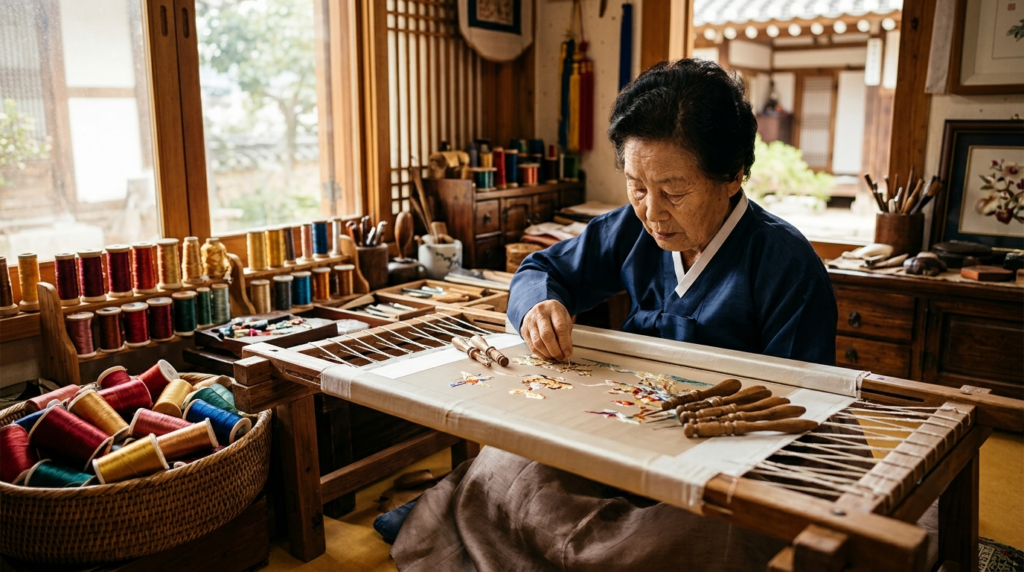
Within Korea’s cultural heritage system, master embroiderers are formally recognized as jasujang (자수장) — a title granted to individuals whose expertise is officially designated as an Important Intangible Cultural Property by South Korea’s Cultural Heritage Administration. This designation isn’t ceremonial; it comes with a genuine responsibility to preserve historically accurate techniques and train the next generation through structured, hands-on apprenticeship, ensuring methods refined over centuries aren’t lost to time or diluted by shortcuts.
One of the most recognized figures to hold this title is Han Sang Soo, a jasujang whose decades of work researching and teaching traditional embroidery led to the founding of a dedicated institute — and eventually a museum — in Seoul specifically to preserve historically accurate Korean embroidery techniques.
Modern Guardians of the Tradition
Korean embroidery faced real existential threats during the twentieth century, as industrialization, the disruptions of war, and the pressures of Japanese colonial rule put the survival of traditional needlework genuinely at risk. In response, dedicated artisans and cultural institutions worked deliberately to research, preserve, and revitalize techniques that had been neglected under decades of modernization and foreign occupation.
This preservation effort wasn’t limited to individual artisans. Institutions like the Museum of Korean Embroidery, founded in Seoul in 1976 by Dong-hwa Huh and Young-suk Park, were established specifically to collect and safeguard historical pieces before they were lost or scattered — work that later informed major international exhibitions, including a joint showcase between the Cleveland Museum of Art and the Seoul Museum of Craft Art examining embroidery as a form of empowerment for Joseon-era women. Today, individuals recognized as jasujang continue producing and teaching jasu, ensuring the craft remains a living, evolving tradition rather than something confined to glass display cases.
The Modern Revival of Korean Embroidery
Jasu in Contemporary Fashion and K-Design
As global interest in Korean culture has surged — driven by K-drama, K-pop, and Korean cinema — traditional crafts like jasu are finding genuinely new audiences, both domestically and internationally. Contemporary Korean designers are increasingly incorporating embroidered motifs and historically grounded techniques into modern fashion, blending centuries-old symbolism with contemporary silhouettes rather than treating tradition and modernity as opposites. This extends into contemporary art as well; Korean institutions have begun examining “modern embroidery” as its own developing category, tracing how the craft was reshaped by port openings, modernization, and Westernization from the nineteenth century onward.
Where to Learn or Experience Korean Embroidery Today
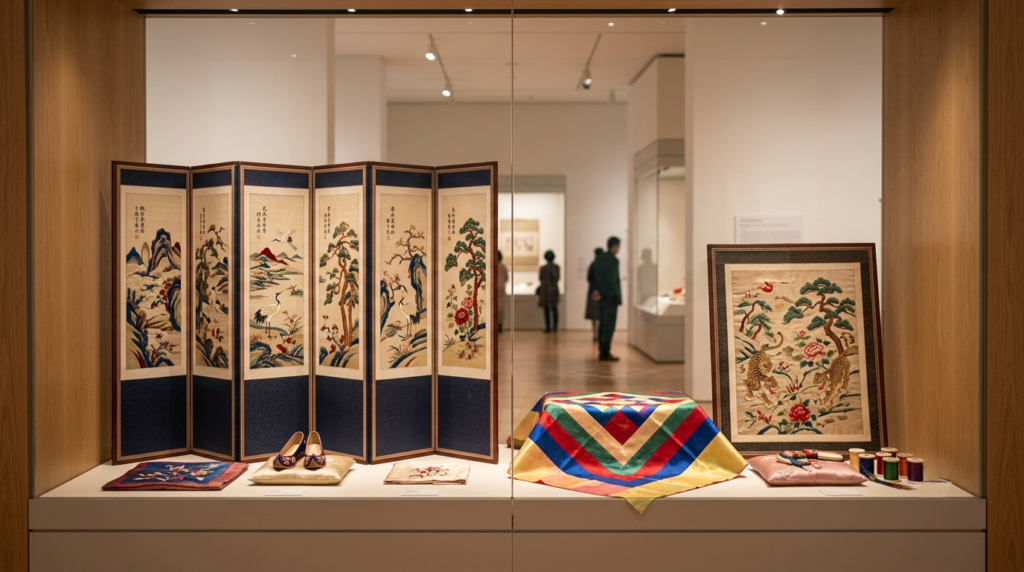
For travelers and culture enthusiasts, Korean embroidery isn’t confined to history books — several institutions in Seoul make the craft directly accessible:
- Han Sang Soo Embroidery Museum (Seongbuk-gu, Seoul) — founded by jasujang Han Sang Soo, this museum specializes specifically in Korean embroidery and reflects one master artisan’s lifetime of research into historically accurate technique.
- Museum of Korean Embroidery (Apgujeong-dong, Seoul) — established in 1976, its collection includes more than 500 pieces, including the sipjangsaeng (ten symbols of longevity) mattress, considered the oldest surviving embroidered work in Korea. Admission is free, though the museum is compact and somewhat difficult to locate, so it’s worth confirming opening hours before visiting.
- Seoul Museum of Craft Art (SeMoCA) — a larger national museum with permanent exhibitions dedicated to Korean embroidery and bojagi (wrapping cloth), including pieces donated by Huh Dong-hwa and Park Young-sook, plus hands-on activities suitable for visitors wanting a more interactive introduction to the craft.
- Chung Young Yang Embroidery Museum, affiliated with Sookmyung Women’s University — notable for placing Korean embroidery in direct dialogue with Chinese and other East Asian embroidery traditions within the same collection, making it a particularly useful stop for readers interested in the comparative context covered above.
How Global Interest in Korean Culture Is Reviving Traditional Crafts
The same wave of global curiosity that has driven interest in hanbok, Korean cuisine, and traditional architecture is now extending to textile arts. International visitors — including, notably, embroiderers from other cultures with their own needlework traditions — have described discovering jasu as a moment of unexpected cultural connection, recognizing shared threads of patience, discipline, and quiet creative expression across otherwise very different histories. As more people engage with Korean culture beyond entertainment media, traditional crafts like embroidery are being rediscovered as sophisticated, historically rich art forms in their own right — one thread, and one story, at a time.
Frequently Asked Questions
What does “jasu” mean in Korean?
Jasu (자수) is the Korean word for embroidery — the traditional art of decorating fabric using needle and thread, also referred to as chasu.
How old is Korean embroidery?
Korean embroidery dates back to the Three Kingdoms period, with physical evidence preserved in burial textiles, making it a continuous tradition spanning roughly two millennia.
What are the four types of traditional Korean embroidery?
The four classical categories are Pokshik chasu (clothing), Kiyong chasu (palace and ceremonial objects), Kamsang chasu (standalone artistic pieces), and Buddhist chasu (temple and religious embroidery).
What do the colors in Korean embroidery symbolize?
Colors are typically drawn from obangsaek, the five traditional Korean colors, each linked to a cardinal direction, natural element, and virtue, giving embroidered pieces layered symbolic meaning beyond their visual design.
How is Korean embroidery different from Japanese or Chinese embroidery?
While all three traditions share silk-based techniques and centuries of history, Korean embroidery is distinguished by its rank-based Hyungbae insignia system, its obangsaek color symbolism, and motifs like the tiger-and-magpie pairing rarely found in Chinese or Japanese work.
Where can I see authentic Korean embroidery today?
Seoul is home to several dedicated institutions, including the Han Sang Soo Embroidery Museum, the Museum of Korean Embroidery, the Seoul Museum of Craft Art, and the Chung Young Yang Embroidery Museum, several of which offer free admission.
What is a jasujang?
A jasujang is a master embroiderer formally recognized by South Korea’s Cultural Heritage Administration as a holder of Important Intangible Cultural Property status, responsible for preserving and teaching traditional techniques.
Conclusion — Why Korean Embroidery Still Matters
Korean embroidery is far more than a decorative craft — it’s a woven record of rank, diplomacy, devotion, and quiet emotional expression that spans dynasties and, at times, national borders. From the Hyungbae insignia that once announced a scholar’s status at a glance, to the unsigned pieces stitched by Joseon-era women recording feelings they couldn’t otherwise voice, jasu has always carried meaning far beyond its threads. As Korea’s cultural influence continues to expand globally, this ancient art form is being rediscovered — not as a relic behind museum glass, but as a living, evolving tradition still capable of telling Korea’s story, one careful stitch at a time.