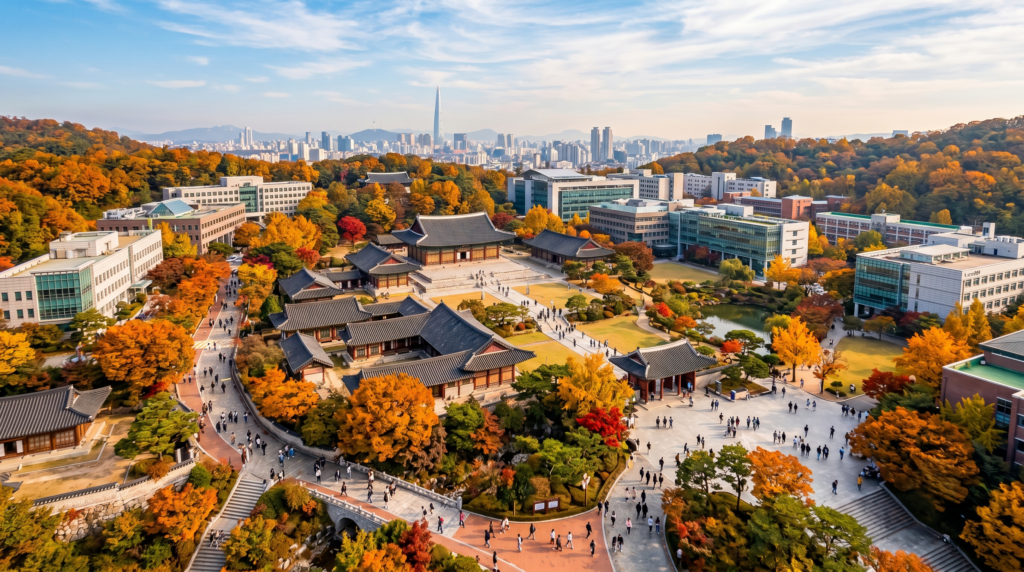
What if your college degree came with world-class academics, cutting-edge research facilities, a thriving cultural scene, and one of the most exciting countries in Asia right outside your campus door? For thousands of international students every year, that is exactly what studying at the best colleges in Korea offers. South Korea has quietly — and then very loudly — transformed itself into one of Asia’s most respected higher education destinations, with several universities now ranking among the top 100 in the world.
Whether you are drawn by Korea’s legendary SKY universities, its government-funded scholarships, its booming tech and entertainment industries, or simply the dream of living in the country that gave the world K-dramas and K-pop, Korean universities offer an academic experience unlike any other. In 2025, more international students than ever are choosing Korea over traditional study-abroad destinations like the United States, the United Kingdom, and Australia — and for very good reason.
This guide covers everything you need to know: the best colleges in Korea ranked for 2025, what makes each one stand out, how to apply as an international student, available scholarships, and what student life truly looks like on a Korean campus. Whether you are a prospective undergraduate, a graduate researcher, or simply exploring your options, this article will give you the clarity and confidence to make the right choice.
Why Study at the Best Colleges in Korea?
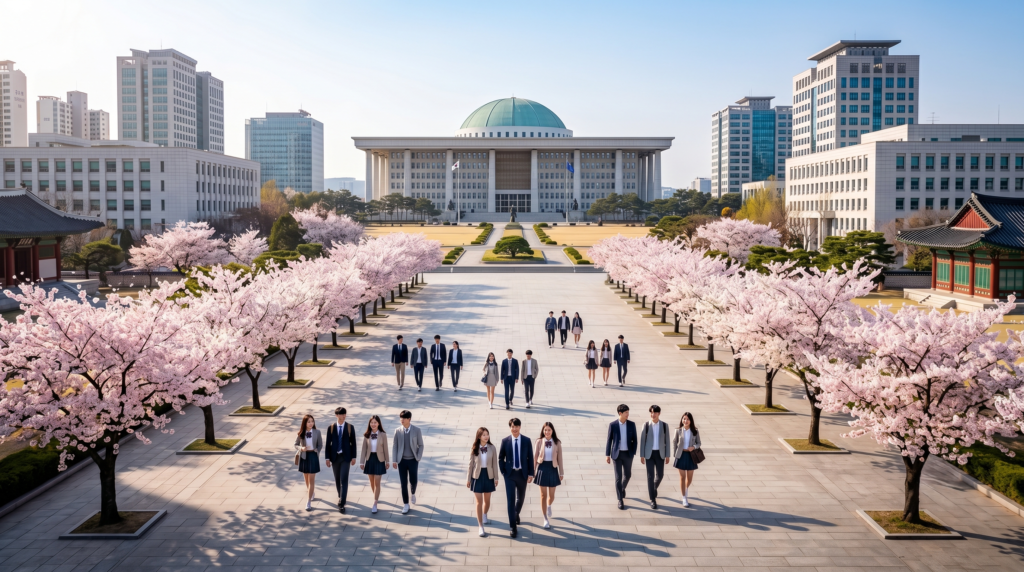
Before diving into individual universities, it is worth understanding why South Korea has become such a compelling study destination — especially when competing with countries that have decades of international student recruitment behind them.
World-Class Education at an Affordable Cost
One of the most immediate advantages of studying in Korea is the cost. Compared to universities in the United States, the United Kingdom, or Australia, Korean universities offer internationally recognized degrees at a fraction of the price. Annual tuition fees at most top Korean universities range between $4,000 and $10,000 USD for international students — significantly lower than the $30,000–$60,000 range common in Western institutions.
Beyond tuition, the South Korean government actively supports international students through the Global Korea Scholarship (GKS), which covers full tuition, monthly living allowances, airfare, and even Korean language training. This makes Korea one of the most financially accessible top-tier education destinations in the world. For students willing to invest time in their applications, the return on investment is extraordinary.
Korea’s Growing Global University Rankings
Korean universities have made impressive strides in global rankings over the past decade. In the 2025 QS World University Rankings, Seoul National University, KAIST, and Yonsei University all appear in the top 100 globally — a testament to Korea’s investment in research output, academic faculty, and international collaboration.
South Korea consistently ranks among the top countries globally for innovation, R&D spending as a percentage of GDP, and patent applications. This culture of innovation flows directly into its universities, where cutting-edge research in semiconductors, biotechnology, artificial intelligence, and green energy is being conducted at a world-leading level. For students in STEM fields especially, Korean universities offer access to research environments that rival anything in the Western world.
Cultural Immersion and Career Opportunities
Studying in Korea is not just an academic decision — it is a life-changing cultural experience. Korea sits at the crossroads of tradition and modernity. On one hand, you have ancient palaces, tea ceremonies, and Confucian academic values. On the other, you have Samsung, Hyundai, BTS, and one of the fastest internet speeds on the planet.
For international students, this means incredible opportunities. Graduates from top Korean universities are highly sought after by global corporations with strong Korean ties, as well as by Korean conglomerates (chaebols) expanding internationally. Learning Korean alongside your degree adds even more career value, opening doors in business, diplomacy, media, technology, and education across Asia and beyond.
Understanding the Korean University System
To make the best choice, it helps to understand how Korean higher education is structured.
What Are the SKY Universities?
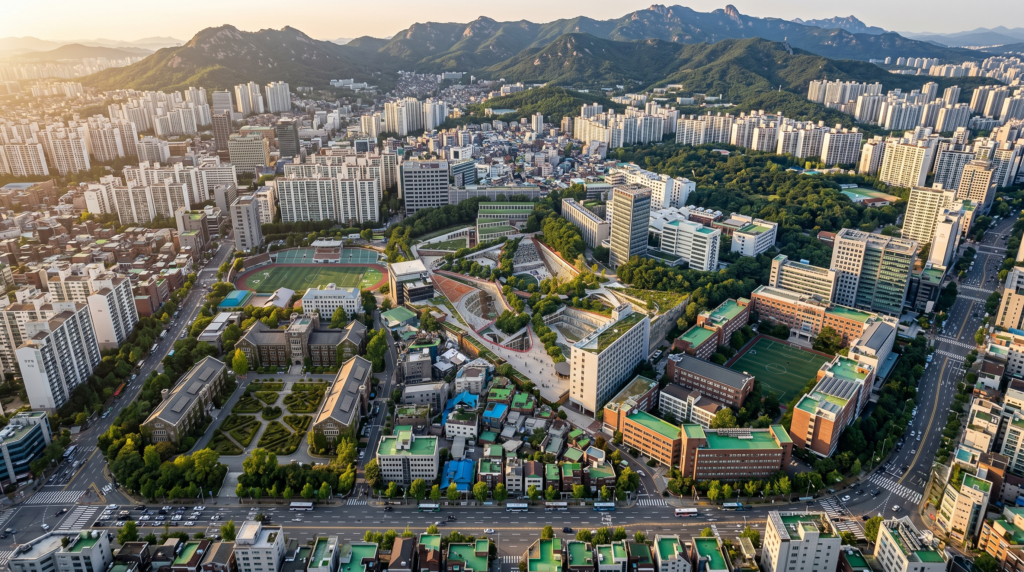
In Korea, the term “SKY” is not just a word — it is a cultural institution. SKY stands for Seoul National University (SNU), Korea University, and Yonsei University — the three most prestigious universities in the country. Getting into a SKY university in Korea carries enormous social prestige, similar to attending an Ivy League school in the United States or an Oxbridge institution in the United Kingdom.
Korean students spend years — sometimes their entire school careers — preparing for the Suneung (college entrance exam) with the goal of earning a place at one of these institutions. For international students, the SKY universities are equally desirable, offering world-class programs, powerful alumni networks, and degrees recognized by employers around the globe.
National vs. Private Universities in Korea
Korean universities fall into two broad categories: national (government-funded) and private. National universities like Seoul National University, KAIST, and POSTECH receive significant government funding, which often translates into lower tuition and heavily subsidized research programs. Private universities like Yonsei, Korea University, and Sungkyunkwan University are independently funded but maintain strong reputations and industry partnerships that make them equally competitive.
Neither type is inherently superior — the right choice depends on your field of study, budget, and personal preferences. KAIST and POSTECH, for example, are the clear leaders in science and engineering. Yonsei and Korea University dominate in business, law, and the humanities.
Academic Calendar and Credit System
Korean universities generally operate on a two-semester system. The spring semester runs from March to June, and the fall semester runs from September to December. Most international exchange programs align with these semesters, though some universities also offer summer intensive programs.
For degree-seeking international students, credits earned at Korean universities are widely transferable, and many institutions have bilateral agreements with universities in Europe, North America, and Southeast Asia. A growing number of programs — particularly at the graduate level — are now taught entirely in English, removing the language barrier that once limited international enrollment.
Best Colleges in Korea — Top Universities Ranked for 2025
Here is a detailed look at the top universities in Korea that consistently deliver excellence for both domestic and international students.
1. Seoul National University (SNU)
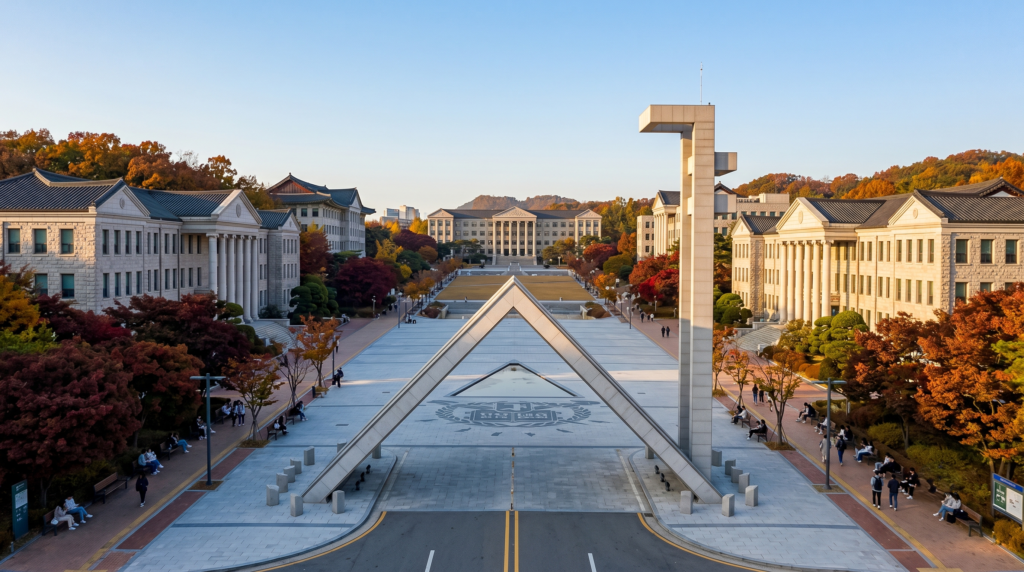
Global Ranking (2025 QS): Top 30 in Asia | Top 50 Globally
Seoul National University is the crown jewel of Korean higher education — the most prestigious, most selective, and most internationally recognized university in the country. Located in the Gwanak district of Seoul, SNU’s sprawling campus is home to over 28,000 students across 16 colleges and 10 graduate schools.
SNU excels across virtually every discipline, but it is particularly renowned for its programs in medicine, law, engineering, natural sciences, and social sciences. The university has a strong international office dedicated to supporting foreign students, and its English-taught graduate programs have grown significantly in recent years.
For international applicants, SNU requires strong academic transcripts, proof of language proficiency (TOPIK Level 3 or above for Korean-taught programs, or TOEFL/IELTS for English-medium programs), and — for graduate programs — a detailed research proposal. Competition is fierce, but the rewards of an SNU degree are unmatched in the Korean academic landscape.
2. Korea Advanced Institute of Science and Technology (KAIST)

Global Ranking (2025 QS): Top 50 Globally
If SNU is Korea’s Harvard, KAIST is its MIT. Founded in 1971 as Korea’s first research-oriented science and engineering university, KAIST has grown into one of Asia’s most respected institutions for technology, innovation, and scientific research. Located in Daejeon — Korea’s “Science City” — KAIST operates with a singular focus: producing the next generation of scientists, engineers, and tech entrepreneurs.
What makes KAIST particularly attractive for international students is that virtually all of its programs are taught in English. This makes it one of the most accessible top-tier Korean universities for students who have not yet mastered the Korean language. KAIST also has one of the strongest scholarship programs in the country, with a significant portion of its students receiving full or partial funding.
Industry partnerships with Korean tech giants like Samsung, LG, and SK Hynix give KAIST students unparalleled access to internships, research funding, and post-graduation employment opportunities in the global tech sector.
3. Yonsei University
Global Ranking (2025 QS): Top 80 Globally
Yonsei University is one of Korea’s oldest and most beloved institutions, founded in 1885 by American missionaries. Located in the heart of Seoul’s Sinchon neighborhood, Yonsei combines a rich historical legacy with a deeply modern, internationally focused academic environment.
Yonsei is particularly strong in medicine, business, international studies, and the humanities. Its Underwood International College (UIC) offers a fully English-medium liberal arts curriculum modeled on Western university traditions — making it one of the most popular choices among international undergraduate students in Korea.
Yonsei also operates a second international campus in Songdo, Incheon, which houses several English-taught programs and is designed specifically to attract and accommodate global students. The Yonsei brand carries enormous weight in Korean society and in international academic circles alike.
4. Korea University
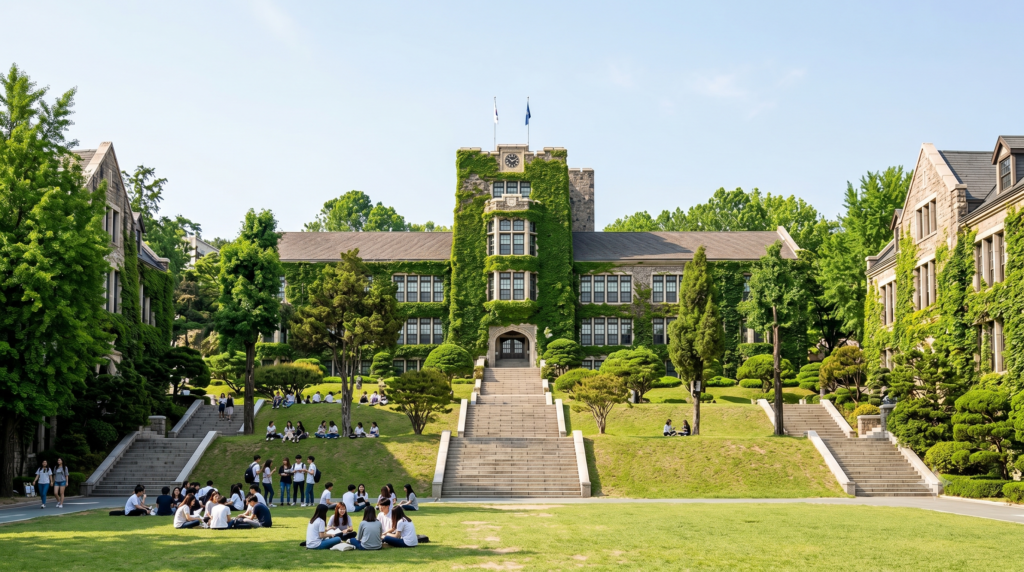
Global Ranking (2025 QS): Top 90 Globally
Korea University (고려대학교), known affectionately as “KU,” is the third pillar of the SKY universities and one of Korea’s most storied academic institutions. Founded in 1905, KU has a fierce academic reputation and an even fiercer rivalry with Yonsei — their annual Akaraka festival and sports competitions are some of the most celebrated traditions in Korean university life.
KU is especially well regarded for its programs in law, business administration, political science, and media studies. The Korea University Business School (KUBS) is internationally accredited and consistently ranked among the best business schools in Asia. For international students interested in Korean politics, society, or business, Korea University offers an unbeatable combination of academic prestige and cultural immersion.
5. Sungkyunkwan University (SKKU)
Global Ranking (2025 QS): Top 120 Globally
Sungkyunkwan University holds a unique distinction: it is both one of Korea’s oldest institutions — tracing its roots to a Confucian academy founded in 1398 — and one of its most industry-connected modern universities. Since Samsung became a major patron and partner of SKKU in 1996, the university has undergone a remarkable transformation, investing heavily in engineering, business, and technology programs.
The Samsung connection is a genuine differentiator. SKKU students benefit from Samsung-funded scholarships, joint research programs, and a pipeline to employment at one of the world’s most powerful technology companies. SKKU’s School of Business and College of Engineering are both internationally accredited and globally recognized.
For international students, SKKU offers a wide range of English-medium programs and has one of the most active international student communities in Korea, with students from over 100 countries enrolled across its Seoul and Suwon campuses.
6. Pohang University of Science and Technology (POSTECH)
Global Ranking (2025 QS): Top 150 Globally
POSTECH may be smaller than most universities on this list — with fewer than 4,000 students — but what it lacks in size it more than compensates for in research intensity and academic excellence. Founded in 1986 by POSCO, one of the world’s largest steel companies, POSTECH is exclusively focused on science and engineering, and it consistently produces some of the highest research output per faculty member of any university in Asia.
For graduate students and researchers in physics, chemistry, materials science, and engineering, POSTECH offers an environment of extraordinary academic rigor. Its small class sizes mean students receive exceptional individual attention from world-class faculty, many of whom are globally recognized leaders in their fields.
7. Sogang University
Global Ranking (2025 QS): Top 300 Globally
Sogang University may not carry the same global ranking weight as SNU or KAIST, but within Korea — and especially among international students — it holds a special place. Founded in 1960 by American Jesuit missionaries, Sogang has built its reputation on academic rigor, small class sizes, and an exceptionally strong humanities and social sciences curriculum.
Sogang is perhaps best known internationally for its Korean Language Education Center (KLEC), which is widely regarded as one of the best Korean language programs in the world. Students from dozens of countries come specifically to Sogang to study Korean, and the immersive language environment on campus makes it an ideal choice for anyone serious about achieving fluency.
Beyond language, Sogang’s programs in economics, communications, and theology are highly respected within Korean academic circles. The university’s location in Mapo-gu, Seoul — close to Hongdae, one of Seoul’s most vibrant youth culture districts — also makes it one of the most socially and culturally engaging campuses in the country.
8. Ewha Womans University
Global Ranking (2025 QS): Top 350 Globally
Ewha Womans University is a landmark institution — not just in Korea, but in the entire world. Founded in 1886, Ewha is the largest women’s university on the planet, and it has played a central role in advancing women’s education and gender equality in Korean society for over a century.
Ewha is academically strong across a wide range of disciplines, with particular excellence in law, education, arts, pharmacy, and social sciences. Its graduate programs are especially well regarded, and the university has cultivated a powerful network of alumnae who occupy prominent positions in Korean government, business, academia, and the arts.
For international female students, Ewha offers a uniquely supportive and empowering academic environment. The university has a dedicated international office, a range of English-medium courses, and a long history of welcoming students from abroad. Its stunning campus — featuring the iconic underground ECC (Ewha Campus Complex) designed by French architect Dominique Perrault — is also one of the most architecturally striking in all of Korea.
9. Hanyang University
Global Ranking (2025 QS): Top 350 Globally
Hanyang University is one of Korea’s most practically oriented top universities, with a long-standing reputation for producing job-ready graduates in engineering, architecture, and applied sciences. Founded in 1939, Hanyang operates two campuses — one in Seoul and one in Ansan (known as the ERICA campus) — giving students access to both the capital’s opportunities and a more suburban academic environment.
Hanyang’s College of Engineering is consistently ranked among the best in Korea, and its architecture program has produced some of the country’s most celebrated designers and urban planners. The university also has a strong business school and an active performing arts program, giving it a well-rounded academic profile.
For international students, Hanyang is an attractive choice for its relatively affordable tuition, extensive English-medium course offerings, and one of the most active international exchange networks in Korean higher education. Hanyang maintains partnership agreements with over 600 universities worldwide, making it an excellent base for students who want a globally connected degree experience.
10. Kyung Hee University
Global Ranking (2025 QS): Top 400 Globally
Kyung Hee University rounds out our list as one of Korea’s most distinctive and internationally minded institutions. Founded in 1949, Kyung Hee is known for its commitment to peace studies and global citizenship — values that are embedded in its curriculum and campus culture in a way that sets it apart from more traditionally focused Korean universities.
Academically, Kyung Hee shines in hospitality and tourism management, Oriental medicine, performing arts, and international studies. Its College of Hotel and Tourism Management is one of the most respected programs of its kind in Asia, attracting students from across the continent and beyond.
Kyung Hee’s Seoul campus is frequently cited as one of the most beautiful university campuses in Korea, with its classical European-inspired architecture and meticulously landscaped grounds creating an environment that feels as inspiring as it is academic. The university also has a Global Campus in Suwon, and its large international student community makes it one of the most welcoming universities in Korea for students from overseas.
How to Apply to the Best Colleges in Korea as an International Student
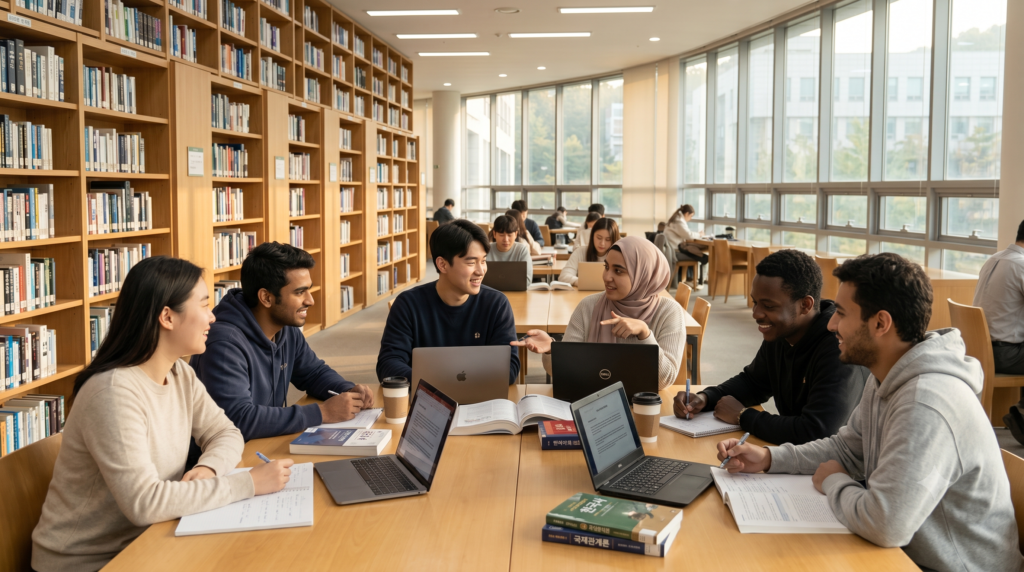
Understanding the application process is essential for anyone seriously considering studying in Korea. While each university has its own specific requirements, the general framework is consistent across most institutions.
General Admission Requirements
Most top Korean universities require the following from international applicants:
Academic Documents:
- Official high school transcripts (for undergraduate applicants) or university transcripts (for graduate applicants)
- Graduation certificates or diplomas
- A minimum GPA — typically 2.5 to 3.0 on a 4.0 scale, though competitive programs expect significantly higher
Language Proficiency:
- For Korean-taught programs: TOPIK (Test of Proficiency in Korean) Level 3 is the standard minimum, with Level 4–6 preferred for competitive programs
- For English-taught programs: TOEFL iBT score of 80+ or IELTS score of 6.0+ is typically required
- Some universities waive language requirements for students from English-speaking countries or those who completed their prior education in English
Additional Documents:
- Personal statement or study plan
- Letters of recommendation (usually two, from academic or professional referees)
- Copy of passport
- Health certificate (for some universities)
- Portfolio (for arts and design programs)
Application Timeline and Deadlines
Korean universities generally have two major intake periods each year. Understanding the timeline is critical, as missing a deadline — even by a day — typically means waiting another full semester.
For the Spring Semester (March start): Applications typically open in September and close in November of the preceding year. Results are announced in December or January.
For the Fall Semester (September start): Applications typically open in March and close in May. Results are announced in June or July.
It is strongly recommended to begin preparing your application materials at least six months in advance. This is particularly important if you need to arrange official transcript translations, secure letters of recommendation, or sit a language proficiency exam — all of which take time.
Scholarships for International Students in Korea
One of the most compelling reasons to study in Korea is the availability of generous, well-funded scholarships specifically designed for international students.
Global Korea Scholarship (GKS) Also known as the KGSP (Korean Government Scholarship Program), the GKS is the flagship scholarship offered by the National Institute for International Education (NIIED). It is one of the most comprehensive government scholarships in the world, covering:
- Full tuition for the entire degree program
- A monthly living stipend (approximately 900,000–1,000,000 KRW per month)
- Round-trip airfare
- One year of Korean language training before the degree begins
- Medical insurance
GKS scholarships are available at both the undergraduate and graduate levels and are offered through two channels: the Korean embassy in your home country, or directly through participating universities.
University-Specific Scholarships Almost every top Korean university offers its own merit-based scholarships for international students, separate from the GKS. These vary widely in value and eligibility criteria, but many cover partial or full tuition. Notable examples include:
- SNU’s Glocal Scholarship
- Yonsei University’s International Student Scholarship
- KAIST’s full tuition waiver for admitted graduate students
- SKKU’s Samsung Scholarship programs
Other Funding Sources The Korea International Cooperation Agency (KOICA) offers scholarships for students from developing countries, with a focus on development studies and public policy. Additionally, several Korean conglomerates, foundations, and cultural organizations offer smaller grants and stipends for international students pursuing Korean studies or related fields.
Student Life at Korean Universities
Academic excellence is only part of the picture. Korean university life is rich, dynamic, and deeply social — and for international students, it offers an immersive window into one of Asia’s most fascinating cultures.
Campus Culture and Clubs (Dongari)
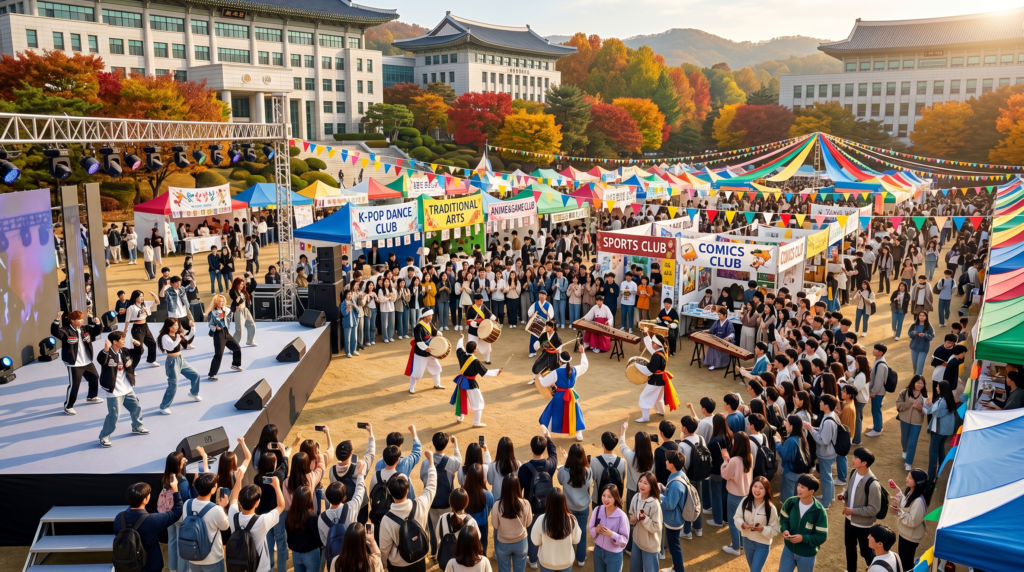
One of the first words any new student at a Korean university will encounter is 동아리 (dongari) — the Korean word for club or extracurricular group. Dongari culture is central to Korean university life, serving as the primary social infrastructure through which students build friendships, develop hobbies, and integrate into campus community.
Korean universities host hundreds of dongari covering everything imaginable: K-pop dance groups, traditional music ensembles, hiking clubs, debate societies, film clubs, volunteer organizations, and academic study groups. For international students, joining a dongari is one of the fastest and most effective ways to meet Korean students, practice the language, and genuinely experience campus culture rather than observing it from the outside.
Many universities also have dedicated international student clubs and buddy programs that pair new foreign students with Korean mentors who help them navigate campus life, administrative processes, and the city around them.
Dormitory and Housing Options
Housing is a practical concern that every prospective international student needs to address early. Most top Korean universities offer on-campus dormitory accommodation, which is strongly recommended for first-year and first-semester international students. Dormitory rooms are typically shared (two to four students per room), clean, well-maintained, and significantly cheaper than off-campus alternatives — with monthly costs ranging from 200,000 to 500,000 KRW depending on the university and room type.
However, demand for on-campus housing often exceeds supply, and international students are not always guaranteed a dormitory place. It is essential to apply for housing as early as possible — ideally at the same time as your university application.
Off-campus options include:
- Gosiwon: Small, budget single rooms popular with students — very affordable but minimal in space and amenities
- One-room (원룸) apartments: Studio apartments available near most university campuses, typically ranging from 400,000 to 800,000 KRW per month
- Goshitel: A step up from gosiwon, offering slightly more space and often including shared kitchen facilities
Living costs in Seoul are higher than in other Korean cities. Students at universities in Daejeon (KAIST, POSTECH) or Suwon (SKKU’s natural science campus, Kyung Hee’s Global Campus) generally enjoy lower living expenses while still accessing world-class academic facilities.
Food, Language, and Daily Life
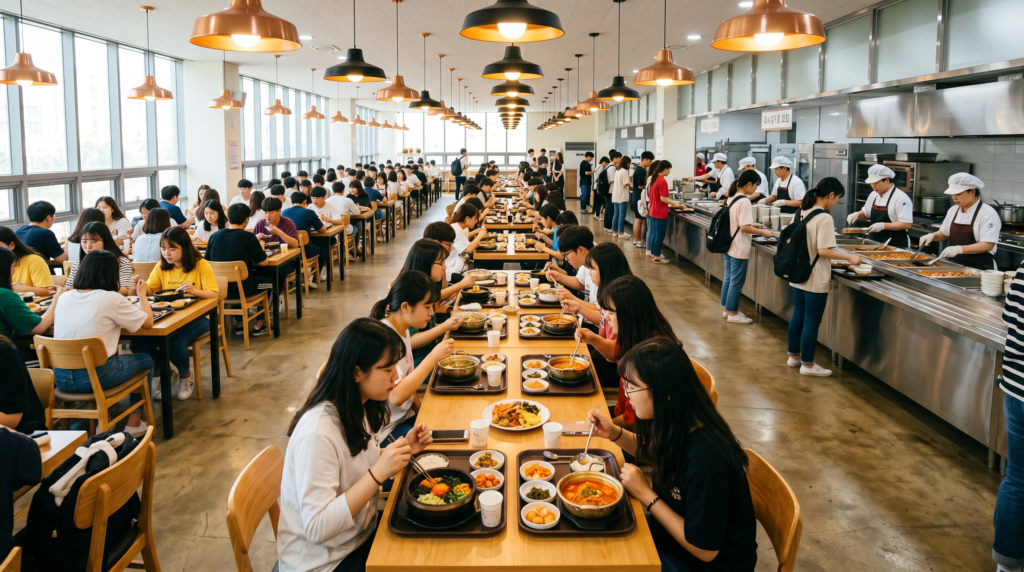
Daily life on a Korean university campus is an experience in itself. Most universities have large, subsidized cafeterias — known in Korean as 학식 (haksik), short for 학생 식당 (student restaurant) — where hot, balanced Korean meals are served for as little as 3,000–5,000 KRW. For international students accustomed to expensive campus dining in Western countries, this is a revelation.
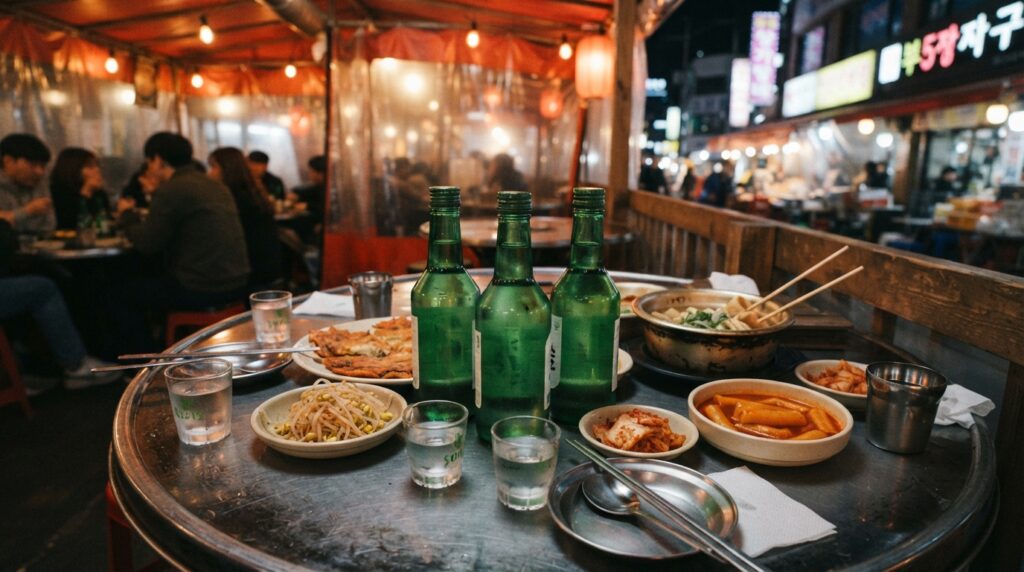
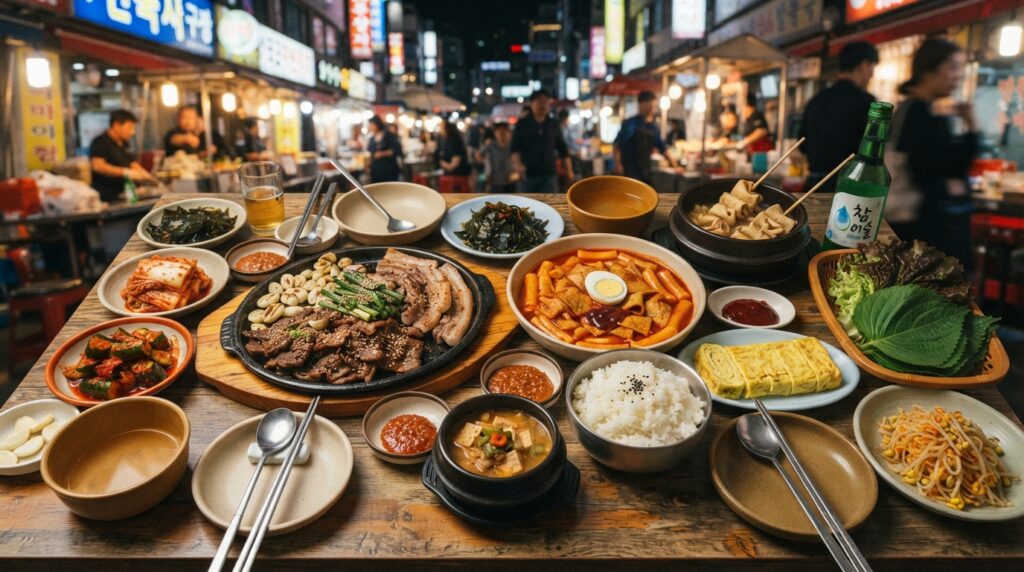
Beyond the cafeteria, Korean university neighborhoods are lined with affordable restaurants, convenience stores, and street food stalls offering everything from tteokbokki and kimbap to international cuisine. Food in Korea is not just sustenance — it is a social ritual, and sharing meals is one of the primary ways Koreans build and maintain relationships.
Language is perhaps the biggest daily challenge for international students who arrive without Korean skills. While English-medium programs reduce academic barriers, navigating daily life — from public transport and banking to medical appointments and administrative tasks — becomes much smoother with even basic Korean proficiency. Most universities offer free or heavily subsidized Korean language classes for international students, and the immersive environment of living in Korea accelerates language learning faster than any classroom abroad ever could.
Best Colleges in Korea by Field of Study
Choosing a university in Korea is not just about prestige — it is about finding the best fit for your specific academic goals. Here is a quick reference guide to help match your field of study with the university best positioned to support it:
| Field of Study | Top Recommended Universities |
|---|---|
| Engineering & Technology | KAIST, POSTECH, Hanyang University |
| Business & Management | Korea University (KUBS), SKKU, Yonsei |
| Medicine & Health Sciences | Seoul National University, Yonsei |
| Natural Sciences & Research | POSTECH, KAIST, SNU |
| Law & Political Science | Korea University, SNU |
| Arts, Film & Performing Arts | Kyung Hee University, Ewha Womans University |
| Korean Language & Linguistics | Sogang University, Yonsei (Korean Language Institute) |
| Hospitality & Tourism | Kyung Hee University |
| Women’s Studies & Gender | Ewha Womans University |
| International Studies | Yonsei (UIC), Kyung Hee, SNU |
Expert Tips for Choosing the Right Korean University
With so many excellent options available, narrowing down your choice can feel overwhelming. These practical tips will help you make a confident, well-informed decision.
Tip 1: Align your major with the university’s strongest department. Do not choose a university solely based on its overall ranking. A university ranked 300th globally may have a top-20 program in your specific field. Research department-level rankings, faculty profiles, and recent research output before making your decision.
Tip 2: Confirm whether English-medium programs are available. If your Korean language skills are limited, verify — directly with the admissions office — that your intended program is taught in English. University websites are not always up to date, and assumptions here can lead to costly mistakes.
Tip 3: Research scholarship deadlines early — they close fast. GKS and university scholarship deadlines often fall months before the general application deadline. Missing a scholarship window means paying full tuition, so build your application timeline around scholarship deadlines first.
Tip 4: Connect with current international students before applying. Platforms like Reddit (r/Korea, r/StudyInKorea), YouTube, and university Facebook groups are filled with honest, first-hand accounts from international students currently enrolled at Korean universities. Their insights on everything from dormitory quality to professor accessibility are invaluable and cannot be found in any official brochure.
Tip 5: Consider location as part of your overall experience. Seoul offers unmatched cultural, professional, and social opportunities — but it is also the most expensive city in Korea. If your priority is research intensity and academic focus with lower living costs, consider KAIST in Daejeon or POSTECH in Pohang. If cultural immersion and city life matter as much as academics, Seoul-based universities offer an experience that is truly hard to match anywhere in Asia.
Frequently Asked Questions — Best Colleges in Korea
Q1: What are the best colleges in Korea for international students? The best colleges in Korea for international students include Seoul National University, KAIST, Yonsei University, Korea University, and Sungkyunkwan University. Each offers strong English-medium programs, dedicated international student support, and globally recognized degrees. The best choice depends on your field of study, language ability, and budget.
Q2: Is studying in Korea expensive? Compared to Western countries, studying in Korea is relatively affordable. Annual tuition at top Korean universities ranges from approximately $4,000 to $10,000 USD. Monthly living costs — including accommodation, food, and transport — typically range from $600 to $1,200 USD depending on the city and lifestyle. Government and university scholarships can significantly reduce or eliminate these costs entirely.
Q3: Can I study in Korea in English? Yes. A growing number of Korean universities now offer full degree programs taught entirely in English, particularly at the graduate level. KAIST, Yonsei’s Underwood International College, and SKKU are among the leaders in English-medium instruction. Even at universities where Korean is the primary language of instruction, most offer a selection of English-taught courses each semester.
Q4: What is a SKY university in Korea? SKY is an acronym referring to Korea’s three most prestigious universities: Seoul National University (S), Korea University (K), and Yonsei University (Y). These institutions are considered the pinnacle of Korean higher education and carry immense social, academic, and professional prestige both within Korea and internationally.
Q5: How do I get a scholarship to study in Korea? The most accessible and comprehensive scholarship for international students is the Global Korea Scholarship (GKS), administered by the Korean government through NIIED. Applications are submitted either through the Korean embassy in your home country or directly through participating universities. Most top Korean universities also offer their own merit-based scholarships for international students — check each university’s international admissions page for details and deadlines.
Q6: Is Korean university life different from Western universities? Yes, in several meaningful ways. Korean university culture places a strong emphasis on seniority, group identity, and collective participation — particularly through dongari (clubs) and hoobae/sunbae (junior/senior) relationships. Academic pressure is high, and the culture of studying diligently is deeply embedded. At the same time, Korean campus life is also intensely social, celebratory, and fun, with festivals, club performances, and social gatherings forming a core part of the university experience. International students generally find the adjustment enriching rather than difficult.
South Korea’s universities have earned their place on the world stage — and the best colleges in Korea offer international students something truly unique: academic excellence woven seamlessly into one of the most culturally vibrant, technologically advanced, and historically rich societies in Asia. Whether you are drawn to the prestige of the SKY universities, the research intensity of KAIST and POSTECH, the cultural depth of Sogang, or the empowering environment of Ewha, there is a Korean university perfectly suited to your goals.
The path to studying in Korea requires planning, preparation, and perseverance — but for those who make the journey, the rewards extend far beyond a degree certificate. You will leave Korea not just with world-class qualifications, but with language skills, cross-cultural fluency, lifelong friendships, and a deep connection to a country that never stops surprising the world.
Start your research early, apply for scholarships as soon as windows open, and do not underestimate the transformative power of spending your most formative academic years in a country as extraordinary as Korea.
Explore more on our blog: Korean Culture and Traditions | K-Drama Guide for Beginners | Best Places to Visit in Korea | Learning Korean: Where to Start