On a quiet stretch of the Imjin River, just a few kilometers south of the world’s most heavily fortified border, sits a modest bridge of wood and steel. It doesn’t look like much at first glance — no grand architecture, no soaring towers, nothing that would stop a casual traveler mid-stride. But in the summer of 1953, as the guns of the Korean War fell silent, this bridge carried 12,773 prisoners of war back into the arms of freedom. Some walked. Some limped. Some had to be carried by fellow soldiers. All of them crossed not knowing, until their feet touched the southern bank, whether the life they’d known before captivity still waited for them.That bridge is the Freedom Bridge South Korea visitors encounter today at Imjingak Park, on the southern edge of the Demilitarized Zone (DMZ).
It has become one of the most quietly powerful sites connected to the Korean War — a place where history isn’t behind glass in a museum case, but stands in the open air, weathered by decades of wind and river mist.
Unlike Seoul’s grand palaces or the buzz of Myeongdong’s shopping streets, Freedom Bridge doesn’t perform for tourists. It doesn’t need to. It simply exists, bearing witness to a national division that, remarkably, is still technically unresolved more than seventy years later. For travelers who want to understand modern Korea — not just visit it — this bridge offers something few other stops on a typical itinerary can: a direct, physical connection to the moment the peninsula split in two.
This guide goes deep into that story. We’ll cover the wartime events that created Freedom Bridge, what it has come to symbolize for Koreans across generations, how it threads through Korean pop culture and K-drama storytelling, exactly what you’ll see when you visit, and a complete, practical guide for adding it to your South Korea itinerary — whether you’re joining an organized DMZ tour or making the trip on your own.
What Is the Freedom Bridge?
Freedom Bridge (자유의다리, Jayuui Dari) is a former railroad bridge spanning the Imjin River, located within Imjingak Park in Paju, Gyeonggi Province — roughly 7 kilometers south of the Military Demarcation Line that divides North and South Korea. It marks the exact spot where thousands of Korean and United Nations prisoners of war crossed back into South Korean territory following the signing of the 1953 Armistice Agreement. Today, the bridge no longer carries trains or foot traffic; it stands preserved as a war memorial, one of the centerpieces of the broader Imjingak Peace Park complex.
What makes Freedom Bridge distinct from many other Korean War memorials is that it isn’t a monument built after the fact to commemorate an event — it’s the actual site where that event happened. Visitors aren’t looking at a replica or a plaque describing something that occurred elsewhere. They’re standing at the very crossing point where thousands of individual, deeply personal stories of survival and homecoming played out in real time.
Location and How It Fits Into Imjingak Park
Freedom Bridge sits toward the rear of Imjingak Park, directly behind the Mangbaedan Altar, in Majeong-ri, Munsan-eup, within Paju city limits. Imjingak itself functions as a kind of gateway — the last major public, freely accessible site before the layered security zones of the DMZ begin. It’s a sprawling park containing multiple memorials, an amusement area for families, restaurants, a gondola, and open green space, all within view of the fenced-off bridge and the hills of North Korea beyond.
Because Imjingak doesn’t require advance registration, a licensed guide, or passport clearance simply to enter, Freedom Bridge is one of the most accessible war memorials anywhere near the inter-Korean border. This is a significant point for travelers: many people assume that anything labeled “DMZ” automatically requires a security-cleared tour, but Imjingak and Freedom Bridge sit just outside that requirement, while still delivering an emotionally and historically rich experience.
Why It’s Called “Freedom Bridge”
Before 1953, the bridge carried a local name — Dokgae Dari — after a nearby village along the Gyeongui rail line. Its renaming to “Freedom Bridge” happened in direct response to what it had just witnessed: thousands of people crossing from captivity into liberty in a matter of weeks. The name wasn’t a marketing decision or a later branding exercise; it was descriptive, almost literal, chosen by people who had just watched that freedom happen in front of them.
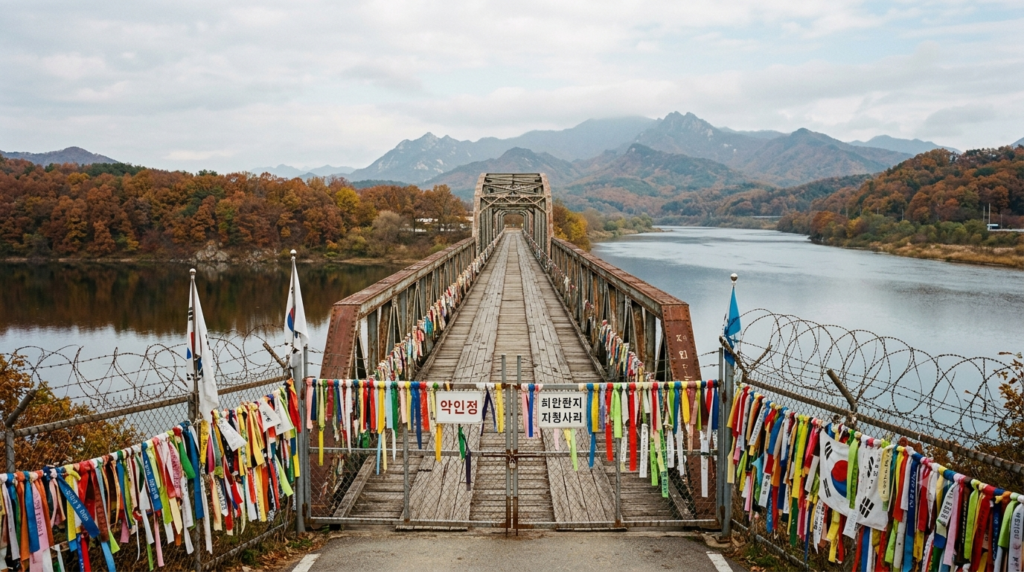
Today, visitors cannot walk onto the bridge itself. A fence marks its entrance, and that fence has, over the decades, become something else entirely — a canvas of collective longing. Thousands of colorful ribbons, handwritten notes, national flags, and photographs are tied along its length, left by visitors hoping for eventual reunification between North and South. Reading even a handful of these messages, many written by elderly visitors whose families remain divided, tends to leave a stronger impression than any placard or exhibit could.
The History Behind Freedom Bridge
The Korean War and the Armistice Agreement (1953)
To understand Freedom Bridge, it helps to understand the war that created the need for it. The Korean War broke out in June 1950, when North Korean forces crossed the 38th parallel into the South, triggering a conflict that would eventually draw in United Nations forces, Chinese troops, and Soviet support for the North. Over three brutal years, the war killed or displaced millions of people, flattened cities, and separated countless families — many of whom remain separated to this day.
The war didn’t end with a peace treaty. It ended with an armistice: a ceasefire agreement signed on July 27, 1953, at Panmunjom, between the United Nations Command, the North Korean Army, and Chinese People’s Volunteers. That document established the Military Demarcation Line and the 4-kilometer-wide, 250-kilometer-long Demilitarized Zone that still separates the two Koreas today. Because no formal peace treaty was ever signed, North and South Korea remain, technically, in a state of war — a fact that gives Freedom Bridge an unusual kind of relevance. It isn’t simply a memorial to a finished conflict; it’s a marker within an ongoing, unresolved one.
The Prisoner Exchange — Thousands Crossing to Freedom
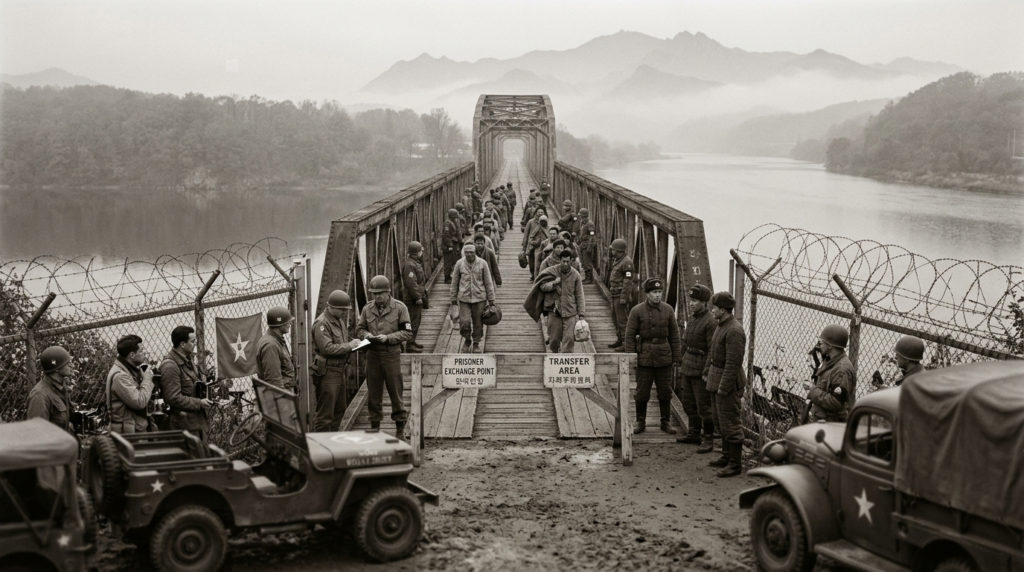
In the weeks immediately following the armistice, attention turned to one of the war’s most human elements: the prisoners held on both sides. Under the terms of the agreement, a large-scale exchange was organized, and Freedom Bridge became its physical stage. Records place the number at approximately 12,773 Korean and United Nations forces personnel who crossed the bridge on foot after arriving by rail along the Gyeongui Line.
These weren’t simple, orderly walks. Many of the returning prisoners arrived injured, malnourished, or suffering the after-effects of years in captivity. Photographs and accounts from the period describe men being helped across by comrades, others walking slowly and unsteadily, some collapsing the moment they reached South Korean soil. For families waiting on the other side — many of whom had received no word of their loved ones’ fates for years — the bridge became the literal threshold between not knowing and knowing, between war and whatever came next.
It’s worth pausing on why this detail matters so much to the site’s meaning today. Freedom Bridge isn’t a monument to strategy, territory, or military victory. It’s a monument to individual human return — to the specific, unglamorous, deeply personal act of walking home after captivity. That distinction is part of why the site continues to draw quiet, reflective visitors rather than crowds seeking dramatic photo opportunities.
From Railroad Bridge to War Memorial
Before the war, the structure now known as Freedom Bridge was part of the Gyeongui Line, a railroad connecting Seoul to Sinuiju near the Chinese border — a vital transportation link across the peninsula. Wartime bombing destroyed the original twin bridges, leaving only their stone piers standing in the river, stark and skeletal. When the prisoner exchange became necessary, the western span was rebuilt specifically for that purpose, with a temporary wooden structure added at its southern end to complete the crossing.
The bridge visitors see today — a mixed wood-and-steel structure spanning roughly 83 meters across six sections — is that restored 1953 structure. It was never returned to active rail service. Instead, it was preserved deliberately, as a physical artifact of the exchange rather than a functioning transportation link. Nearby, the original Gyeongui Line bridge ruins remain visible as well, offering a striking visual contrast: one bridge destroyed by war and left as ruins, the other rebuilt and repurposed as a symbol of what survived it.
What Freedom Bridge Symbolizes Today
A Site of Mourning — Mangbaedan Altar and Separated Families
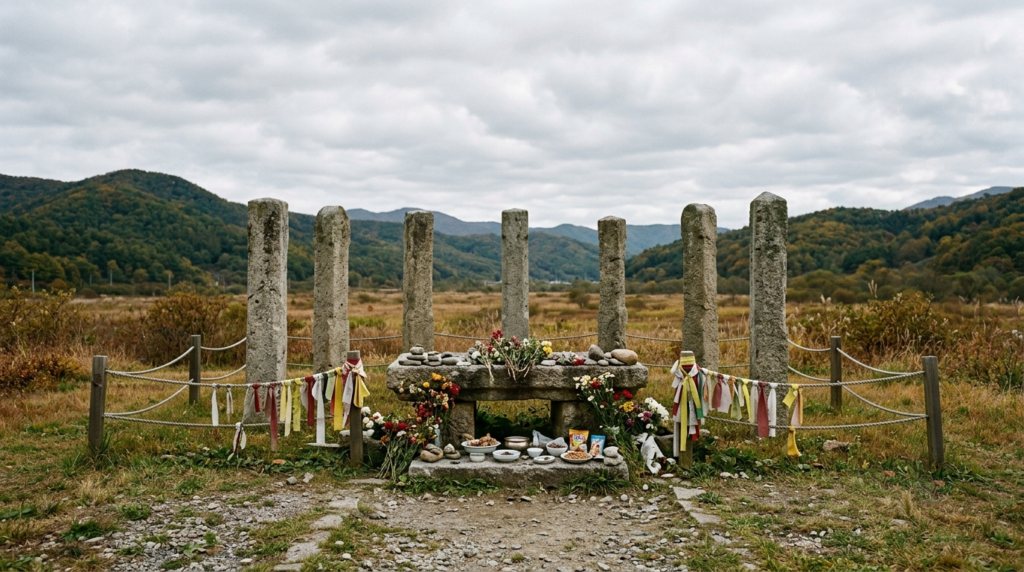
Standing directly in front of Freedom Bridge is the Mangbaedan Altar, one of the most emotionally charged structures in the entire Imjingak complex. It consists of seven sculpted stone pillars arranged to face north, toward the family homes, villages, and gravesites that countless displaced Koreans have never been able to return to. For those separated from relatives in North Korea during the war — a population that, even now, includes elderly survivors in their eighties and nineties — this altar has become something close to a substitute gravesite.
On major Korean holidays like Lunar New Year (Seollal) and Chuseok, when tradition calls for families to visit ancestral graves and perform memorial rites, separated families gather here instead. They bow toward the north, make small offerings of food, and observe rituals meant for relatives they cannot reach, on land they cannot cross into. It’s a practice built entirely out of necessity — a workaround for a division that shows no sign of resolving within the lifetimes of the people most affected by it. Visiting Freedom Bridge without registering the weight of this altar means missing much of what makes the site significant; the two are, in practice, inseparable.
Annual Unification Events and Ceremonies Held Here
Imjingak Park and Freedom Bridge are not static, roped-off relics — they remain active sites for public memory and political expression. Ceremonies are regularly held here, particularly around the anniversary of the Armistice Agreement each July, as well as around major national holidays. These events bring together separated families, Korean War veterans’ organizations, government officials, and sometimes international delegations, all gathering at the same fence where prisoners once crossed to freedom.
These ceremonies serve a dual purpose: they honor the historical event the bridge commemorates, and they keep the broader conversation about Korean reunification visible in public life. For a visitor who happens to arrive during one of these events, the experience shifts considerably — from quiet historical reflection to witnessing, in real time, a living political and emotional issue that continues to shape South Korean society.
A Reminder of Korea’s Ongoing Division
Because the Korean War concluded in armistice rather than treaty, the peninsula remains, in a strict legal sense, still at war. This is easy to state as a historical fact, but Freedom Bridge makes it tangible in a way that textbooks rarely manage. Here is a bridge explicitly built to carry people toward liberty — and yet it still marks the edge of a boundary that the overwhelming majority of Koreans, and nearly all their descendants, will never be permitted to cross in the other direction.
For international visitors, particularly those arriving with a mostly modern impression of South Korea shaped by K-pop, technology, and cosmopolitan Seoul, standing at this fence tends to recalibrate that picture considerably. It’s one thing to know intellectually that North and South Korea remain divided. It’s another to stand at a physical checkpoint where that division is enforced, visible, and unresolved in real time.
Freedom Bridge and Korean Culture
The DMZ in Korean Storytelling
The DMZ and its surrounding sites have become a recurring backdrop in Korean film and television — not simply for visual novelty, but because the region carries built-in symbolic weight. Stories set here almost automatically engage themes of separation, loss, longing, and the possibility (or impossibility) of reunion, whether between former lovers, estranged family members, or divided nations.
The Netflix series Crash Landing on You remains one of the most widely recognized examples internationally. The show follows a South Korean businesswoman who accidentally paraglides into North Korean territory and falls in love with a North Korean officer who helps shelter her. While the drama’s actual border-crossing sequences weren’t filmed at the real DMZ — for obvious security reasons — the production leaned heavily on the region’s real symbolism to ground its central love story in something recognizably, historically weighty. The DMZ in the show functions almost as a character itself: a space defined by danger, secrecy, and the ache of division.
Why the Site Resonates With K-Drama Fans Visiting Korea
For fans making a pilgrimage to Korean drama filming locations, the DMZ region offers a different kind of stop than the palaces, cafés, and shopping streets that dominate most K-drama location guides. Nearby Camp Greaves — a former U.S. military base now repurposed as a peace and security exhibition space, accessible via the Imjingak gondola — served as a filming location for the popular military romance Descendants of the Sun, and has since become a recognizable stop for fans tracing the show’s real-world settings.
Pairing a visit to Freedom Bridge with a stop at Camp Greaves offers a layered experience: the fictional romance of a beloved drama sitting alongside the very real history that shaped the landscape it was filmed in. For many fans, this combination adds unexpected emotional depth to a trip that might otherwise stay firmly in pop-culture territory — a reminder that the themes of division and longing so common in Korean storytelling aren’t invented out of nowhere. They’re drawn directly from the country’s lived history, and Freedom Bridge sits close to the source.
What You’ll See at Freedom Bridge and Imjingak Park
The Bridge Itself (What’s Visible vs. Off-Limits)
Visitors can walk right up to the fenced entrance of Freedom Bridge, though crossing it is not permitted under any circumstances — this is a preserved historical structure, not a functioning walkway. What draws most visitors’ attention isn’t the bridge’s engineering, but the fence in front of it: a dense, colorful accumulation of ribbons, prayer flags, handwritten notes, and photographs left by people hoping for reunification. Some notes are decades old and faded; others are clearly recent. Taking the time to read even a few of them — many written in careful, deliberate handwriting — tends to leave a longer-lasting impression than the bridge’s physical structure alone.
Mangbaedan Altar
Positioned just in front of the bridge, this stone memorial altar is where separated families conduct ancestral rites facing north, toward the homes and relatives they can’t reach. Even outside of major holidays, it’s common to see fresh flowers, small food offerings, or a lone visitor standing quietly in front of the stones. Photographers should approach this area with particular sensitivity — for many Koreans, this is not a scenic backdrop but an active, personal site of grief.
The Korean War Locomotive (“The Last Train”)

A short walk from the bridge sits one of the park’s most visually arresting exhibits: a rusted, bullet-riddled steam locomotive, frozen in the exact damaged state it was left in decades ago. This is the same train that was stranded and deliberately disabled near the border in 1950 to prevent it from falling into North Korean hands during the chaos of the war’s early months. Riddled with over a thousand bullet holes and left exposed to the elements for years, it was formally registered as a Cultural Heritage site in 2004 and remains one of the most photographed relics in the entire park — a striking, almost surreal visual reminder of how abruptly ordinary life was interrupted by the conflict.
Dokgae (Gyeongui Line) Railroad Bridge Ruins
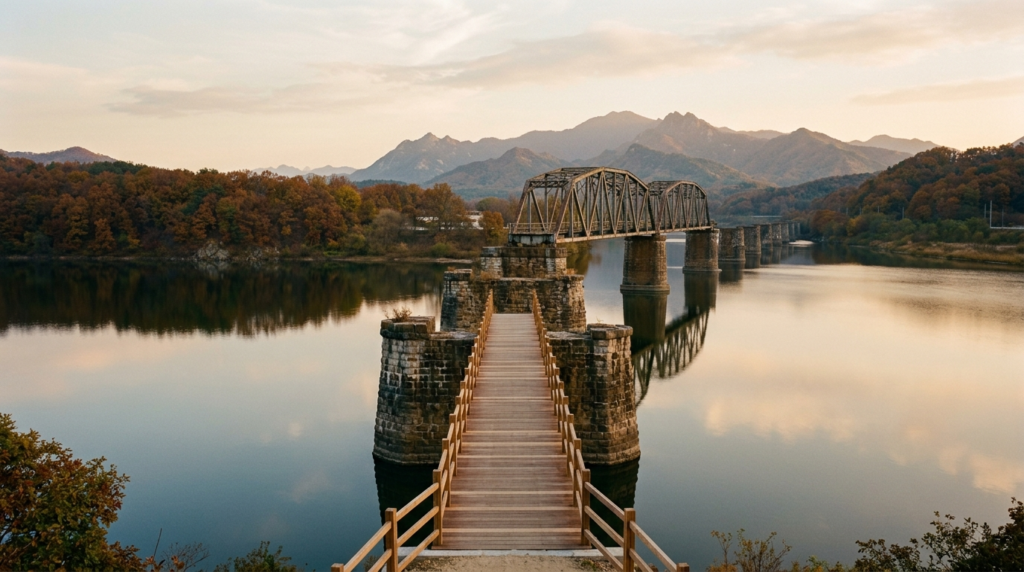
Immediately adjacent to Freedom Bridge are the ruins of the original Gyeongui Line railroad bridge — the structure destroyed by wartime bombing before Freedom Bridge was rebuilt for the prisoner exchange. Only the stone piers remain, rising out of the river in a broken, skeletal line. For an additional fee, visitors can walk out onto a restored wooden walkway built along part of this original path, offering open, unobstructed views across the Imjin River toward the hills beyond. Seeing the two structures side by side — one destroyed and left as ruins, the other rebuilt and repurposed — makes for one of the most visually effective illustrations of the site’s dual themes: destruction and survival, loss and return.
Peace Bell and Unification Park
Rounding out the complex, the Peace Bell is rung during unification ceremonies and stands as a hopeful counterpoint to the site’s heavier memorials. The surrounding grounds include open memorial spaces and monuments dedicated to UN forces and Korean veterans who served during the war, giving visitors room to walk, reflect, and take in the broader scale of the park at their own pace before or after focusing on Freedom Bridge itself.
How to Visit Freedom Bridge: A Practical Guide
Can You Visit Independently, or Do You Need a Tour?
One of the most common misconceptions among first-time visitors is that anything associated with the DMZ automatically requires a security-cleared guide, passport registration, and weeks of advance planning. That’s true for the more restricted zones — but not for Imjingak Park and Freedom Bridge. This section of the site sits just outside the Civilian Control Line, which means it’s open to the general public with no advance booking, no passport check, and no guide requirement. You can walk in, spend as much time as you like at the bridge and altar, and leave entirely on your own schedule.
This distinction matters for trip planning. If your main interest is Freedom Bridge, the locomotive, and the Mangbaedan Altar specifically, you genuinely don’t need to book a formal DMZ tour at all — a self-guided day trip works perfectly well. However, if you also want to see sites further inside the restricted zone — the Third Tunnel of Infiltration, Dora Observatory, or the Joint Security Area (JSA) — those require a licensed tour operator, advance registration, and a passport for entry, since they sit within the Civilian Control Zone or the DMZ itself.
Best DMZ Tours That Include Freedom Bridge

Most half-day and full-day DMZ tours departing from Seoul include Imjingak and Freedom Bridge as a standard stop, typically bundled with the Third Tunnel, Dora Observatory, and sometimes Dorasan Station or the Gamaksan Suspension Bridge. The catch is that on many standard itineraries, Imjingak is treated as a brief stop — sometimes just a lunch break or a 15-minute photo opportunity before moving on to the more heavily marketed tunnel and observatory sites.
If Freedom Bridge and its surrounding memorials are your priority rather than an afterthought, it’s worth specifically looking for tours that allocate meaningful time at Imjingak, or considering a self-guided visit followed by a separate half-day tour for the restricted DMZ sites. Reading tour itineraries closely before booking — rather than assuming all “DMZ tours” offer the same pacing — will save you from rushing through the site’s most meaningful areas.
Getting There From Seoul (Train, Bus, Tour Pickup)
There are three practical ways to reach Freedom Bridge from central Seoul:
- By tour bus: Most DMZ tour operators offer direct pickup from central Seoul locations, making this the most convenient option if you’re also visiting restricted zones on the same trip.
- By train and local bus: Take a train to Munsan Station, then transfer to a local bus or taxi for the final 10–15 minute leg to Imjingak Pavilion. This route is ideal for travelers who prefer a self-guided, independent visit without joining an organized tour.
- By private car or taxi: Imjingak is roughly a one-hour drive from central Seoul, covering approximately 55 kilometers (35 miles) north, mostly along well-maintained highways.
Hours, Admission, and Entry Requirements
Admission to Imjingak Park, including Freedom Bridge, the Mangbaedan Altar, and the locomotive display, is free of charge. Parking fees apply for those arriving by private car. No passport or advance registration is required to enter the park itself — that requirement only applies to tours continuing into the more restricted DMZ zones beyond Imjingak’s boundary.
Best Time to Visit
Weekday mornings tend to offer the quietest, most reflective experience, especially outside of Korean public holidays, when the park draws significantly larger crowds for unification ceremonies and family gatherings. Spring and autumn provide the most comfortable weather for spending extended time walking the open grounds, while summer can bring heat and humidity, and winter can be bitterly cold given the site’s exposed, riverside location.
Tips for Visiting Freedom Bridge and the DMZ
- Bring your passport regardless of your plan for the day. Even though it isn’t required for Imjingak itself, it’s mandatory for any add-on tour continuing into the Civilian Control Zone, and having it on hand avoids missing a last-minute opportunity to extend your visit.
- Dress conservatively and comfortably. This is an active memorial and mourning site for many Korean families, not a casual photo backdrop — modest, respectful clothing is appropriate, and comfortable walking shoes matter given the amount of open ground to cover.
- Understand photography restrictions before you go. While Imjingak Park and Freedom Bridge allow photography freely, restricted DMZ zones like the Third Tunnel prohibit it entirely, and JSA tours enforce strict rules about where and when cameras can be used.
- Book restricted-zone tours well in advance. Sites requiring security clearance, particularly the JSA, often have limited daily visitor quotas and can be booked out days or weeks ahead, especially during peak travel seasons.
- Set aside more time than you think you’ll need. Rushed group tour schedules can limit your time at Freedom Bridge to as little as 15–20 minutes; an independent visit allows for a slower pace that better suits the reflective nature of the site.
- Approach the Mangbaedan Altar with sensitivity. Avoid loud conversation, posed photography, or treating the altar area as a casual backdrop — for many visitors present, this is a genuine site of personal grief.
Nearby Attractions to Combine With Your Visit

- Gamaksan Suspension Bridge (Gloucester Heroes Bridge) — A scenic 150-meter suspension bridge offering mountain and valley views, with hiking trail access for those wanting to extend their day beyond the memorial sites.
- The Third Tunnel of Infiltration — One of four tunnels discovered beneath the DMZ, dug by North Korea as a potential invasion route; accessible only via licensed tour.
- Dora Observatory — The northernmost observation point accessible in South Korea, offering telescope views into North Korean territory and villages.
- Camp Greaves — A former U.S. military base turned peace and security exhibition space, also recognized as a filming location for Descendants of the Sun.
- War Memorial of Korea (Seoul) — For travelers wanting deeper historical context before or after a DMZ day trip, this Seoul museum offers an extensive, well-curated overview of the Korean War.
Frequently Asked Questions
Is Freedom Bridge open to the public?
Yes. Freedom Bridge and the surrounding Imjingak Park are open to the public year-round, with free admission and no passport or tour requirement for entry.
Can you walk across Freedom Bridge?
No. The bridge is fenced off for preservation as a historical structure; visitors can view it closely and read the ribbons and messages left on the fence, but cannot cross onto the bridge itself.
How far is Freedom Bridge from Seoul?
Approximately 55 kilometers (35 miles) north of central Seoul, roughly a one-hour drive, or a combination train-and-bus journey via Munsan Station.
Do you need a passport to visit?
Not for Imjingak Park itself, but a passport is required for any tour continuing into the Civilian Control Zone or restricted DMZ areas, including the JSA and Third Tunnel.
Is Freedom Bridge the same as the JSA or Panmunjom?
No. Freedom Bridge is located at Imjingak, just outside the restricted DMZ zone, while the Joint Security Area (JSA) and Panmunjom sit inside the DMZ itself and require separate, heavily regulated tour access with advance security clearance.
Freedom Bridge doesn’t rely on scale or spectacle to make its impression — its power comes entirely from what it represents. A single crossing point between captivity and liberty, still standing more than seven decades after the guns of the Korean War fell silent, it offers something few other stops on a South Korea itinerary can match: a direct, physical connection to a history that remains, in a very real sense, unfinished.
Whether you’re drawn here by an interest in Korean War history, a desire to understand the peninsula’s ongoing division beyond headlines and textbooks, or simply looking to add meaningful depth to a trip otherwise filled with palaces, cafés, and shopping streets, Freedom Bridge rewards visitors who take the time to slow down and really look — at the ribbons on the fence, the stones of the altar, the bullet holes in the old locomotive.
If you’re planning a DMZ day trip, consider pairing this visit with our guides to nearby Korean War sites and other Gyeonggi Province attractions to round out a full day of thoughtful, well-paced travel.