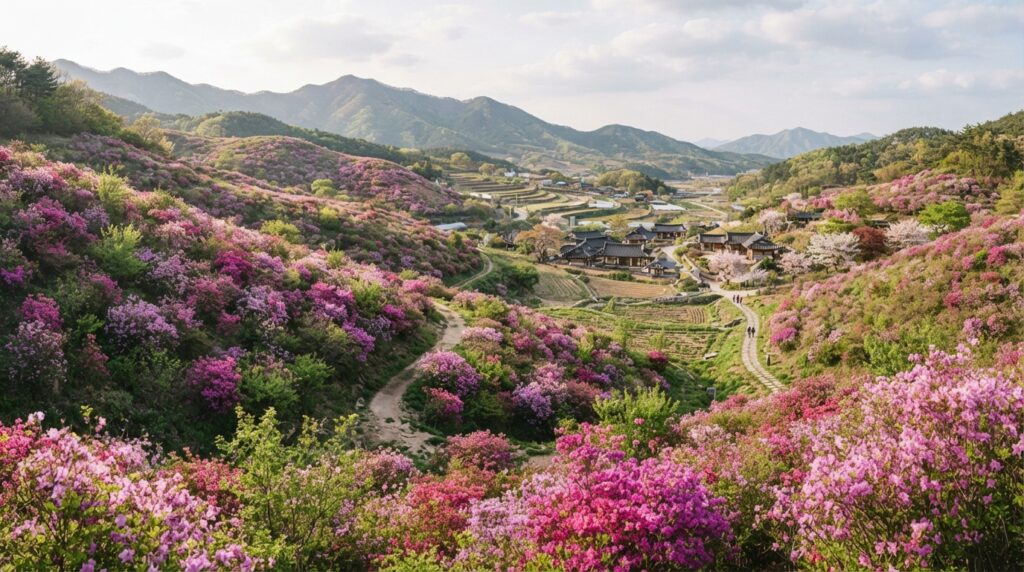
Imagine standing on a Korean mountainside in early April. The air is still cool, carrying the last whisper of winter, but everywhere you look, the hills are on fire — not with flame, but with thousands upon thousands of deep pink blooms cascading down the ridgeline like a living waterfall of color. Women in pastel hanbok pause to take photographs. Hikers stop mid-trail, breathless — not from the climb, but from the view. The Korean azalea has arrived, and with it, spring has truly begun.
Few flowers anywhere in the world carry the cultural weight that the Korean azalea carries on the Korean Peninsula. Known in Korean as jindallae (진달래), this remarkable bloom is not simply a seasonal decoration. It is woven into the very fabric of Korean identity — appearing in the nation’s most beloved poetry, coloring its most celebrated festivals, flavoring its most treasured spring foods, and framing countless emotional moments in K-dramas watched by millions across the globe.
Whether you are planning a spring trip to Korea, exploring Korean culture through its art and literature, or simply curious about the flower that appears again and again in everything from ancient folk songs to modern television dramas, this guide will take you deep into the world of the Korean azalea — its meaning, its magic, and why it continues to captivate hearts across generations.
What Is the Korean Azalea? Botanical and Cultural Identity
The Science Behind the Bloom
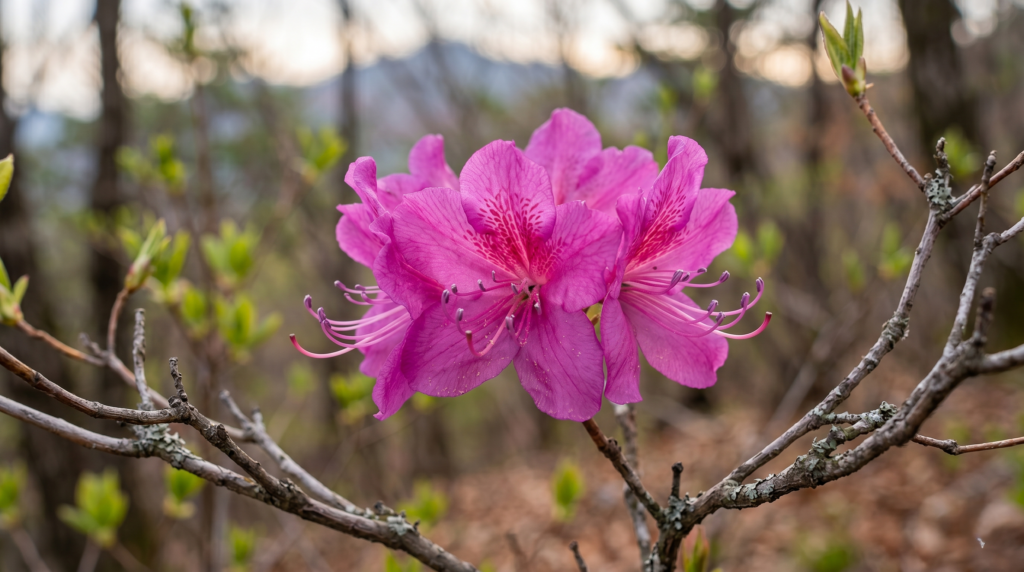
The Korean azalea belongs to the species Rhododendron mucronulatum, commonly known in the West as the Korean rosebay or Korean rhododendron. It is native to the Korean Peninsula, where it grows wild across mountain slopes, forest edges, and open hillsides, as well as in parts of northeastern China (Manchuria) and northern Japan.
What makes this flower visually extraordinary is one unusual botanical trait: it blooms before its leaves appear. In late March and early April, when the trees are still bare and the landscape remains largely brown from winter, the Korean azalea erupts in color — a shock of vivid pink against skeletal branches and pale sky. This leafless blooming gives the flower an almost otherworldly quality, as though the color itself has arrived ahead of the season, impatient and bold.
The flowers range in color from soft lilac-pink to deep magenta, with wild mountain varieties typically displaying a more saturated, jewel-like hue compared to cultivated garden types. The blooms are funnel-shaped, delicate in texture, and appear in clusters of two to six per stem, creating the dense, lush effect that makes Korean hillsides so visually spectacular during peak bloom season.
What Koreans Call It — Jindallae (진달래)
In Korea, the distinction between azalea species is not merely botanical — it is cultural and practical in equal measure. Two azalea species dominate the Korean landscape: jindallae (진달래), the wild Korean azalea, and cheoljjuk (철쭉), the royal azalea.
The jindallae blooms first, typically in late March to mid-April. Its flowers are edible and have been used in Korean cuisine and traditional rituals for centuries. The cheoljjuk, which blooms slightly later in April and May, is larger and more ornamental, but its flowers contain grayanotoxins — making it toxic if consumed.
This distinction matters deeply in Korean culture. The jindallae is the flower of the people: wild, free, edible, and emotionally resonant. The cheoljjuk is admired from a distance. When Koreans write poetry about azaleas, when they sing folk songs about spring longing, when they gather petals for traditional rice cakes, it is almost always the jindallae they mean. The name itself — soft, lyrical, beginning with that gentle jin sound — carries emotional warmth in Korean that is difficult to fully translate into another language.
The Deep Cultural Symbolism of the Korean Azalea
A Flower Rooted in Korean Poetry and Literature
No discussion of the Korean azalea is complete without Kim Sowol’s “Azaleas” (진달래꽃), written in 1922 and widely regarded as one of the most beloved poems in the Korean language. Generations of Korean schoolchildren have memorized its lines. Couples have quoted it. Musicians have set it to song. It is, in many ways, the emotional core of what the jindallae means to Korean people.
The poem is written from the perspective of someone bidding farewell to a departing lover — not with anger or tears, but with a quiet, aching grace. The speaker promises to scatter azalea petals along the path of the one who is leaving, so that they may walk away gently, in beauty, without pain. It is a poem about love expressed through sacrifice, about devotion that asks for nothing in return.
Through Kim Sowol’s words, the Korean azalea became permanently associated with silent devotion, graceful sorrow, and enduring love. These themes recur throughout classical sijo (traditional Korean short poetry) and folk songs, where the azalea appears consistently as a symbol of the emotions too large and too tender to be spoken aloud — the feelings that can only be expressed by scattering flowers on the road.
National and Patriotic Symbolism
Beyond romance and personal emotion, the Korean azalea carries a powerful dimension of national and patriotic feeling. Its blooming season coincides with the March 1st Independence Movement of 1919 — one of the most significant moments in Korean history, when the Korean people rose up against Japanese colonial rule in a sweeping, nonviolent demonstration of national will.
In the decades that followed, the azalea became associated with the Korean spirit of resilience: beautiful under pressure, blooming even in harsh conditions, appearing each spring no matter what winter had brought. It entered school textbooks, national anthems, and the cultural imagination as a flower that represented not just the beauty of Korea’s landscape, but the endurance of its people.
Interestingly, North Korea developed its own azalea symbolism around a cultivated hybrid called kimjindallia, named in honor of Kim Il-sung. While its political context differs entirely from the South Korean cultural tradition, this parallel demonstrates just how deeply the azalea is embedded across the entire Korean Peninsula as a flower of national significance.
Symbolism in K-Dramas and Modern Media
For international audiences discovering Korean culture through the hallyu (Korean Wave), the azalea is a recurring visual and emotional signal in K-dramas. Directors and cinematographers use the flower deliberately: a confession scene filmed against a hillside of blooming jindallae; a farewell framed by falling pink petals; a character standing alone among azaleas as a visual metaphor for longing or transition.
In dramas set during spring, the azalea functions almost as a second language — one that Korean audiences read instinctively. When the flowers appear on screen, viewers understand: something emotionally significant is happening. Something is beginning, or ending, or being felt too deeply for words.
This visual grammar has extended into K-pop as well. Album covers, music video aesthetics, and concept photography frequently incorporate azalea imagery to evoke themes of youth, impermanence, and beauty that does not last — the classic Korean aesthetic concept of han (한), a bittersweet awareness of sorrow within beauty.
Korean Azalea Festivals — Where the Flower Comes Alive
Hwangmaesan Azalea Festival (황매산 철쭉제)
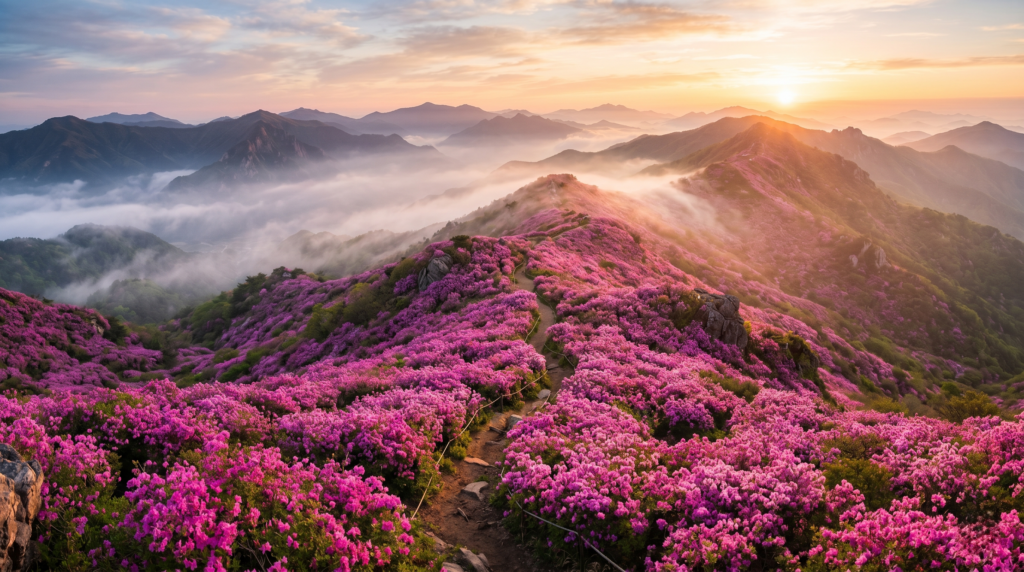
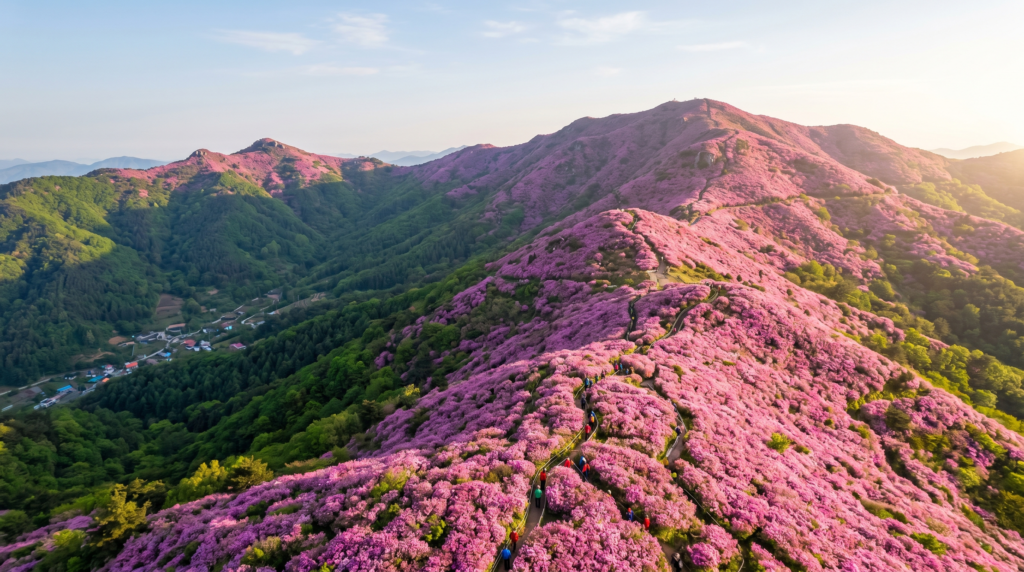
Among Korea’s many spring flower festivals, the Hwangmaesan Azalea Festival in South Gyeongsang Province stands in a category of its own. Hwangmaesan — literally “Yellow Plum Mountain” — transforms each spring into one of the most photographed landscapes in all of Korea, as its upper ridges become blanketed in a near-continuous carpet of azalea blooms stretching across the horizon.
The festival typically runs in late April to early May, coinciding with peak bloom at higher elevations. Visitors hike the mountain’s well-maintained trails past thousands of azalea bushes in full flower, with the ridgeline views offering sweeping panoramas of the surrounding valleys. The experience is genuinely breathtaking — a rare case where even the most spectacular photographs fail to fully capture what it feels like to stand inside that much concentrated color.
For the most dramatic experience, experienced visitors recommend sunrise hikes: arriving before dawn to watch the pink-covered ridgeline emerge from morning mist is widely described as one of the most memorable sights in Korean nature tourism. Weekends during peak bloom draw very large crowds, so weekday visits are preferable for those who want a more peaceful experience on the trails.
Cheongryeongsan Azalea Festival
The Cheongryeongsan Azalea Festival, held on the mountain of the same name straddling Gyeonggi Province, is an excellent option for visitors based in Seoul. Cheongryeongsan is accessible by public transportation, making it one of the more convenient azalea festival destinations for travelers who are not renting a car.
The festival features not just the natural bloom but also cultural performances, local food stalls, and organized hiking events. It draws a mix of local families, couples, and international tourists, creating a warm, festive atmosphere that balances natural beauty with cultural celebration. For first-time visitors to a Korean spring flower festival, Cheongryeongsan offers an accessible and richly enjoyable introduction.
Other Notable Azalea Bloom Spots Across Korea
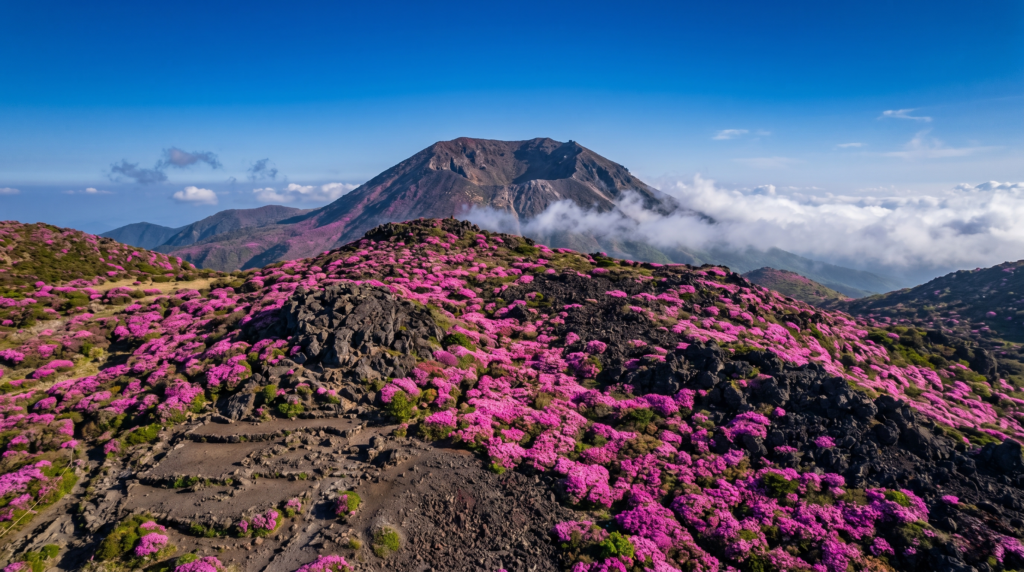
Korea’s azalea season unfolds across the entire country, and some of the most rewarding experiences are found beyond the formal festival sites:
| Location | Peak Bloom | Highlight |
|---|---|---|
| Hallasan, Jeju Island | Late April | High-altitude blooms; UNESCO World Heritage landscape |
| Inwangsan, Seoul | Early April | Urban hiking with city skyline views |
| Bugaksan, Seoul | Early–Mid April | Historic fortress walls lined with azaleas |
| Sobaeksan National Park | Late April–Early May | Mass ridge blooming across multiple peaks |
| Biseulsan, Daegu | Late April | Dense azalea forests; less crowded than major festivals |
Practical visitor tips for azalea festival season:
- Best months overall: Late March (low elevations, southern regions) through early May (high elevations, northern regions)
- What to wear: Layered clothing — mornings at altitude remain cold even in April; comfortable hiking shoes are essential
- Photography: Overcast days produce the most even, saturated light for azalea photography; midday harsh sun can wash out the delicate pink tones
- Crowds: Major festival weekends draw very large numbers; arriving early in the morning (before 9 a.m.) significantly improves both the experience and photo opportunities
- Accommodation: Book well in advance for the Hwangmaesan festival period — nearby towns fill up quickly during peak bloom weekends
The Korean Azalea in Food and Traditional Customs
Jindallae Hwajeon — Edible Azalea Rice Cakes
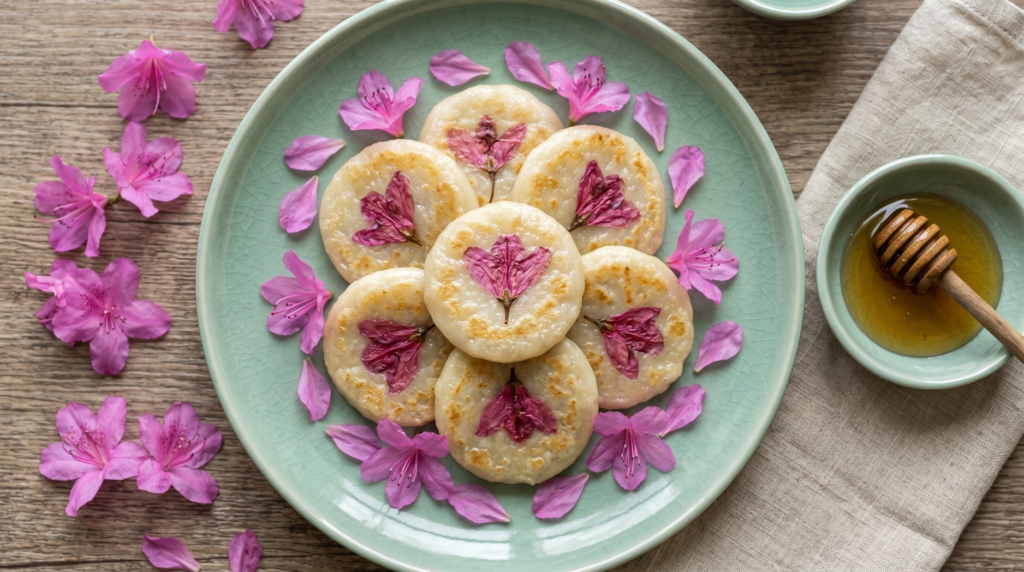
Of all the ways the Korean azalea intersects with daily life, perhaps none is more delightful — or more surprising to outsiders — than its role in traditional Korean cuisine. The jindallae is one of a small number of flowers in Korean food culture that moves beyond decoration to become an actual ingredient, and the dish it is most associated with is hwajeon (화전): beautiful, pan-fried rice flour pancakes pressed with flower petals.
Jindallae hwajeon is made by pressing fresh azalea petals onto small, round discs of glutinous rice flour dough, then pan-frying them gently in a lightly oiled pan until the edges turn golden and the petals soften into the surface of the cake. The result is something almost too pretty to eat — a pale, chewy round of rice cake wearing a crown of deep pink petals, typically sweetened with honey or a light sugar syrup. The flavor is subtle and floral, the texture soft and satisfying.
This dish is not a modern food trend. Hwajeon has been prepared in Korea for well over a thousand years, with records of flower-petal rice cakes appearing in historical texts from the Goryeo Dynasty (918–1392). It was traditionally associated with court cuisine and aristocratic yangban culture before becoming a beloved springtime folk food enjoyed by people across all social classes.
The traditional occasion for eating jindallae hwajeon is Samjinnal (삼짇날) — the third day of the third lunar month, one of Korea’s ancient seasonal holidays that celebrates the arrival of spring and the return of migratory swallows. On this day, it was customary for women and young girls to gather outdoors, pick fresh azalea petals, prepare hwajeon together, play traditional outdoor games, and celebrate the turning of the season with food, song, and company.
It is worth emphasizing one critical distinction: only jindallae (진달래) petals are safe to eat. The cheoljjuk (철쭉) azalea, which blooms slightly later and is often confused with the jindallae by those unfamiliar with the difference, contains grayanotoxins that can cause serious illness if ingested. Traditional Korean knowledge of this distinction was passed down through generations as a matter of basic food safety. Any modern attempt to prepare azalea-based dishes should carefully confirm the species before use.
Azalea in Folk Medicine and Traditional Korean Wellness
Within Korea’s traditional herbal medicine system — hanbang (한방) — the jindallae azalea appears in historical records as a plant with medicinal applications. Historical sources reference the use of azalea roots and bark in preparations intended to address conditions related to circulation and respiratory health, reflecting the broader hanbang principle of aligning the body’s rhythms with the seasons.
It is important to note, however, that the Korean azalea is not a widely used or recommended medicinal plant in contemporary Korean traditional medicine practice. The gap between historical folk use and modern validated application is significant, and the toxicity risks associated with the broader azalea family mean that any medicinal use should be approached with great caution and professional guidance. The cultural and historical interest of the azalea’s place in hanbang tradition is genuine — but it belongs firmly in the category of ethnobotanical history rather than practical wellness advice.
Spring Rituals and the Azalea’s Role in Seasonal Celebrations
Beyond hwajeon and Samjinnal, the Korean azalea participates in a broader cultural calendar of spring rituals rooted in Korea’s deep tradition of jeolgi — seasonal foods and customs aligned with nature’s own rhythms. Korean culture has historically maintained a finely tuned attentiveness to the changing seasons, with specific foods, activities, and ceremonies assigned to each moment in the natural year.
The arrival of azalea season signals not just a change in temperature but a cultural shift: the time for winter’s quietude is over, and the season for gathering, celebrating, and expressing gratitude for the renewal of life has begun. Families still picnic beneath blooming azalea hills in spring. Young couples photograph themselves against pink hillsides as a modern continuation of the tradition of celebrating jindallae season together. Food markets in spring stock fresh azalea petals for home cooking. The flower’s presence in Korean life in spring is, even today, genuinely pervasive.
Growing and Appreciating Korean Azaleas Outside Korea
Can You Grow Korean Azalea at Home?
For gardeners and Korean culture enthusiasts outside the peninsula, the good news is that Rhododendron mucronulatum — the Korean azalea — is one of the more adaptable and cold-hardy members of the rhododendron family, making it a genuinely rewarding choice for temperate gardens around the world.
Growing conditions to know:
- Hardiness: Rhododendron mucronulatum is cold-hardy to approximately USDA Zone 4 (–34°C / –30°F), making it suitable for gardens across much of the northern United States, Canada, the United Kingdom, and northern Europe
- Sunlight: Prefers full sun to partial shade; more sun generally produces more abundant flowering, though afternoon shade in hotter climates protects the flowers
- Soil: Like all rhododendrons, it requires well-drained, acidic soil (pH 4.5–6.0); it will not thrive in alkaline or waterlogged conditions
- Watering: Moderate moisture is ideal; the plant is reasonably drought-tolerant once established but benefits from consistent watering during dry spring periods
- Pruning: Minimal pruning required; if shaping is needed, prune immediately after flowering to avoid cutting off next year’s buds
- Bloom time outside Korea: In the UK and northeastern United States, expect blooms from late February to early April — often among the first garden shrubs to flower in the new year
Korean azalea plants and seeds are available through specialist rhododendron nurseries in the United States, United Kingdom, and across Europe. When purchasing, look for the species name Rhododendron mucronulatum to ensure you are getting the authentic Korean variety rather than a hybrid cultivar that may lack the characteristic flower form.
Korean Azalea in Global Botanical Gardens
The Korean azalea has earned a place of genuine prestige in botanical institutions around the world, valued by horticulturalists for its exceptionally early bloom time and its dramatic visual impact in the early-spring garden.
The Royal Botanic Garden Edinburgh maintains a significant rhododendron collection that includes Korean azalea specimens, typically among the first to flower each spring and drawing considerable visitor attention for their vivid color against the Scottish winter landscape. The United States National Arboretum in Washington D.C. features Korean azaleas within its extensive azalea collection, where they bloom reliably each spring alongside hundreds of other azalea species and hybrids.
For international visitors and expat Koreans who cannot travel to Korea during azalea season, these botanical garden displays offer a meaningful connection to the flower’s beauty — and increasingly, botanical institutions worldwide are expanding their Korean plant collections as interest in Korean culture and horticulture grows alongside the global reach of the hallyu wave.
Why the Korean Azalea Endures as a Cultural Icon
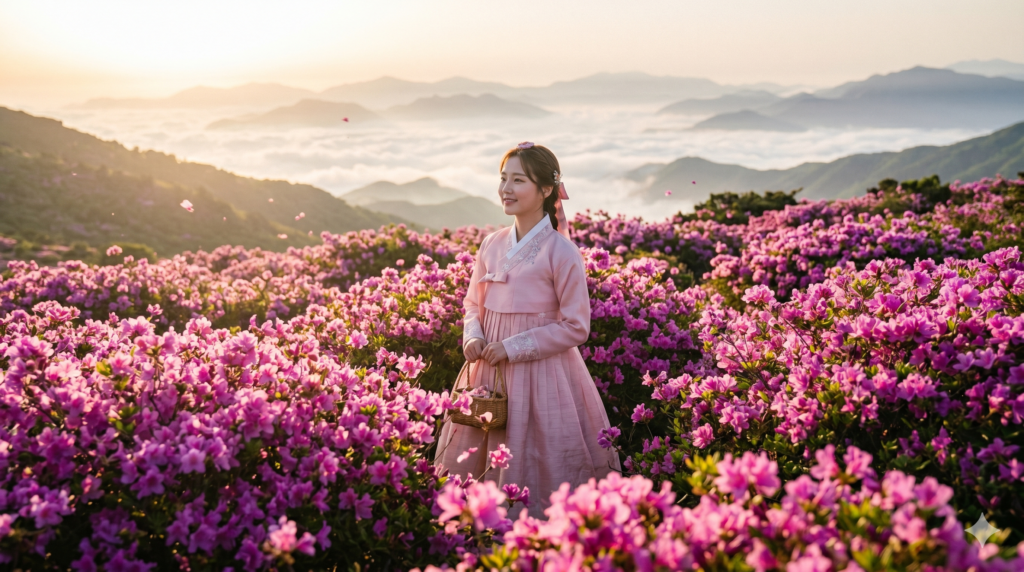
In a world of accelerating change, it is worth pausing to ask: what is it about one wild mountain flower that allows it to remain so central to Korean cultural life across more than a thousand years of history?
The answer, perhaps, lies in what the Korean azalea represents at its deepest level. It blooms without its leaves — vulnerably, entirely, without the protection of foliage — as if willing to be seen completely, without guard. It arrives at the most uncertain moment of the year, when winter has not fully released its hold and spring has not yet confirmed its arrival, and it colors the bare hillsides with an almost defiant beauty. It is edible, wearable, singable, paintable, and filmable. It asks nothing of the people who love it, and gives everything it has in the brief weeks of its flowering.
Kim Sowol understood this. The Samjinnal celebrants of the Goryeo Dynasty understood it. The K-drama directors who frame their most emotional scenes in pink azalea light understand it. And the hikers who stand breathless on Hwangmaesan’s blooming ridgeline at sunrise, unable to speak, understand it too.
The Korean azalea endures as a cultural icon because it tells the truth about something universal — that beauty is most powerful when it is temporary, that love is most moving when it is given without guarantee of return, and that spring, after every winter, is always worth waiting for.
In contemporary Korea, this endurance takes practical, living forms. The jindallae still appears in school curricula, where Kim Sowol’s poem is taught as foundational literature. It appears in wedding traditions, where azalea imagery represents devotion and new beginnings. It drives seasonal tourism that brings hundreds of thousands of visitors to Korea’s mountain festivals each spring. And it continues to appear in the visual language of K-dramas and K-pop, carrying its ancient emotional weight into the streaming era — reaching audiences in São Paulo, Paris, Jakarta, and Los Angeles who may never have heard of Samjinnal but who feel, instinctively, what those pink blooms mean when they appear on screen.
As global interest in Korean nature tourism grows — accelerated by the cultural curiosity that the hallyu wave has generated — the azalea season is increasingly being recognized internationally as one of East Asia’s most spectacular and culturally rich spring experiences. Travel features, documentary segments, and social media content about Korean spring regularly feature the jindallae as a central attraction, introducing the flower to new audiences who come for the visual drama and stay for the story behind it.
Frequently Asked Questions About the Korean Azalea
Q1: What is the Korean azalea called in Korean? The Korean azalea is called jindallae (진달래) in Korean. This refers specifically to the wild, edible azalea (Rhododendron mucronulatum) that is beloved in Korean poetry, cuisine, and cultural tradition. It is distinct from the cheoljjuk (철쭉), a related but toxic ornamental azalea species that also grows widely across Korea.
Q2: Is the Korean azalea the national flower of Korea? No — Korea’s official national flower is the Mugunghwa (무궁화), or Rose of Sharon (Hibiscus syriacus), which symbolizes perseverance and eternity. However, the Korean azalea holds a depth of cultural, poetic, and emotional significance that arguably gives it an equally important place in Korean national identity. Where the Mugunghwa is the official symbol, the jindallae is the beloved one.
Q3: When do Korean azaleas bloom? Korean azaleas typically bloom from late March through early May, depending on location and altitude. Low-elevation areas in southern Korea and Jeju Island see the earliest blooms, often in late March. Higher-elevation sites such as Hwangmaesan and Sobaeksan reach peak bloom in late April to early May. Bloom timing also varies year to year based on winter temperatures and the pace of the spring warm-up.
Q4: Can you eat Korean azalea flowers? Yes — but only the jindallae (진달래) variety. The petals of Rhododendron mucronulatum are edible and have been used in Korean cuisine for centuries, most famously in jindallae hwajeon (azalea rice cakes). The cheoljjuk (철쭉) azalea, which blooms slightly later and is often mistaken for the jindallae, is toxic and must never be eaten. Always confirm the species before consuming any azalea.
Q5: What does the azalea symbolize in Korean culture? The Korean azalea symbolizes longing, silent devotion, enduring love, resilience, and the bittersweet beauty of spring. These meanings were most powerfully articulated through Kim Sowol’s 1922 poem “Azaleas” (진달래꽃), which associated the flower with graceful farewell and love that gives without expectation. The flower also carries patriotic associations of national resilience and the Korean spirit.
Q6: What famous Korean poem features the azalea? Kim Sowol’s “Azaleas” (진달래꽃), written in 1922, is the most famous Korean poem to feature the azalea and is widely considered one of the greatest works in the Korean literary canon. It is taught in Korean schools, memorized by generations of Koreans, and has been set to music multiple times. The poem uses the image of scattering azalea petals as a metaphor for selfless, aching love.
The Korean azalea is far more than a pretty spring flower. It is a living archive of Korean feeling — carrying within its brief, brilliant blooms centuries of poetry, protest, celebration, cuisine, and quiet devotion. From the bare mountain slopes of Hwangmaesan to the pages of Kim Sowol’s most tender verses, from the pan-fried hwajeon of Samjinnal to the emotional shorthand of K-drama cinematography, the jindallae has been present at the heart of Korean life in ways that few other natural symbols can claim.
For those who have never experienced Korean azalea season in person, it belongs firmly on the travel wish list — not simply as a visual spectacle, though the spectacle is genuinely extraordinary, but as a portal into a culture that has always known how to find meaning in the natural world. And for those exploring Korean culture from a distance, through its dramas, its poetry, or its cuisine, the azalea offers one of the most rewarding threads to follow — a single flower that, pulled gently, unravels something essential and beautiful about what it means to be Korean.
Spring in Korea waits for no one. But for those who arrive at the right moment, the hillsides remember them in pink.
Enjoyed this article? Explore more Korean seasonal traditions, spring festival guides, and cultural deep-dives across our site — and plan your own journey into the heart of Korean spring.