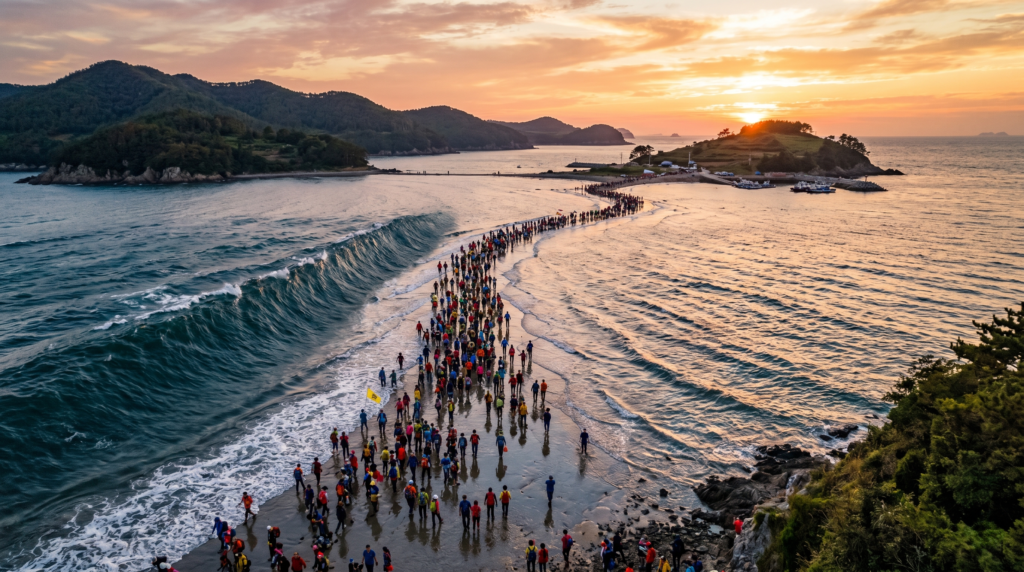
Imagine standing on the floor of the ocean. The sea has pulled back before you like a curtain being drawn open by invisible hands, revealing a sandy road stretching nearly three kilometers into the distance. On either side of you, walls of water rise quietly, and thousands of people walk alongside you — laughing, bending down to pick up crabs and shellfish, their voices rising into the salt-brushed air. This is not a scene from a Korean drama. This is real, it happens every year, and it happens on Jindo Island Korea.
Located at the southwesternmost edge of the Korean peninsula, Jindo Island is one of those rare destinations that manages to feel both mythical and deeply, authentically human. It is Korea’s third largest island, yet it remains remarkably free from the tourist overload that crowds Seoul, Busan, and Jeju. For Korean culture lovers, K-drama fans, and curious travelers looking to experience something genuinely unforgettable, Jindo is not just worth visiting — it is worth building an entire trip around.
This guide covers everything: the legendary Miracle Sea Road Festival, historic battle sites, UNESCO-recognized folk traditions, the iconic Korean Jindo dog, extraordinary local food, and practical travel tips to help you plan the perfect visit.
What Makes Jindo Island Korea So Special?
A Brief History and Geography of Jindo Island
Jindo Island sits in the Korea Strait within Jeollanam-do (South Jeolla Province), separated from the mainland by a narrow channel and connected today by the Jindo Bridge. The island spans approximately 364 square kilometers, making it the third largest island in South Korea after Jeju and Geoje.
But Jindo’s significance goes far beyond its size. This island carries the weight of history in a way few places in Korea can match. In 1597, during the Japanese invasions known as the Imjin War, Admiral Yi Sun-sin achieved one of the most staggering naval victories in world history here — defeating a Japanese fleet of over 300 ships with just 13 vessels at the Battle of Myeongnyang. That story of courage against impossible odds mirrors the spirit of the island itself: quiet, underestimated, and extraordinary.
The landscape of Jindo is shaped by its coastal geography — dramatic tidal flats, rocky cliffs, pine-covered hillsides, and expanses of sea that shift color depending on the season. The island has long been isolated enough to preserve traditions that have vanished elsewhere in Korea, which is precisely what makes it so valuable to anyone seeking authentic Korean cultural experiences.
Why Jindo Remains One of Korea’s Best-Kept Secrets
Most international tourists to South Korea follow a predictable circuit: Seoul, the DMZ, Gyeongju, Busan, and Jeju. Jindo Island rarely makes the list — and that is exactly why it should.
Unlike heavily commercialized tourist destinations, Jindo retains the texture of genuine Korean rural life. Fishing communities still work the tidal flats at dawn. Elderly women sing folk songs passed down through generations. The food is cooked in home kitchens and served at tables where the owner also sat an hour ago. There are no luxury hotel chains here, no Starbucks on every corner, no entrance fees to manufactured attractions.
For fans of Korean dramas and Korean culture, Jindo offers something K-dramas gesture toward but rarely capture in full: the Korea that existed before the Han River Miracle, the Korea of deep roots, communal identity, and a relationship with the natural world that is ancient and still alive. Jindo’s folk traditions are so significant that several have been designated UNESCO Intangible Cultural Heritage, placing the island on the same global stage as far more famous Korean landmarks.
The Jindo Miracle Sea Road Festival — Korea’s Own “Moses Miracle”
The Legend Behind the Sea Parting
Every great natural phenomenon deserves a great story, and Jindo’s is one of the most beautiful in all of Korean folklore.
Long ago, according to local legend, the villagers of Jindo were driven to Modo Island by a tiger that had been terrorizing the island. In the panic and chaos of the escape, an elderly woman named Grandma Ppong was left behind. Stranded and desperate, she prayed night after night to Yongwang, the Dragon King of the Sea, begging to be reunited with her family. Her prayers were so sincere, her longing so deep, that one morning the sea answered. The water parted, revealing a road of land that she walked across to reach her family on the other side.
The village people wept when they found her. And from that moment, the sea has parted in that place every year — a gift from the ocean to a woman who refused to give up hope.
This legend is not merely a charming tale. It is a window into the Korean spiritual tradition — a worldview where nature is not indifferent but responsive, where sincere human emotion can move the world itself. For anyone who has watched Korean dramas and felt the depth of feeling woven into Korean storytelling, this legend is a perfect expression of that same sensibility.
What Actually Happens During the Festival
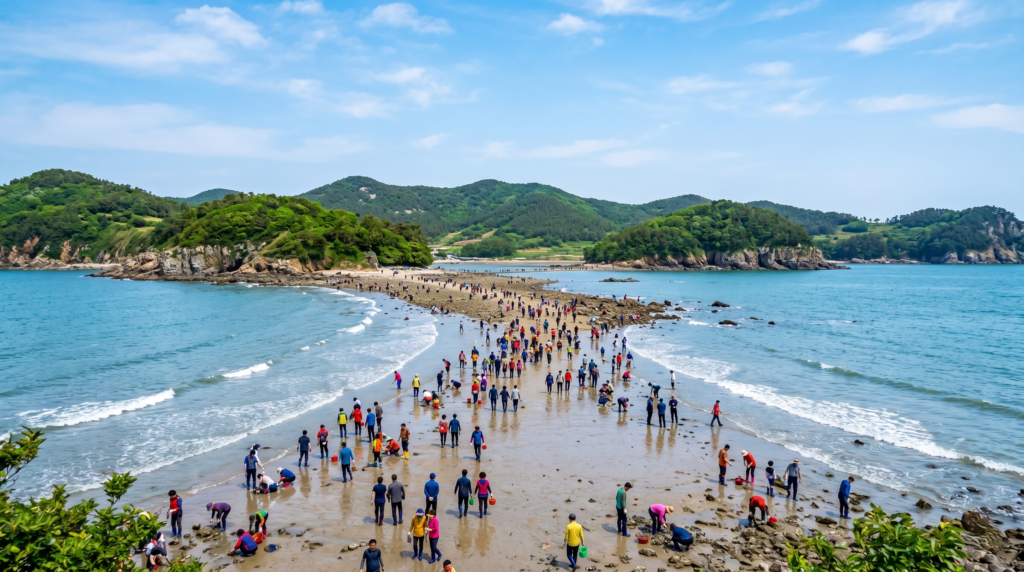
The mythological explanation is beautiful, but the scientific one is equally impressive. The Jindo sea parting is a genuine tidal phenomenon caused by the alignment of tidal forces and the specific underwater topography between Jindo and the small neighboring island of Modo. During certain days in spring, extreme low tides — driven by the gravitational pull of the sun and moon working in combination — cause the seabed to emerge, creating a natural land bridge approximately 2.8 kilometers long and up to 40 meters wide.
During the Uhangri Sea Parting Festival, this natural event becomes a full cultural celebration. Tens of thousands of visitors — Koreans and international travelers alike — gather on the shores of Jindo and Modo. As the water retreats, people step onto the exposed seabed and walk. The ocean floor is not bare sand but a living landscape: riddled with shellfish, sea cucumbers, crabs, and other marine life that visitors are welcome to collect by hand. Children squeal. Grandparents bend slowly, filling baskets. Photographers press forward to capture the walls of water on either side.
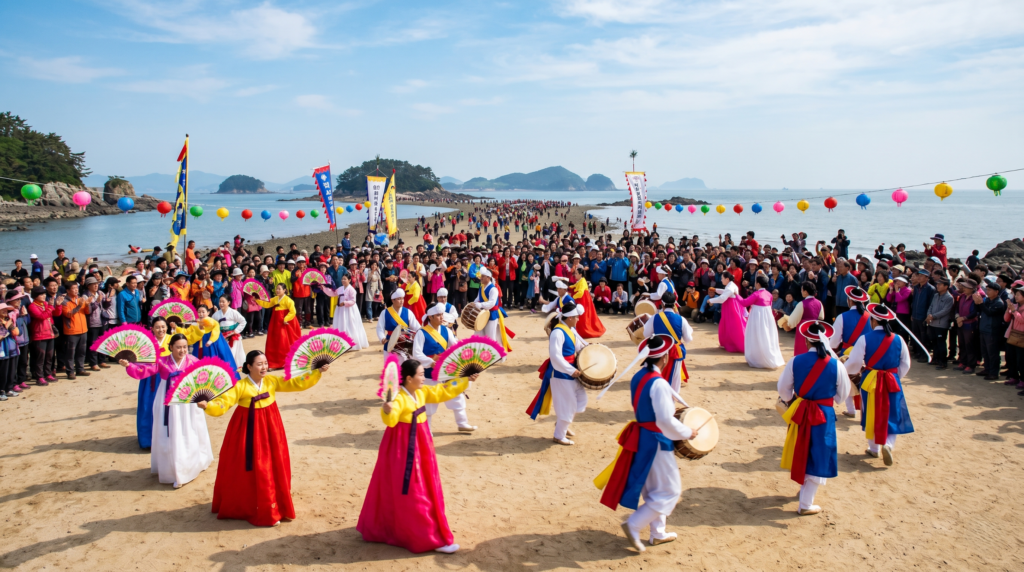
Around the festival grounds, the atmosphere is electric in the best possible way — traditional samulnori percussion performances, folk dancers in bright hanbok, vendors selling grilled seafood and Jeolla-style delicacies, and the kind of crowd energy that only comes from a shared experience of something genuinely miraculous.
Festival Dates, Timing, and How to Plan Your Visit
The Jindo Miracle Sea Road Festival is held annually, typically in late March or April, with the exact dates determined by the lunar calendar and tidal charts. The phenomenon occurs for approximately one hour during the lowest tidal point of the day, though the festival itself spans several days of cultural programming around the main event.
Because the dates shift each year, it is essential to check the official Jindo County website or the Korea Tourism Organization (KTO) website for confirmed annual dates before booking travel.
Planning tips for the festival:
- Arrive on the island at least one day before the sea parting to secure accommodation and get oriented
- On the day of the event, reach the shoreline 2–3 hours early — crowds swell quickly and the best viewing and walking positions go fast
- Wear waterproof shoes or sandals — the seabed is wet, uneven, and alive with marine life
- The sea road is open for roughly 40 minutes to one hour, so do not linger too long at the edges — walk confidently and turn back before the tide returns
- Check the weather forecast — while the event proceeds rain or shine, dry days make the experience far more enjoyable
Pro Tip: If you miss the main festival dates, smaller sea partings occur at Jindo throughout the year during spring tidal cycles. Check local tidal charts — you may experience a quieter, less crowded version of the same phenomenon.
Beyond the Festival — Hidden Wonders of Jindo Island Korea
The Miracle Sea Road Festival is the headline act, but Jindo Island’s supporting cast is just as compelling. Travelers who stay beyond the festival discover an island layered with natural beauty, history, and cultural richness that rewards slower, more curious exploration.
Uhangri Beach and the Tidal Flats
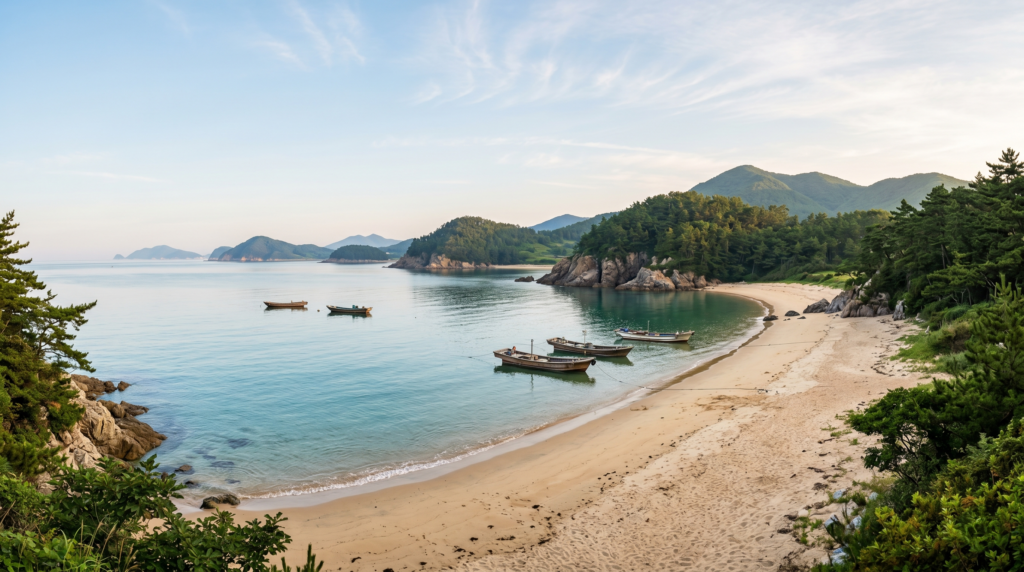
The area surrounding Uhangri — the village where the sea parting occurs — is home to some of the most pristine coastal scenery on the island. Outside of festival season, Uhangri Beach is tranquil and largely uncrowded, with clear water, a gentle shoreline, and tidal flats that reveal a complex marine ecosystem at low tide.
The tidal flats (getbol) of the Jeollanam-do coast are internationally recognized for their ecological significance — the broader region’s mudflats are UNESCO World Heritage listed for their role as a habitat for migratory birds and marine biodiversity. Walking them at low tide, even outside festival season, is a quietly extraordinary experience: the kind that slows you down and reminds you that nature operates on timescales far longer than human memory.
Jindo’s Historic Fortresses and the Battle of Myeongnyang
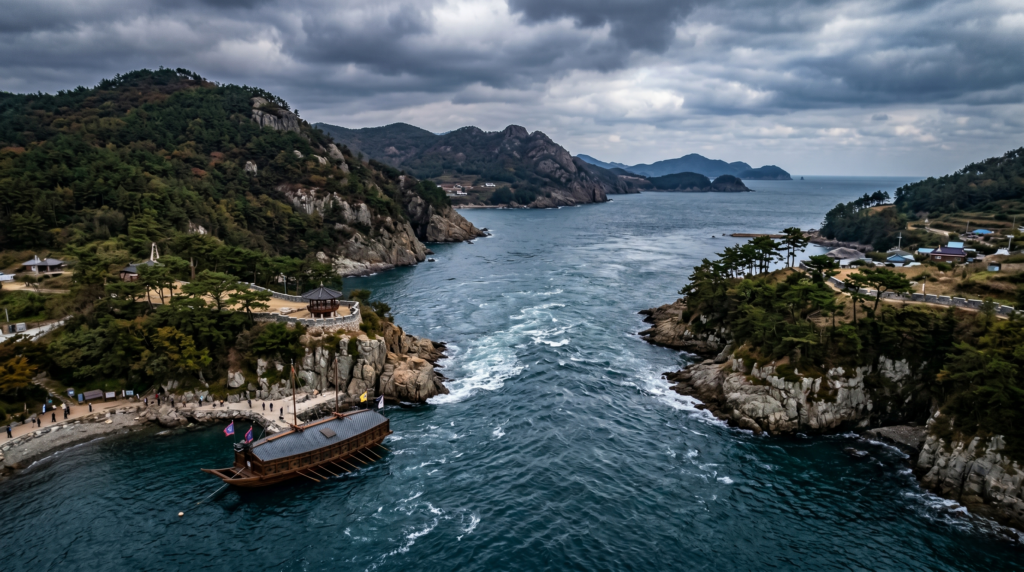
For history lovers and fans of the Korean film The Admiral: Roaring Currents — which dramatized Admiral Yi Sun-sin’s legendary naval victory — Jindo is sacred ground.
The Battle of Myeongnyang took place in the narrow strait between Jindo and the mainland in October 1597. Yi Sun-sin, commanding a fleet of just 13 ships against a Japanese armada of more than 300, used his intimate knowledge of the local tidal currents to create conditions that neutralized the enemy’s numerical advantage. The result was one of the greatest military upsets in naval history, and it turned the tide — literally and figuratively — of the Japanese invasion of Korea.
Today, the Myeongnyang Battle Site near Uldolmok Strait preserves this memory with historical monuments, a reconstructed battleship (geobukseon or turtle ship), and sweeping views of the very waters where the battle unfolded. Standing there on a quiet morning, watching the currents churn through the narrow channel, it is not difficult to imagine the chaos and brilliance of that day.
Byeokpa Pavilion, perched on a clifftop above the strait, offers one of the most dramatic panoramic views on the island — a favorite among photographers and contemplative travelers alike.
Ssanggyesa Temple and Mountain Retreats
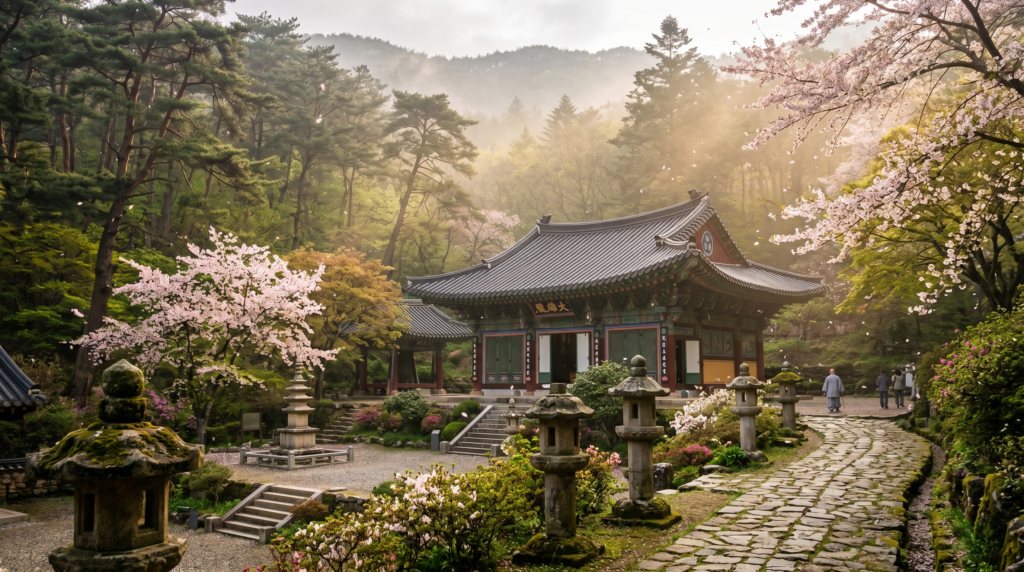
Tucked into the forested hills of Cheomchalsan Mountain, Ssanggyesa Temple is one of Jindo’s most peaceful and spiritually resonant sites. Founded during the Silla Dynasty over a thousand years ago, the temple complex is modest in scale but deeply atmospheric — its wooden halls surrounded by ancient trees, its courtyards filled with the smell of incense and the sound of distant bells.
In spring, the approach to Ssanggyesa is lined with cherry blossoms. In autumn, the hillside turns amber and red. The temple offers temple stay programs (templestay), allowing visitors to experience the rhythms of Buddhist monastic life — early morning meditation, communal meals, walking meditation through the forest, and deep, uninterrupted quiet.
For Korean culture enthusiasts, a night at Ssanggyesa is an immersion into a dimension of Korean life that few international travelers ever access — and one that K-dramas, for all their depth, rarely portray with the stillness it deserves.
Jindo Arirang — Korea’s UNESCO-Listed Folk Song
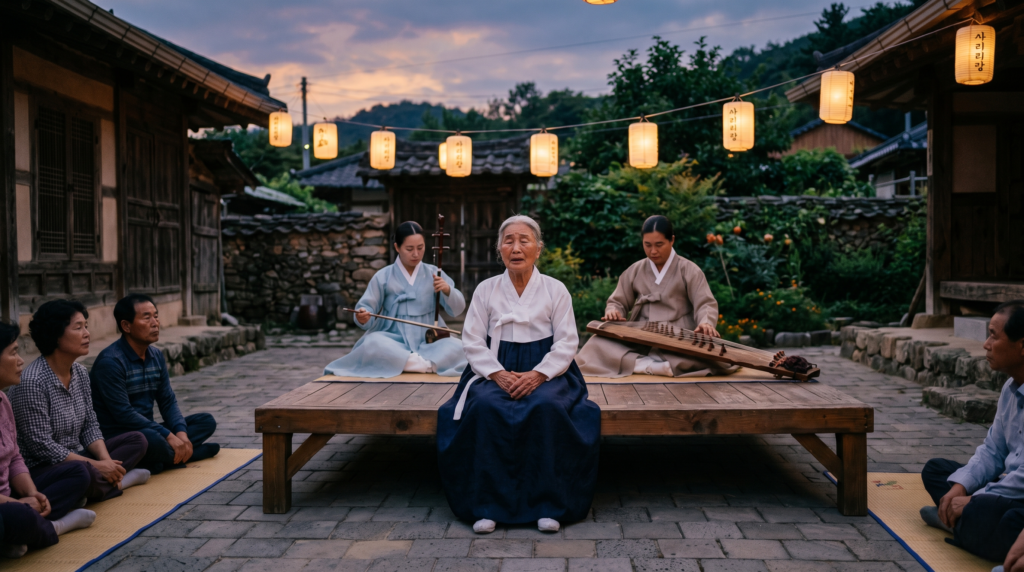
Korea’s national folk song, Arirang, is familiar around the world. But few people outside Korea know that Jindo has its own distinct version — and that it is widely considered one of the most musically sophisticated and emotionally powerful of all Arirang variations.
Jindo Arirang (Jindo Minyo) is characterized by its complex rhythmic structure, its improvisational quality, and the raw emotional weight it carries — a combination of joy, longing, and resilience that feels distinctly tied to the island’s history and geography. It has been designated a UNESCO Intangible Cultural Heritage, a recognition of its cultural significance not just to Korea but to humanity.
Visitors to Jindo can hear live performances at the Jindo Folk Culture Center and during festival season, when traditional performances are held throughout the island. If you have the opportunity to hear an elderly Jindo woman sing this song in its original form, stop everything and listen. It is one of those experiences that stays with you long after you leave.
The Korean Jindo Dog — A National Treasure
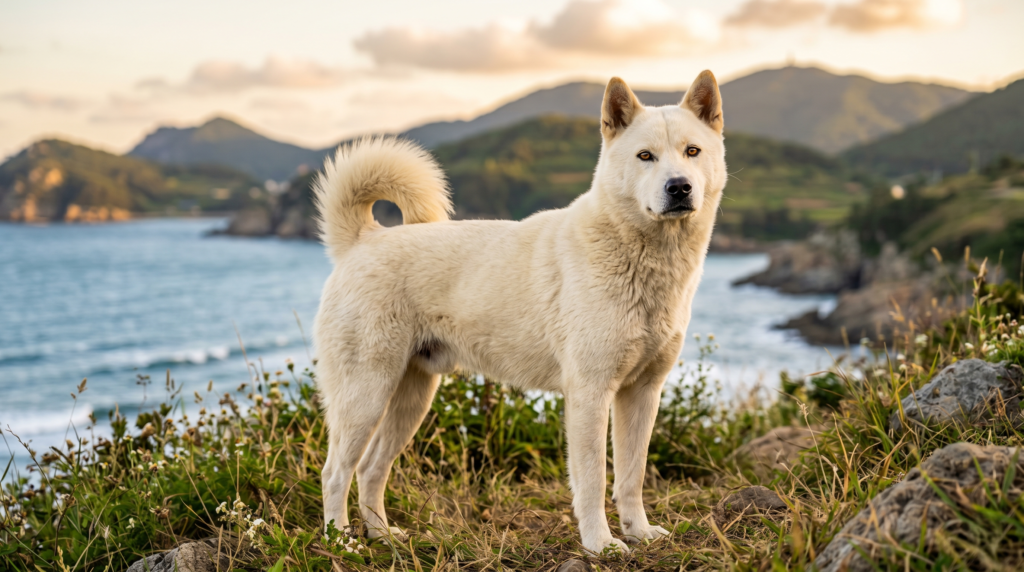
Why the Jindo Dog Is Unlike Any Other Breed
There are few places in the world where an entire island’s identity is so thoroughly intertwined with a single animal. On Jindo Island Korea, the dog is not simply a pet or a working animal — it is a symbol of the island’s soul, a living embodiment of the qualities Jindo people hold most dear: loyalty, independence, intelligence, and an unbreakable connection to home.
The Korean Jindo dog (Jindo-gae) has been designated Natural Monument No. 53 by the South Korean government, a distinction that places it alongside ancient temples, rare geological formations, and protected ecosystems in the hierarchy of things Korea considers worth preserving at all costs. Exporting purebred Jindo dogs from the island is heavily regulated by law — a measure taken not out of commercial interest but out of genuine cultural protectiveness.
What makes the Jindo dog so remarkable, beyond its striking appearance — the thick double coat, the curled tail, the alert amber eyes — is its temperament. Jindo dogs are profoundly loyal to a single owner, highly intelligent, and famously clean (they are known to housetrain themselves with minimal effort). They are also intensely independent, not given to the eager-to-please energy of many popular Western breeds. Earning a Jindo dog’s trust is not automatic — it is something the dog bestows deliberately, and once given, it is absolute.
This loyalty has produced some of the most remarkable stories in the annals of human-animal relationships. The most famous is the case of Baekgu, a female Jindo dog who was sold to a family in Daejeon — over 300 kilometers from Jindo Island — and found her way back to her original owner on the island seven months later, crossing mountains, rivers, and open terrain through a combination of instinct and will that researchers still find difficult to fully explain. Baekgu’s story was adapted into a beloved Korean children’s book and remains one of the most cherished animal stories in Korean culture.
Where to See Jindo Dogs on the Island
Visitors to Jindo who want to meet these remarkable animals firsthand should head to the Korean Jindo Dog Theme Park (Jindo-gae Temi Park), located near the center of the island. The park is dedicated entirely to the breed — its history, its characteristics, and its cultural significance — and offers visitors the rare opportunity to interact with purebred Jindo dogs in a well-maintained, humane environment.
The park includes exhibition halls detailing the breed’s history and the legal framework protecting it, outdoor areas where the dogs can be observed in more naturalistic settings, and designated interaction zones where visitors — particularly families with children — can spend time with the dogs under supervision.
For K-drama fans, the Jindo dog carries an additional layer of resonance. The breed has appeared in several Korean productions and is frequently referenced in Korean popular culture as a shorthand for a particular kind of steadfast, quietly fierce loyalty — the same quality that makes so many K-drama protagonists so compelling to international audiences.
What to Eat on Jindo Island — A Local Food Guide
The Culinary Identity of Jeollanam-do
Before exploring Jindo’s specific food culture, it is worth understanding the broader culinary context the island belongs to. Jeollanam-do — the South Jeolla Province of which Jindo is a part — is widely regarded by Koreans as the country’s foremost food region. If Korean cuisine were a country, Jeollanam-do would be its culinary capital: the place where banchan (side dishes) are most numerous, where fermentation techniques are most refined, where the relationship between land, sea, and table is most deliberately honored.
Eating in Jindo is, therefore, not simply a matter of refueling between attractions. It is one of the most authentic regional food experiences available anywhere in South Korea — a genuine expression of a culinary tradition that has developed in relative isolation over centuries, shaped by the island’s extraordinary marine environment and the agricultural rhythms of the surrounding province.
Must-Try Jindo Island Foods
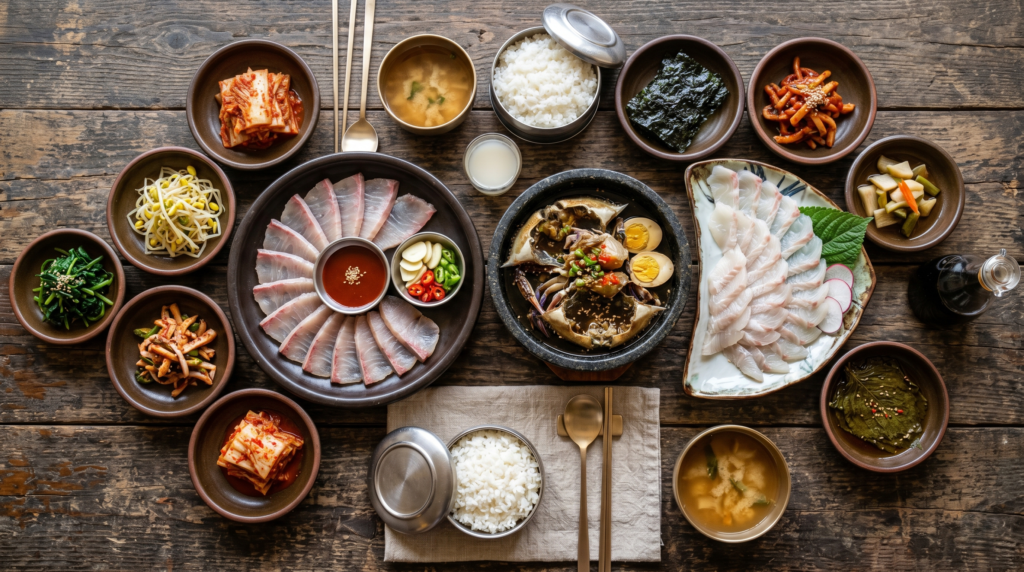
Hongeo (홍어) — Fermented Skate Fish
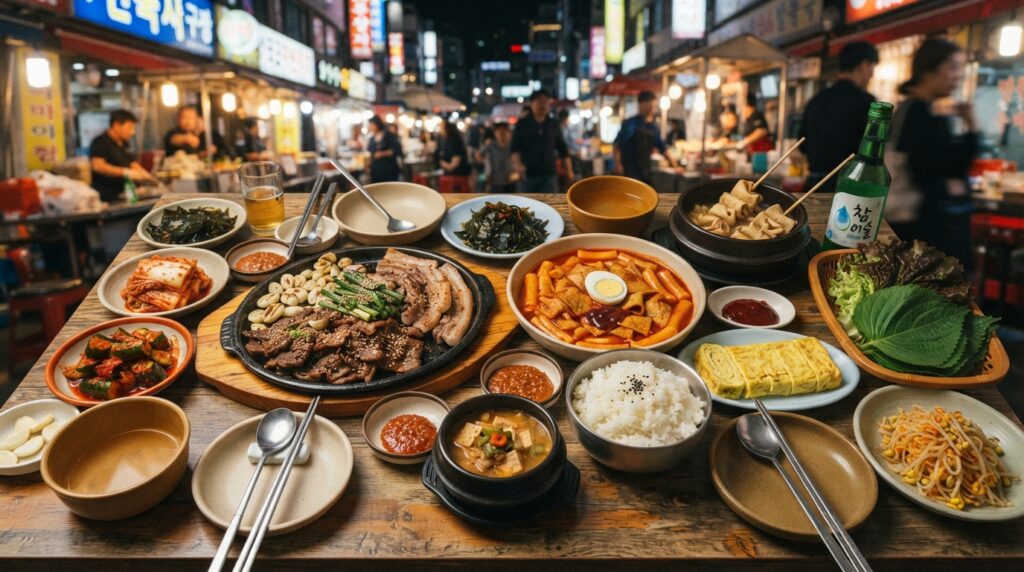
Jindo’s most famous — and most polarizing — culinary offering is hongeo, fermented skate fish. This is not a dish for the timid. Hongeo is fermented through a traditional process that produces a powerful ammonia-rich flavor and aroma that challenges even adventurous eaters on first encounter. It is typically served raw, sliced thinly, and eaten wrapped in kimchi with a piece of boiled pork belly — a combination known as hongeo samhap (the “three harmonies”).
To Koreans from the Jeollanam-do region, hongeo is not simply food — it is cultural identity on a plate, the taste of home and heritage. Trying it on Jindo, where it is made with the freshest local skate and prepared by people who have eaten it their entire lives, is the only proper way to encounter it. You may not love it. But you will remember it.
Ganjang Gejang (간장 게장) — Soy-Marinated Raw Crab
Often described as “rice thief” (bap doduk) in Korean — because it is so delicious it causes you to eat bowl after bowl of rice without realizing — ganjang gejang is raw crab marinated in soy sauce, garlic, ginger, and other aromatics. On Jindo, where the crabs come directly from the surrounding tidal flats and are marinated according to recipes passed down through generations, this dish reaches a level of refinement that justifies every superlative.
The combination of briny, silky crab meat and the deep umami of the soy marinade is unlike anything in international cuisine. It is subtle, complex, and profoundly satisfying — precisely the kind of dish that turns casual food travelers into devoted pilgrims of Korean cuisine.
Fresh Raw Seafood (Hoe — 회)
Jindo’s position in the Korea Strait means that its surrounding waters are among the most productive fishing grounds on the peninsula. Hoe — thinly sliced raw fish and seafood, the Korean equivalent of sashimi — served at restaurants near the island’s fishing docks and markets is as fresh as it is possible for seafood to be: caught that morning, prepared that afternoon, on your table by evening.
Local varieties to look for include domi (sea bream), gwang-eo (olive flounder), and various shellfish including jeonbok (abalone) — which is farmed in the clean waters around Jindo and considered among the finest in Korea.
Where to Eat Like a Local
The best food on Jindo is not found in restaurants with English menus and tourist-facing marketing. It is found in small, family-run establishments clustered around the Jindo Ferry Terminal and the Jindo Traditional Market, where the owners are also the cooks, and where the menu changes based on what came in from the sea that morning.
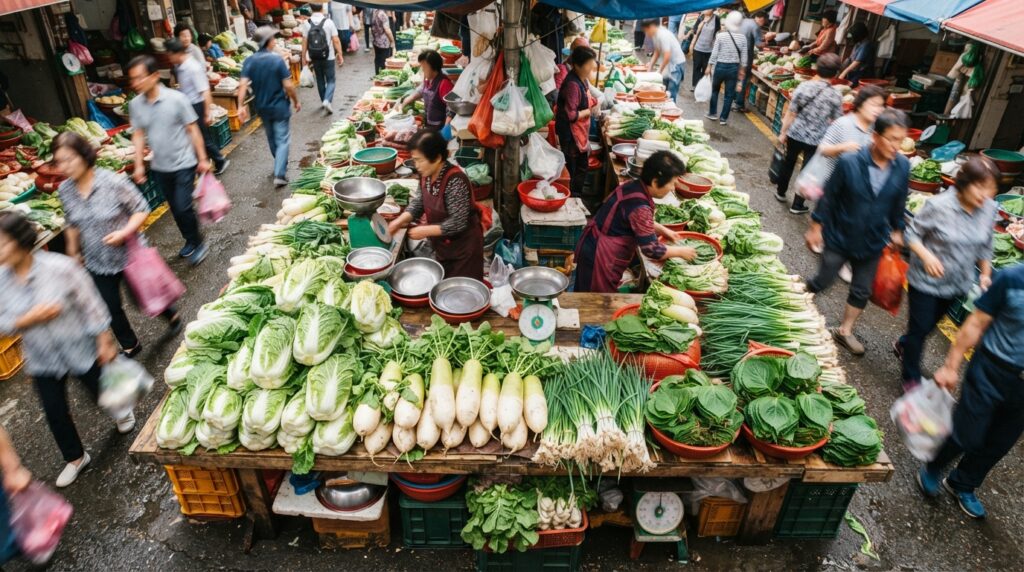
The Jindo Traditional Market (진도 전통시장) is particularly worth visiting — a bustling local market held regularly where vendors sell everything from live seafood to homemade doenjang (fermented soybean paste) to jars of kimchi made from recipes that predate the Korean War. Walking through it is a sensory education in the depth and variety of Korean food culture.
Insider Tip: In Jeollanam-do restaurants, the banchan — the array of small side dishes served alongside every meal — is often more impressive and numerous than anywhere else in Korea. Do not fill up on rice before exploring what surrounds it. A typical Jindo meal may arrive with eight to twelve individual side dishes, each prepared differently and each worth attention.
How to Get to Jindo Island Korea — Complete Travel Guide
Getting There from Seoul, Busan, and Other Cities
Jindo Island’s relative remoteness is part of its charm — but it does require some planning to reach, particularly for international travelers arriving in Seoul or Busan.
From Seoul: The most common route is by express bus from Seoul’s Useo Bus Terminal (센트럴시티) to Jindo Bus Terminal, a journey of approximately five to six hours depending on traffic. Buses run several times daily and are comfortable, reliable, and affordable. This is the most direct option for travelers without a car.
Alternatively, travelers can take the KTX high-speed train from Seoul to Mokpo Station (approximately two and a half hours), then transfer to a local bus to Jindo (approximately one hour). This combined route is faster overall and allows you to experience Korea’s impressive rail network — though it requires one additional transfer.
From Busan: Travelers from Busan can reach Jindo by bus via Gwangju (approximately four hours total), or by taking the train to Mokpo and connecting by bus. There is no direct train service to Jindo itself.
From Gwangju or Mokpo: Both cities offer regular bus connections to Jindo, making them natural transit hubs for travelers already exploring the Jeollanam-do region. From Mokpo, the bus journey to Jindo takes approximately one hour and runs frequently throughout the day.
Getting Around Jindo Island
Once on the island, transportation options are more limited than in Korea’s urban centers — which is something to plan for deliberately rather than discover inconveniently.
Local buses serve the main routes between Jindo town and major sites including Uhangri, the Myeongnyang Battle Site, and the Jindo Dog Theme Park, but service is infrequent — often one to two buses per hour on main routes, less on secondary ones. Timetables are primarily posted in Korean, so having a translation app (Naver Papago is highly recommended) or asking your accommodation host for guidance is advisable.
Taxis are available in Jindo town and can be hailed or arranged through your accommodation. For visiting multiple sites in a single day, negotiating a half-day or full-day rate with a local taxi driver is a practical and affordable option — and an opportunity for genuine cultural exchange if your driver speaks any English or you have any Korean.
Car rental is by far the most flexible and recommended option for exploring Jindo comprehensively. Rental agencies are available in Mokpo (the nearest major city), and driving across the Jindo Bridge onto the island takes approximately one hour from Mokpo city center. Having a car allows you to reach coastal viewpoints, mountain temples, and small fishing villages that public transport simply does not serve.
Where to Stay on Jindo Island
Accommodation on Jindo is authentic rather than luxurious — which, for the right traveler, is a significant part of the appeal.
Budget options center around minbak — traditional Korean family guesthouses where you sleep on floor bedding (yo) in heated ondol rooms, share common bathrooms, and may be offered home-cooked breakfast by your host. This is one of the most genuine cultural accommodation experiences available in rural Korea, and Jindo’s minbak owners are typically warm, hospitable, and quietly proud to host travelers who have made the effort to visit their island.
Mid-range options include pensions — small Korean-style guesthouses or pension houses, many of which are coastal properties with ocean views. These offer more privacy than minbak, often with private bathrooms and small kitchen facilities, and represent excellent value compared to equivalent accommodation in Seoul or Busan.
For a truly unique experience, the temple stay program at Ssanggyesa offers a night or two within a functioning Buddhist monastery — waking before dawn for meditation, eating communal vegetarian meals, and spending the evening in the kind of quiet that is almost impossible to find in modern urban life. Advance booking through the Korea Tourism Organization’s official Templestay program website is required.
Important Note for Festival Season: Accommodation on Jindo fills completely — sometimes months in advance — during the Miracle Sea Road Festival period. If your visit coincides with the festival, book the moment dates are announced. Travelers who leave accommodation to the last minute typically find themselves staying in Mokpo or Haenam on the mainland and commuting to the island for the event.
Best Time to Visit Jindo Island Korea
| Season | Highlights | Considerations |
|---|---|---|
| Spring (March–May) | Miracle Sea Road Festival, cherry blossoms at Ssanggyesa, mild temperatures, peak cultural energy | Festival week is crowded; book accommodation early |
| Summer (June–August) | Beach season at Uhangri, lush green hillsides, long days | Humidity and occasional typhoon-season rain in late summer |
| Autumn (September–November) | Spectacular foliage, comfortable temperatures, significantly fewer crowds | Festival has passed; sea parting not during this period |
| Winter (December–February) | Quiet, atmospheric, authentic off-season island life | Cold temperatures, limited tourist facilities, reduced transport frequency |
For first-time visitors, spring — specifically the festival period — is the clear recommendation. The combination of the Miracle Sea Road, spring blossoms, ideal temperatures, and peak cultural programming creates an experience that justifies the extra planning required.
For returning visitors or those seeking a more contemplative experience, autumn offers Jindo at its most visually beautiful and its most peaceful — a combination that photographers and slow travelers in particular tend to find deeply rewarding.
Practical Travel Tips for Visiting Jindo Island Korea
These tips are drawn from the realities of traveling in rural South Korea and are designed to help you avoid the most common friction points:
- ✅ Book accommodation months in advance for festival season — this is not an exaggeration
- ✅ Download Naver Maps before you arrive — Google Maps has significantly limited coverage in rural Korea, while Naver Maps includes local bus routes, real-time traffic, and detailed pedestrian navigation even in small island villages
- ✅ Carry cash — many local restaurants, market vendors, and small guesthouses on Jindo are cash-only. While Korea’s urban centers are highly card-friendly, rural islands operate differently
- ✅ Wear waterproof footwear for the sea road walk — the seabed is wet, uneven, and home to sharp shells. Dedicated water shoes or rubber sandals are ideal
- ✅ Learn basic Korean phrases — even a handful of words (annyeonghaseyo for hello, gamsahamnida for thank you, eolmaeyo for how much) will be received with genuine warmth by local residents who rarely encounter international visitors
- ✅ Verify festival dates annually through the Korea Tourism Organization website or official Jindo County government channels — dates shift with the lunar calendar and are confirmed fresh each year
- ✅ Bring a portable battery pack — outdoor festival areas and remote coastal sites may not offer charging facilities
- ✅ Respect the tidal window — when guides or local officials signal that it is time to return from the sea road, do so promptly. The tide returns decisively
Frequently Asked Questions About Jindo Island Korea
Q1: When exactly does the Jindo sea parting happen?
The Jindo Miracle Sea Road occurs annually, typically in late March or April, with exact dates determined by the lunar calendar and spring tidal cycles. The sea parts for approximately 40 minutes to one hour at the lowest point of the tide. Dates are announced each year through the Korea Tourism Organization and official Jindo County channels.
Q2: Is Jindo Island worth visiting outside of the festival season?
Absolutely — and in some ways, more so. Outside festival season, Jindo offers the Myeongnyang Battle Site, Ssanggyesa Temple, Uhangri Beach, the Jindo Dog Theme Park, extraordinary local food, and UNESCO-listed folk music performances, all without the festival crowds. Autumn in particular is strikingly beautiful.
Q3: How many days should I spend on Jindo Island?
A minimum of two full days is recommended to experience the major highlights. Three days allows for a more relaxed pace that includes a temple visit, beach time, and exploration of smaller fishing villages. If your visit coincides with the festival, add an additional day for the festival programming surrounding the main sea parting event.
Q4: Is Jindo Island suitable for families with young children?
Yes, very much so. The Miracle Sea Road walk is a magical experience for children, the Jindo Dog Theme Park is a highlight for younger visitors, and Uhangri Beach is calm and safe for families during summer. The main consideration is accommodation — minbak floor-sleeping may not suit all families, so booking a pension with standard beds is advisable.
Q5: What is the Korean Jindo dog’s most famous characteristic?
The Jindo dog is renowned above all for its extraordinary loyalty and homing instinct. The famous case of Baekgu — a female Jindo who traveled over 300 kilometers back to her original home after being rehomed — remains one of the most remarkable documented examples of canine loyalty in history and is celebrated in Korean children’s literature.
Q6: Can I bring a Jindo dog home from Korea?
Exporting purebred Jindo dogs from Jindo Island is heavily regulated under Korean law due to the breed’s status as a national natural monument. While it is not entirely impossible to acquire a Jindo dog outside the island through registered breeders in Korea or abroad, removing purebred animals from the island itself requires navigating significant legal requirements. Consult the Korean Cultural Heritage Administration for current regulations.
Q7: Is English widely spoken on Jindo Island?
Less so than in Seoul or Busan. Jindo is a rural island destination, and while younger Koreans may have some English, most local residents communicate primarily in Korean. Having a translation app (Naver Papago or Google Translate with the Korean language pack downloaded offline) is strongly recommended. The Korea Tourism Organization’s 1330 travel hotline offers English-language assistance 24 hours a day and is an invaluable resource for navigating rural Korea.
There is a moment — if you are lucky enough to be standing on the ocean floor of Jindo, the sea pulled back on either side of you, thousands of voices filling the salt air around you — when the distinction between legend and reality becomes beautifully irrelevant. Whether the sea parts because of tidal mathematics or because an old woman prayed hard enough, you are walking on the floor of the ocean. The water is real. The road is real. The wonder is absolutely real.
Jindo Island Korea is the kind of place that travel writing struggles to do justice to, because its greatest qualities are experiential rather than descriptive. The taste of ganjang gejang made by someone’s grandmother. The sound of a Jindo Arirang sung without amplification in a village square. The feeling of a Jindo dog deciding, after careful consideration, that you might be worth trusting. These are things you collect in person, carried back in the part of memory that does not fade.
For Korean culture lovers, K-drama enthusiasts, and travelers seeking something genuinely beyond the well-worn tourist trail, Jindo offers a complete and irreplaceable experience — natural wonder, living history, UNESCO-recognized heritage, extraordinary food, and one of the most unique animal encounters in the world, all on an island most travelers have never heard of.
Add it to your Korea itinerary. Give it more than a day. Go in spring if you can, and stand on the ocean floor.
You will not regret it.