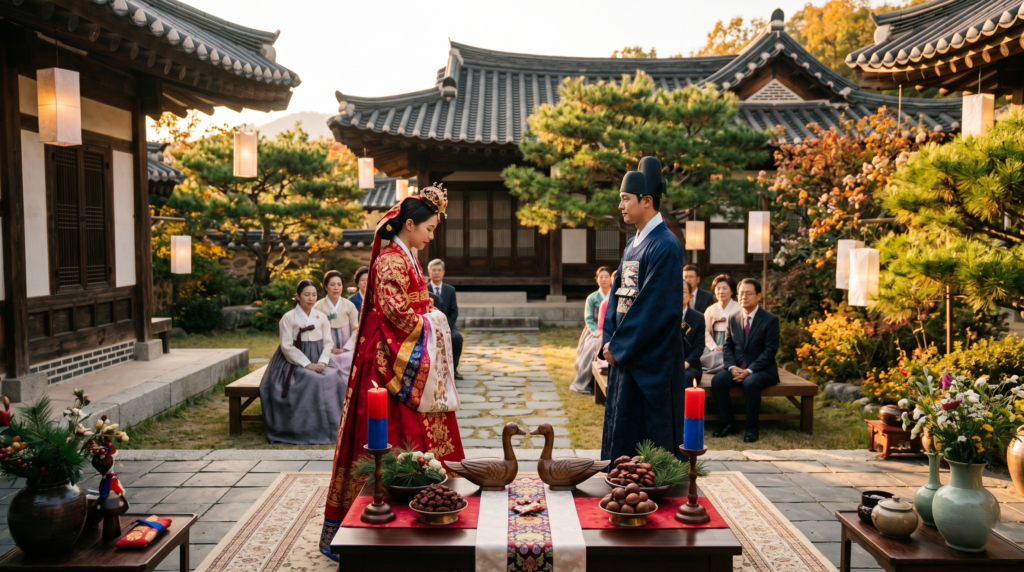
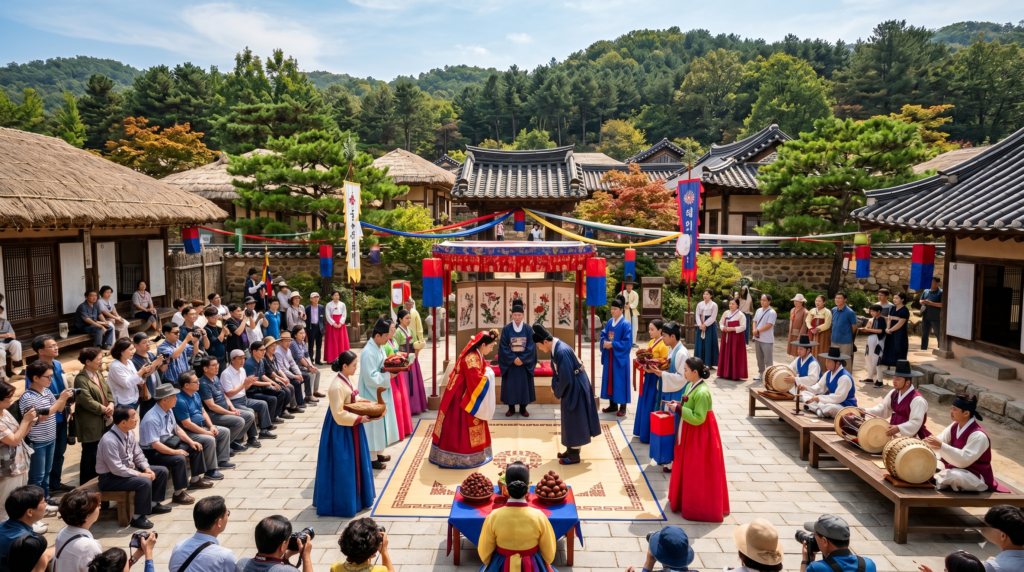
Imagine standing in a sunlit courtyard, surrounded by the scent of pine and the soft rustling of silk. A bride dressed in crimson and blue — her robe embroidered with phoenixes and peonies — stands across from her groom, both about to participate in a ceremony that has remained largely unchanged for over six centuries. This is a Korean traditional wedding: not merely a celebration of love, but a living ritual woven from Confucian philosophy, family devotion, and breathtaking artistry. Whether you discovered these ceremonies through a K-drama, a travel documentary, or simple curiosity, this guide will take you deeper than any drama scene ever could — into the heart of one of the world’s most beautifully preserved wedding traditions.
What Is a Korean Traditional Wedding?
A Korean traditional wedding, known formally as Jeonangnye (전안례), is a ceremonial union rooted in centuries of Confucian values and Korean cultural identity. Unlike the Western model of a wedding focused primarily on romantic love and individual expression, the traditional Korean ceremony is a communal and philosophical event — one that unites not just two people, but two families and, by extension, two bloodlines.
The origins of this ceremony trace back to the Joseon Dynasty (1392–1897), a period that profoundly shaped Korean society through the lens of Neo-Confucian thought. During this era, marriage was considered one of the most important rites of passage a person could undergo — second only to death in terms of ceremonial weight. It was not a private affair but a public declaration of social responsibility, filial piety, and the continuation of family legacy.
What makes the Korean traditional wedding particularly remarkable is how much of it has survived into the modern age. In an era of rapid globalization and Westernization, these ancient customs have not disappeared — they have adapted, persisted, and, thanks in part to the global popularity of Korean dramas and the Hallyu wave, experienced a remarkable cultural renaissance.
The Joseon Dynasty Roots
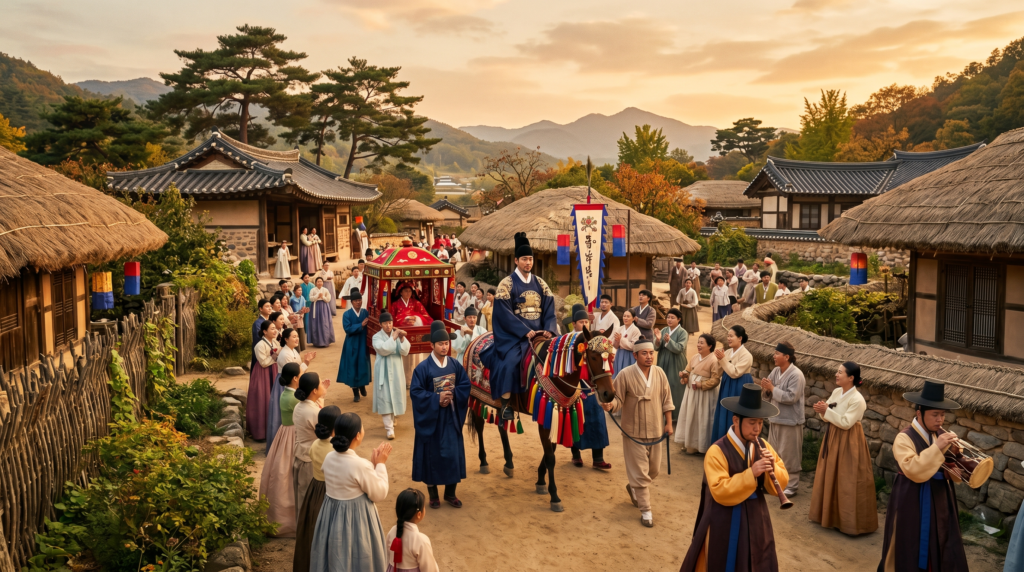
To understand a Korean traditional wedding, you must first understand the Joseon Dynasty‘s approach to human relationships. Confucian philosophy placed enormous importance on hierarchy, duty, and ritual propriety. Marriage was not simply a personal choice — it was a sacred obligation to one’s ancestors, parents, and future descendants.
Weddings during this period were arranged through Jungmae (중매), a formal matchmaking process managed by family elders or professional matchmakers. Compatibility was assessed not through personality or romance, but through family background, social standing, and most importantly, the Saju — the four pillars of a person’s birth year, month, day, and hour — which were analyzed for astrological harmony.
These Joseon-era customs created a framework of ceremony so detailed and intentional that each gesture, color, food, and object carried layered symbolic meaning. That framework is the foundation of every Korean traditional wedding still performed today.
The Korean Traditional Wedding Ceremony Step by Step
The traditional Korean wedding is not a single event — it is a carefully choreographed sequence of rituals, each with its own name, meaning, and emotional weight. Understanding each step transforms the experience from a beautiful spectacle into something profoundly meaningful.
Expert Insight: According to documentation from the National Folk Museum of Korea, every element of the traditional ceremony is intentional. Nothing is merely decorative — even the direction a couple faces and the number of times they bow carries philosophical significance rooted in Confucian cosmology.
1. Napchae — The Proposal and Matching Phase
Before any ceremony takes place, the two families must first agree that the union is auspicious. This begins with Napchae (납채), the formal proposal phase.
The groom’s family sends the bride’s family a document containing the groom’s Saju — his four birth pillars. A traditional fortune teller or family elder then evaluates whether the couple’s birth data are compatible. If the signs are favorable, the bride’s family sends back a letter of acceptance, setting the date for the wedding.
This phase also included the formal gifting of Hahm (함) — a wooden box filled with gifts from the groom’s family, including bolts of blue and red silk fabric, which would later become the bride’s ceremonial Hanbok. In some regions, the delivery of the Hahm was itself a festive event, with the groom’s male friends carrying it loudly through the streets and demanding food and drink before handing it over — a tradition that persists in humorous form at many weddings today.
2. Daerye — The Main Wedding Ceremony
The heart of the Korean traditional wedding is Daerye (대례), the main ceremony. Historically, this took place at the bride’s family home, not the groom’s — a notable cultural distinction that reflects the Joseon-era belief that the groom must journey to claim his bride respectfully.
The groom arrives in a formal procession, often on horseback in historical depictions, dressed in his ceremonial Gwanbok robes. He carries with him a carved wooden goose, known as Kirogi (기러기) — arguably the most iconic symbol in all of Korean wedding tradition.
The wooden goose is offered to the bride’s mother as the groom’s first act upon arrival. Its symbolism is deeply poetic: wild geese are believed to mate for life, and if one dies, its partner never remarries. By presenting the Kirogi, the groom makes a wordless vow of lifelong fidelity. The goose is placed on the ceremonial table and remains a witness to the entire ceremony.
3. Gyobaerye — The Bowing Ritual
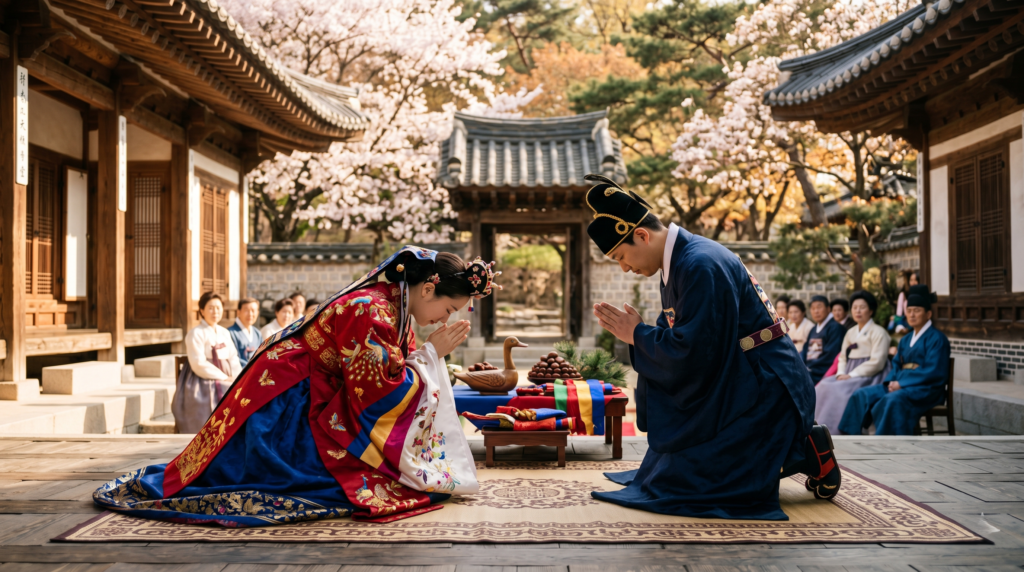
Once the groom has arrived and the families are assembled, the ceremony’s most visually striking ritual begins: Gyobaerye (교배례), the exchange of bows between bride and groom.
The couple faces each other across the ceremonial table, the Honsang, which is elaborately set with symbolic foods, candles, and living animals. They then perform the keun jeol — a deep, formal bow that touches the floor.
The groom bows twice and the bride bows four times. This asymmetry is not a reflection of inequality — in traditional Korean cosmology, even numbers are associated with yin (the feminine principle) and odd numbers with yang (the masculine). The different number of bows aligns each person with their cosmological nature, creating a complementary rather than hierarchical dynamic.
This bowing ritual is a moment of extraordinary solemnity. In a culture where deep bows are reserved for the most respectful occasions — greeting elders, honoring the deceased, expressing profound gratitude — performing the keun jeol to one’s spouse is among the most sincere acts of reverence a person can offer.
4. Hapgeunrye — The Shared Cup Ritual
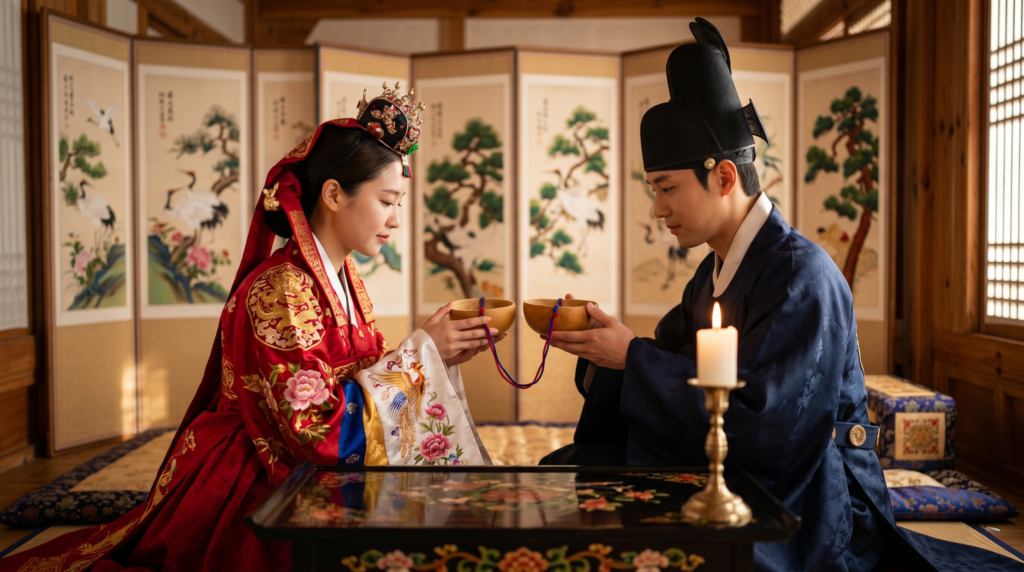
Following the bows, the couple participates in Hapgeunrye (합근례) — one of the most symbolically rich moments in the entire ceremony.
A gourd, grown specifically for this purpose and dried over many months, is split into two halves and filled with wine (traditionally makgeolli or rice wine). The bride and groom each drink from one half. The two halves are then brought together, and they drink again — this time from the rejoined gourd.
The symbolism is unmistakable and achingly beautiful: two separate beings, each whole on their own, who choose to join together and become something greater. The gourd itself — grown as one, divided, and then reunited — mirrors the journey of two people becoming a couple. Many families keep this gourd for generations as a cherished family heirloom, a tangible reminder of the day their lineage was formed.
5. Paebaek — The Family Ceremony
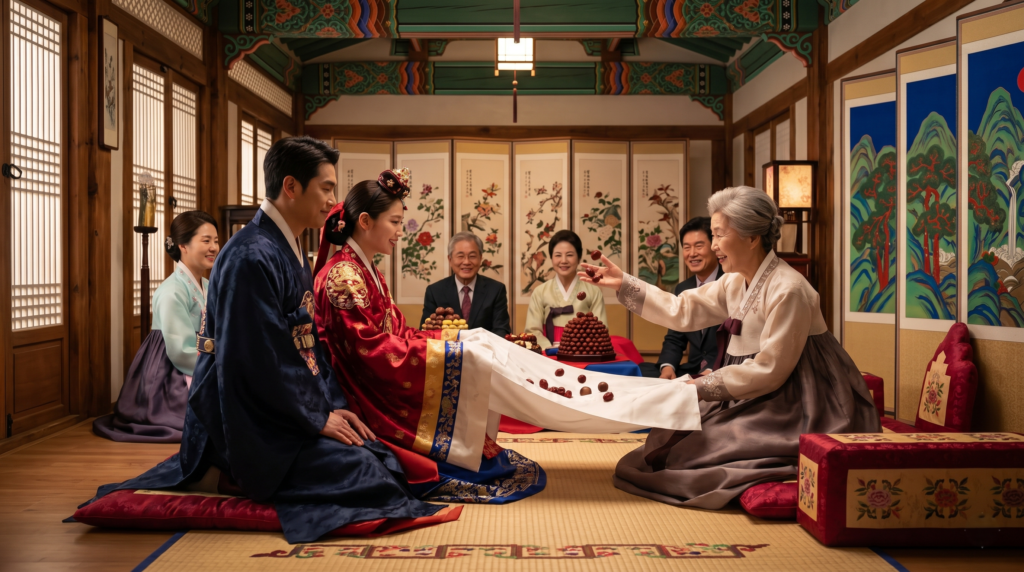
If Daerye is the ceremony for the community, then Paebaek (폐백) is the ceremony for the family — and for many attendees, it is the most emotionally resonant part of the entire day.
Held after the main ceremony, Paebaek takes place in a private room or inner chamber, in the presence of the groom’s close family members — particularly his parents and grandparents. The couple, still in full ceremonial Hanbok, kneels and performs deep bows to each elder in turn, formally greeting them as members of the bride’s new family.
Each elder then offers words of blessing — and then, in a moment that never fails to produce tears and laughter simultaneously, they toss jujube dates and chestnuts toward the bride, who holds out her Hanbok skirt to catch them. Dates represent future sons; chestnuts represent future daughters. The more she catches, the more children (and blessings) are predicted for the couple.
It is during Paebaek that the weight of what is happening truly lands. This is not simply a party — it is a transfer of belonging, a formal welcome into a new family, and a blessing carried forward through generations.
Korean Traditional Wedding Attire — The Hanbok
No element of a Korean traditional wedding captures the imagination quite like the Hanbok (한복) — the traditional Korean garment that transforms the wearer into something that looks almost mythological in its beauty.
Hanbok is not merely clothing. It is a philosophical statement about the relationship between the human body, nature, and the cosmos. Its silhouette — the full, flowing skirt (chima) rising high under the bust, the short jacket (jeogori) with its graceful ribbon tie — is designed to suggest natural landscape: rolling hills, flowing rivers, the gentle arch of a horizon.
For a wedding, Hanbok reaches its most elaborate and symbolic form.
The Bride’s Hanbok
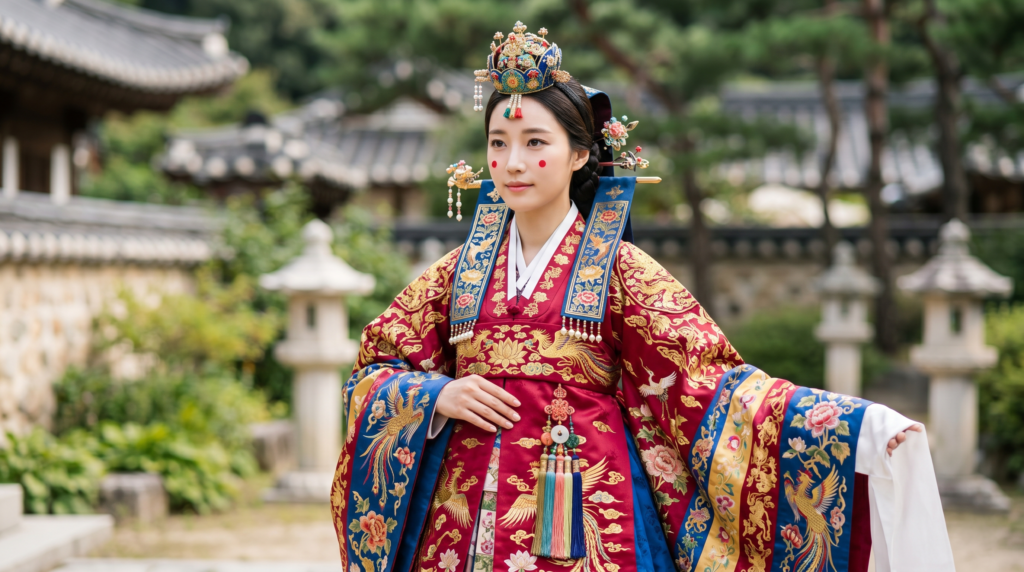
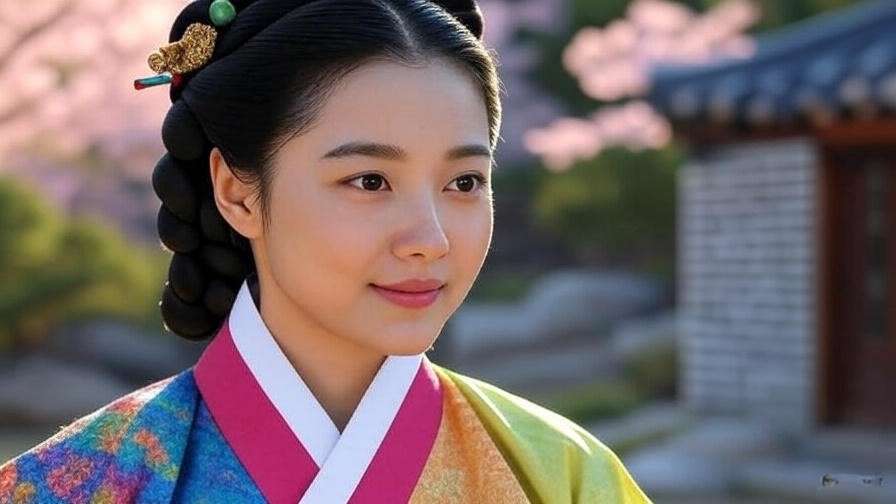
The bride wears one of two ceremonial robes: the Wonsam (원삼) or the more elaborate Hwarot (활옷), which was historically reserved for royalty but is now worn by all brides in traditional ceremonies.
The Hwarot is a masterwork of textile art. Its base colors — crimson red and deep blue — are not chosen for aesthetics alone. They represent eumyang (음양), the Korean equivalent of yin and yang: red for yang (fire, heaven, the masculine principle) and blue for eum (water, earth, the feminine principle). Their combination on a single garment represents the union of opposites — the very essence of marriage.
The robe is covered in intricate embroidery: phoenixes symbolizing grace and virtue, peonies representing prosperity and honor, lotus flowers for purity, and cranes for longevity. Every stitch is intentional; every image is a wish stitched into silk.
The bride’s hair is elaborately styled into a Chignon and adorned with a Jokduri (족두리) — a small, jeweled ceremonial crown — and Binyeo (비녀), decorative hairpins often made of gold, jade, or silver. Her face is traditionally painted with red dots on her cheeks and forehead — marks believed to ward off evil spirits on this auspicious day.
The Groom’s Hanbok
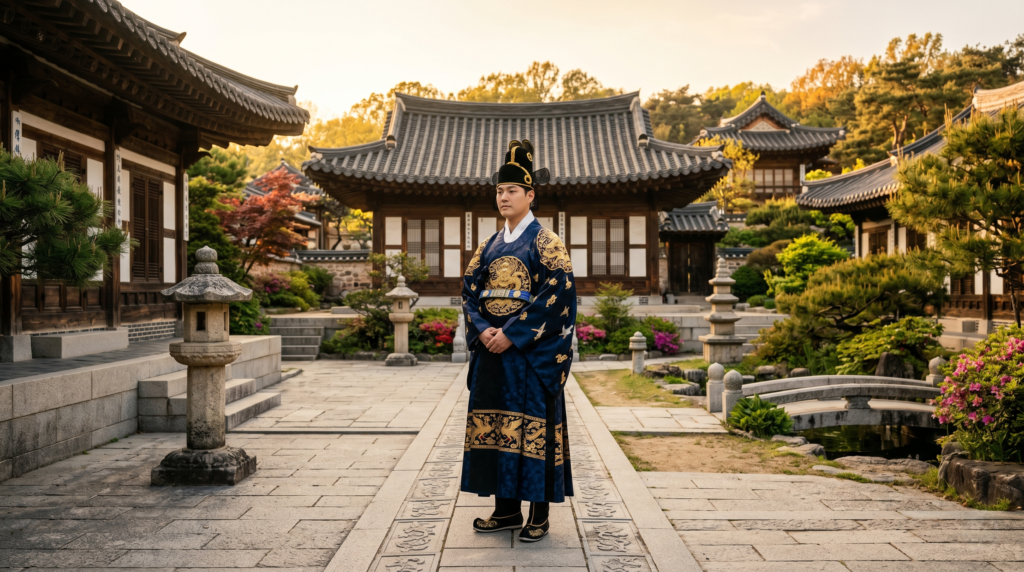
The groom wears Gwanbok (관복) — the formal court robe historically worn by government officials, adopted for wedding ceremonies as a mark of honor and gravitas. It is typically deep navy, forest green, or black, conveying authority and solemnity.
Upon his head sits the Samo (사모) — a stiff black ceremonial hat with wing-like projections on either side — and around his chest, a Hyungbae (흉배), an embroidered badge that in the Joseon Dynasty indicated a court official’s rank. For a wedding groom, it signals that he is entering the most important role of his life.
Hanbok in Modern Korean Weddings
Today, very few Korean couples hold a full Jeonangnye ceremony from start to finish. Most opt for a Western-style wedding in a ceremony hall, followed by a Paebaek conducted in a private room — during which both bride and groom change into traditional Hanbok.
This hybrid model has made Hanbok simultaneously more accessible and more cherished. Young Korean couples who might never have considered a full traditional ceremony are rediscovering Hanbok through K-dramas, fashion editorials, and cultural pride movements. Globally, interest in Hanbok has surged — a direct result of dramas like Mr. Sunshine, The Red Sleeve, and My Dearest dressing their leads in historically accurate ceremonial robes.
The Korean Traditional Wedding Table — Honsang
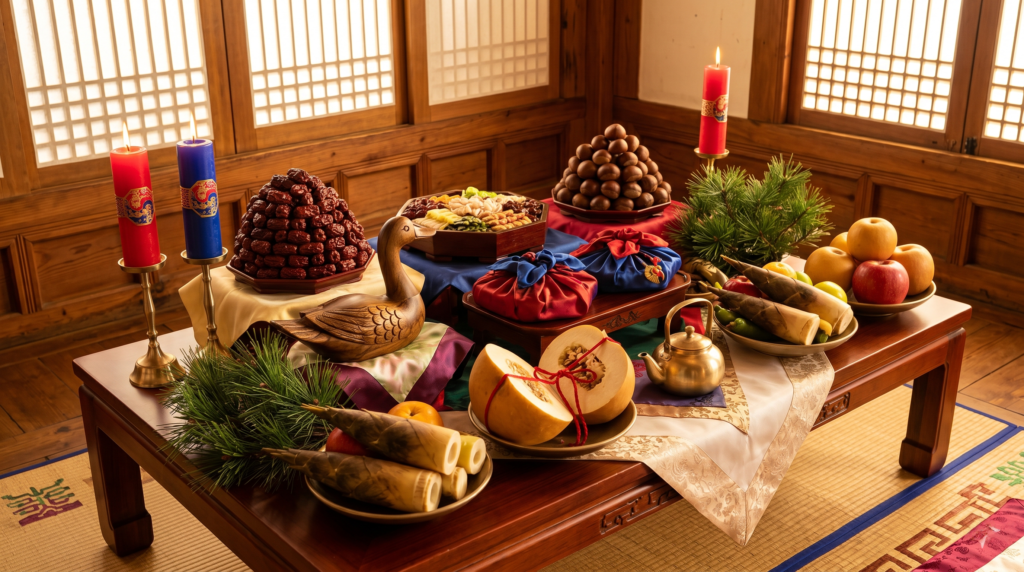
At the center of every Daerye ceremony stands the Honsang (혼상) — the ceremonial wedding table — and it is far more than a decorative arrangement. Every object placed upon it has been chosen with deliberate symbolic intent, creating what amounts to a three-dimensional blessing for the couple’s future.
The table is typically arranged by the bride’s family and set up in the outdoor courtyard where the ceremony takes place. Items commonly found on the Honsang include:
Jujube dates — placed in abundance, they represent the hope for sons and the continuation of the family line. Chestnuts are placed alongside them, symbolizing daughters. Together, they express the traditional wish for many children and a full household.
Bamboo and pine branches are placed at either end of the table, representing resilience, constancy, and longevity. Both plants remain green through winter — a metaphor for a love that endures through hardship.
Two candles — one on each side of the table — represent the light that guides the couple’s shared path. The candle on the east side symbolizes the groom; the one on the west, the bride. They burn simultaneously, never outshining one another.
Perhaps the most striking element: a live rooster and hen, their legs gently bound with red and blue cloth and placed on the table facing each other. They represent the couple themselves — bound together, facing the future side by side. In more modern ceremonies, carved wooden birds replace the live animals, but the symbolism remains unchanged.
The Honsang is not just a table. It is a map of the couple’s hoped-for future, laid out in food, fiber, and living things — a blessing made tangible.
Korean Traditional Wedding Food and Celebration
A Korean wedding is, among many other things, a feast — and the food served carries as much cultural meaning as the rituals themselves.
Ritual Foods Served at a Korean Wedding
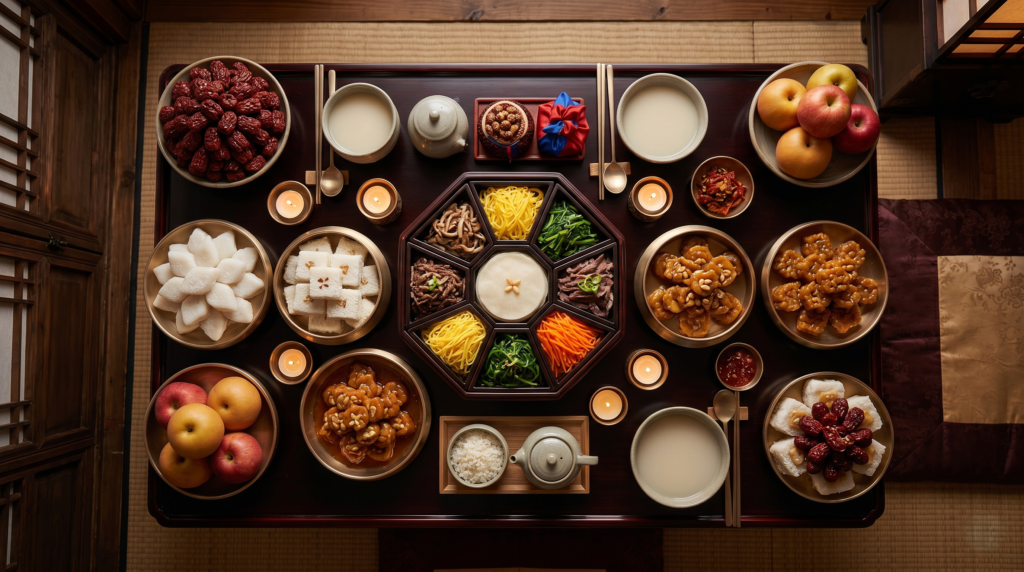
Tteok (떡), or Korean rice cakes, are the cornerstone of virtually every Korean celebration, and weddings are no exception. At a traditional wedding, tteok is prepared in large quantities and shared with every guest — and importantly, with neighbors and community members who may not have been formally invited. Sharing wedding tteok is considered a blessing; to receive it is considered good fortune.
The variety of tteok served at weddings is deliberate. Baekseolgi (white steamed rice cake) represents purity and a clean beginning. Sujeonggwa-tteok, flavored with cinnamon and ginger, adds warmth and spice — metaphors for a lively marriage.
Gujeolpan (구절판) — a nine-sectioned lacquerware dish filled with nine different ingredients — is served as a representation of harmony and balance. The nine compartments hold ingredients of contrasting colors and flavors, which are combined by the diner into small pancakes. Like marriage itself, it requires different elements coming together to create something complete.
The Role of the Wedding Feast in Community
In Joseon-era Korea, a wedding feast was not a private dinner — it was a community event. Hosting a wedding meant feeding your entire village, and the generosity of the spread was a direct reflection of the hosting family’s virtue, wealth, and social standing.
Families would spend months preparing — fermenting kimchi, brewing rice wine, curing meats, and making tteok in quantities that could feed hundreds. To be stingy at a wedding feast was considered a profound social failure; to be generous was to honor not just the couple, but every ancestor who had contributed to the family’s position.
This spirit of communal generosity lives on in modern Korean weddings, where large buffet-style receptions and elaborate meal services remain the norm — a lingering echo of the village feast that once defined the celebration.
Korean Traditional Wedding vs. Modern Korean Wedding
One of the most common questions asked by those discovering Korean wedding culture for the first time — particularly K-drama fans who have seen both elaborate Joseon-era ceremonies and sleek contemporary wedding halls — is this: How much has actually changed?
The answer is nuanced. On the surface, a great deal has changed. Beneath the surface, far less than you might expect.
| Element | Traditional (Jeonangnye) | Modern Korean Wedding |
|---|---|---|
| Venue | Bride’s family home or outdoor courtyard | Wedding hall, hotel ballroom, or church |
| Duration | Multi-day celebration | 30–60 minute ceremony |
| Attire | Full ceremonial Hanbok throughout | Western dress + Paebaek Hanbok |
| Core Ritual | Gyobaerye, Hapgeunrye, Paebaek | Vows, ring exchange, Paebaek |
| Family Role | Central, ceremonial, deeply ritualistic | Present but less structurally ritualistic |
| Matchmaking | Arranged via Jungmae and Saju analysis | Self-chosen partners; family approval still valued |
| Food | Community feast, ritual tteok | Buffet reception or sit-down dinner |
| Wooden Goose | Ceremonially presented by groom | Often given as a decorative wedding gift |
| Community Role | Entire village involved and fed | Guest list controlled; ticketed entry common |
What this table reveals is that modern Korean weddings are not a rejection of tradition — they are a compression of it. The Paebaek ceremony, the Hanbok, the ritual foods, the deep bows to elders — all of these persist. What has been streamlined is the multi-day communal structure, replaced by the efficiency demanded by contemporary urban life.
Why Korean Couples Are Returning to Traditional Elements
In recent years, a quiet but meaningful cultural shift has been taking place in South Korea. Younger couples — particularly those in their late twenties and thirties — are increasingly choosing to incorporate more traditional elements into their weddings, not out of obligation, but out of genuine pride and a desire for depth and meaning.
This movement has been called the Hanbok renaissance. Bridal studios across Seoul now offer full Jeonangnye ceremony packages. Traditional wedding photographers have built thriving businesses specializing in Hanbok portraits and ceremonial documentation. Social media platforms, particularly Instagram and YouTube, are filled with Korean couples sharing their Paebaek moments — and receiving overwhelming positive responses from both Korean and international audiences.
The reasons are layered. In a society that has modernized at extraordinary speed over the past five decades, many young Koreans feel a genuine hunger to reconnect with the culture that preceded that transformation. A traditional wedding ceremony is, in this sense, not a look backward — it is an act of cultural reclamation and identity affirmation.
At the same time, the global popularity of Korean content has created external appreciation that reinforces internal pride. When millions of viewers around the world express genuine awe at the sight of a Hwarot robe or the Paebaek date-tossing ritual, it becomes easier for Korean couples to see their own traditions as treasures rather than formalities.
Korean Traditional Weddings in K-Dramas and Pop Culture
For the majority of international audiences, the first glimpse of a Korean traditional wedding didn’t come from a museum or a cultural documentary. It came from a screen — and that is not a small thing.
K-dramas have functioned as the most powerful ambassador of Korean traditional wedding culture the world has ever seen. Through emotionally resonant storytelling, stunning costume design, and meticulous set decoration, they have introduced tens of millions of viewers to rituals they had never encountered before — and made them care deeply about those rituals.
Dramas That Brought Traditional Weddings to Life
Mr. Sunshine (2018) — Set at the twilight of the Joseon Dynasty, this series features some of the most visually stunning depictions of late-19th century Korean aristocratic culture ever committed to screen. While not centered on a wedding, its treatment of Hanbok, ceremonial dress, and Confucian social ritual gave international audiences their first sustained look at the aesthetics of traditional Korean ceremony.
My Dearest (2023) — Widely praised by Korean historians and cultural commentators for its extraordinary attention to period accuracy, My Dearest depicts the mid-Joseon era with a level of detail rarely seen even in prestige historical dramas. The wedding and courtship rituals depicted in the series — including the exchange of Saju, the ceremonial Hanbok, and family bow sequences — align closely with documented historical practice, making it an invaluable cultural text as well as a compelling love story.
The Red Sleeve (2021) — This royal court drama offers a window into the even more elaborate ceremonial world of the Joseon royal family. Royal wedding customs differed from commoner ceremonies in scale and specific ritual detail, but shared the same philosophical foundations. The series’ treatment of court dress, particularly the Hwarot robes worn by noblewomen, sparked a significant international interest in traditional Korean textile arts.
Jewel in the Palace / Dae Jang Geum (2003) — Though older, this landmark drama introduced the ceremonial and culinary traditions of the Joseon court to audiences across Asia and beyond, laying the groundwork for the global appreciation of Korean cultural heritage that later Hallyu waves would build upon.
How Drama Portrayals Differ From Authentic Ceremonies
It is worth noting, with honesty and nuance, that K-drama depictions of traditional weddings are not always historically precise. Dramatic license is routinely taken — ceremonies are compressed, emotional beats are heightened, and costume choices sometimes prioritize visual impact over strict historical accuracy.
For example, the iconic image of a Joseon-era bride with perfectly painted white skin, elaborate hair ornaments, and a luminously embroidered Hwarot is partly a product of dramatic styling. Real historical brides, particularly those from non-aristocratic families, would have worn simpler versions of these garments with fewer embellishments.
Similarly, the romantic framing of traditional weddings in K-dramas — with couples exchanging longing glances during the Gyobaerye bowing ritual — reflects modern storytelling sensibilities rather than historical reality. In actual Joseon ceremonies, bride and groom were often meeting for the first time or near the first time, and the ceremony was conducted with great formality rather than romantic warmth.
None of this diminishes the value of what K-dramas have accomplished. By making these ceremonies emotionally accessible and visually magnificent, they have inspired genuine curiosity and deep appreciation that no academic text could replicate. The drama viewer who then seeks out real documentation of Jeonangnye ceremonies — and many do — is following a path that begins with storytelling and ends with genuine cultural understanding.
How to Experience a Korean Traditional Wedding Today
If reading this guide has sparked a desire to witness — or even participate in — a Korean traditional wedding ceremony, you are far from alone. Tourism around Korean cultural heritage has grown significantly, and there are now numerous accessible ways to experience these ceremonies firsthand.
Cultural Venues and Folk Villages
National Folk Museum of Korea (Seoul) Located within the grounds of Gyeongbokgung Palace in central Seoul, the National Folk Museum is arguably the best single destination in the country for understanding traditional Korean life, including wedding customs. The museum holds live demonstrations of traditional ceremonies throughout the year, and its permanent exhibitions include detailed reconstructions of Jeonangnye ceremonies, complete with authentic Hanbok, ceremonial tables, and explanatory materials in multiple languages.
Korean Folk Village — Yongin (용인 한국민속촌) Approximately one hour from Seoul, the Korean Folk Village is a living history museum spread across 243 acres of reconstructed Joseon-era architecture and landscape. Traditional wedding reenactments are performed regularly, with actors in full ceremonial dress performing each stage of the Daerye ceremony with remarkable authenticity. For many visitors, this is the closest experience to witnessing a real Joseon-era wedding available outside of a time machine.
Namsangol Hanok Village (Seoul) Situated in the heart of Seoul near Namsan Mountain, Namsangol Hanok Village offers traditional ceremony packages for both tourists and Korean couples who wish to hold or photograph their Paebaek in a historically authentic setting. The village’s five restored aristocratic hanok (traditional Korean houses) provide a stunning backdrop for ceremonial photography, and cultural programs run year-round.
Bukchon Hanok Village (Seoul) While primarily a residential area of preserved hanok architecture, Bukchon offers cultural experience programs — including traditional dress rental and ceremony introductions — that provide an immersive taste of traditional Korean aesthetics. It is particularly popular with visitors who want to experience Hanbok in an authentic architectural setting.
For Couples Wanting a Traditional Korean Wedding
If you are a couple — Korean, Korean diaspora, or international — interested in incorporating traditional Korean wedding elements into your ceremony, the options have never been more accessible or more beautiful.
Full Jeonangnye Ceremony Packages are now offered by a growing number of specialist vendors in Seoul, Busan, and Gyeongju. These packages typically include: ceremonial Hanbok rental or purchase, a traditional Honsang table setup, a ceremony officiant versed in traditional ritual protocol, professional photography, and catering of traditional wedding foods including tteok and ritual dishes.
Hybrid Wedding Planning — incorporating a Paebaek ceremony into an otherwise contemporary wedding — is the most popular option for modern Korean couples. Many wedding halls in South Korea now include a dedicated Paebaek room as a standard facility, allowing couples to conduct the family blessing ritual in traditional Hanbok before or after their Western-style ceremony.
Budget Considerations: A full traditional ceremony package in Seoul can range from approximately ₩2,000,000 to ₩10,000,000 (roughly $1,500–$7,500 USD) depending on the scale, the quality of the Hanbok, and the elaborateness of the Honsang setup. Paebaek-only packages are considerably more affordable, typically ranging from ₩500,000 to ₩2,000,000.
7 Fascinating Facts About Korean Traditional Weddings
Even after everything covered in this guide, Korean traditional wedding culture still holds surprises. Here are seven facts that tend to stop readers mid-scroll — because they are genuinely extraordinary.
1. Traditional Korean weddings lasted three full days. The modern conception of a wedding as a single-day event would have been completely foreign to a Joseon-era Korean. The full ceremony cycle — from the groom’s procession to the final family rituals — unfolded over three days, with the couple moving between the bride’s home and the groom’s home as part of the ceremonial process.
2. The groom traveled to the bride’s village — not the other way around. In a profound reversal of the Western tradition in which the bride is “given away” and travels to her new home, the Joseon-era groom made the journey to the bride’s family compound to conduct the ceremony. He was, in essence, a respectful guest who had to earn his welcome.
3. Wooden geese are still given as wedding gifts today. The Kirogi — the carved wooden goose presented by the groom at the ceremony — has not disappeared from Korean culture. It remains a popular and deeply meaningful wedding gift, given by family members or close friends as a wish for the couple’s lifelong fidelity and devotion.
4. The color red was used to ward off evil spirits. The red dots painted on the bride’s cheeks and forehead were not purely decorative. In Korean shamanistic tradition, red is a powerful protective color, capable of repelling malevolent spirits who might seek to disturb the auspiciousness of a new union. This blending of Confucian ceremony with shamanistic practice is one of the most fascinating aspects of traditional Korean wedding culture.
5. Brides were traditionally expected to maintain a completely expressionless face. Far from the joyful, tearful brides common at modern weddings, a Joseon-era bride was expected to maintain an expression of complete composure — even solemnity — throughout the ceremony. Smiling was considered improper and undignified. The ceremony was a solemn rite, not a celebration of personal happiness, and the bride’s composure demonstrated her virtue and emotional discipline.
6. The ceremonial gourd cup is often kept as a family heirloom for generations. The split gourd used in the Hapgeunrye shared-cup ritual is not discarded after the ceremony. In many Korean families, it is carefully preserved, wrapped in silk, and stored as one of the family’s most precious objects — a physical artifact of the moment the family began. Some families have gourds that are over a hundred years old, passed down through multiple generations.
7. Korea has one of the world’s most comprehensively documented traditional wedding systems. Unlike many ancient ceremonial traditions that survive only in fragmented records or oral history, the Korean Jeonangnye ceremony is extraordinarily well-documented. Detailed written guides to proper ceremony protocol — including the precise sequence of bows, the correct arrangement of the Honsang, and the proper wording of ritual declarations — were produced during the Joseon Dynasty and have been preserved by the National Folk Museum of Korea and academic institutions. This documentation has made authentic reconstruction and continuation of these ceremonies possible in a way that is rare among the world’s ancient wedding traditions.
Frequently Asked Questions About Korean Traditional Weddings
Q1: What is a Korean traditional wedding called?
A Korean traditional wedding is formally called Jeonangnye (전안례). This term refers specifically to the main ceremonial sequence of the traditional wedding, rooted in Confucian ritual protocol developed during the Joseon Dynasty. The word encompasses the full ceremony cycle, from the groom’s arrival and the presentation of the wooden goose through the bowing ritual and the shared cup ceremony.
Q2: What does the bride wear at a Korean traditional wedding?
The bride wears a ceremonial Hanbok called either a Wonsam (원삼) or a Hwarot (활옷) — the latter being the more elaborate and richly embroidered of the two. The garment is predominantly red and blue, symbolizing the union of complementary cosmic forces. It is covered in embroidery featuring phoenixes, peonies, lotus flowers, and cranes — each representing a specific blessing for the bride’s future. Her head is adorned with a Jokduri crown and Binyeo hairpins, and her face is painted with small red dots for spiritual protection.
Q3: What is the Paebaek ceremony in a Korean wedding?
Paebaek (폐백) is the post-ceremony family ritual in which the newlyweds formally bow to the groom’s parents and extended family members. It takes place in a private room, with the couple in full Hanbok. Elders offer blessings and then toss dates and chestnuts toward the bride, who catches them in her skirt as a symbol of future children and prosperity. It is widely considered the most emotionally resonant part of a Korean wedding — deeply intimate, deeply familial, and deeply meaningful.
Q4: Why do Korean brides receive dates and chestnuts at the Paebaek ceremony?
The tossing of dates (daechu, 대추) and chestnuts (bam, 밤) at the Paebaek ceremony is one of the most charming and symbolically rich traditions in Korean wedding culture. Dates represent future sons; chestnuts represent future daughters. The act of tossing them toward the bride — and her catching as many as possible in her outstretched skirt — is a joyful, participatory blessing: the more she catches, the more children and good fortune are predicted for the couple’s future.
Q5: Are Korean traditional weddings still practiced today?
Yes — though the form has evolved. Full Jeonangnye ceremonies conducted entirely according to historical protocol are relatively rare in contemporary South Korea, largely due to the time, cost, and logistical demands involved. However, key elements of the traditional ceremony — most notably the Paebaek ritual and the wearing of ceremonial Hanbok — are incorporated into the vast majority of Korean weddings today. There is also a growing movement among younger couples to revive more complete traditional ceremonies, supported by specialist vendors, cultural venues, and a broader cultural pride movement.
Q6: What is the meaning of the wooden goose in a Korean wedding?
The wooden goose, or Kirogi (기러기), is presented by the groom to the bride’s mother at the beginning of the Daerye ceremony. Its significance lies in the natural behavior of wild geese, which are believed to mate for life — and if one partner dies, the survivor never takes another mate. By presenting the Kirogi, the groom makes a symbolic vow of absolute fidelity: he is pledging to love his bride as a goose loves its partner — completely, exclusively, and permanently. It remains one of the most poetically meaningful gestures in any wedding tradition in the world.
Conclusion
A Korean traditional wedding is, at its core, a love letter written not just between two people, but between a couple and their history, their families, their culture, and their future. From the moment the groom arrives carrying his carved wooden goose — a silent vow of lifelong fidelity — to the laughter and tears of the Paebaek ceremony, where dates and chestnuts rain down as blessings for children yet to come, every gesture in this ancient ceremony has been refined over centuries to carry maximum meaning in minimum movement.
What makes Korean traditional wedding culture so remarkable is not simply its beauty — though the beauty is extraordinary. It is the fact that these ceremonies have survived. In a world where so many ancient traditions have been swept away by modernization, the Jeonangnye endures, adapts, and continues to find new admirers with each passing generation. Today, a bride in Seoul might wear a Western gown for her ceremony and change into a Hwarot for her Paebaek. A couple in Los Angeles might hire a ceremony officiant to conduct a full traditional ritual in their backyard. A teenager in Brazil might watch My Dearest and find themselves genuinely moved by the sight of two people bowing deeply to one another in silk robes — and then spend hours researching what those bows actually mean.
That is the power of a living tradition. It does not require a museum to survive. It requires only people who find it meaningful — and, as the world’s growing love affair with Korean culture makes clear, there is no shortage of those.
Which part of the Korean traditional wedding surprised you most? Was it the symbolism of the wooden goose, the emotional depth of the Paebaek ceremony, or the extraordinary artistry of the Hwarot? Share your thoughts in the comments — and if you found this guide valuable, explore more of our Korean culture and drama content below.