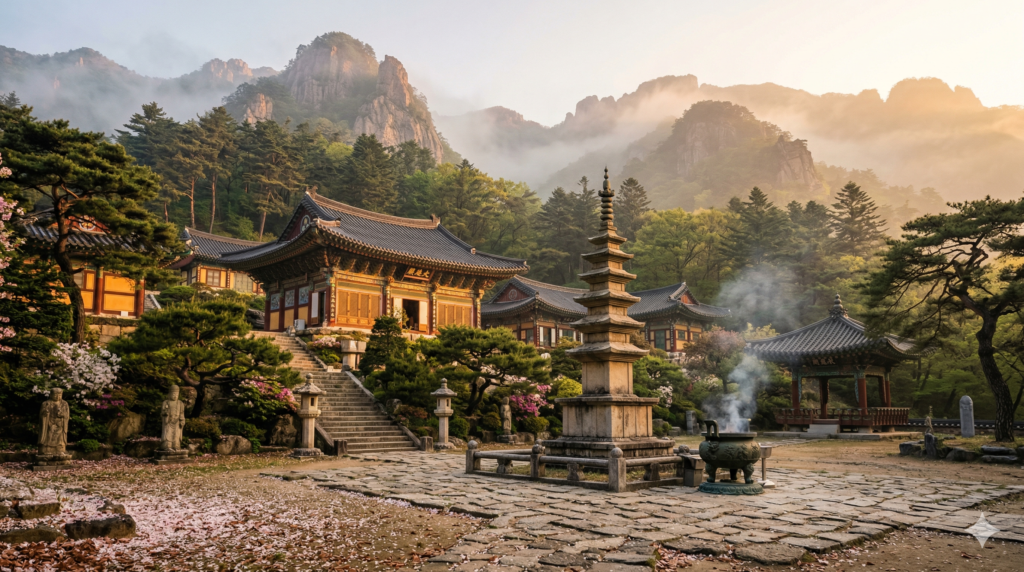
Imagine standing at the base of a stone staircase as the morning mist rolls down from the mountain above. The air smells of pine and incense. Somewhere deep within the courtyard, a bronze bell rings — once, twice, three times — and the sound travels across centuries before it reaches your ears. This is not a scene from your favorite K-drama. This is the living, breathing reality of a temple of Korea, and it has been quietly waiting for you long before you ever noticed it on a screen.
For millions of people around the world, Korean temples were first discovered not through travel guides or history books, but through the atmospheric backdrops of beloved K-dramas. The mist-shrouded courtyards of Goblin, the serene mountain paths of My Love from the Star, the ancient stone walls that seem to hold centuries of secrets — these images ignited something in viewers that went far beyond curiosity about a television show. They sparked a genuine longing to understand Korean culture at its deepest level.
And that longing leads here — to the gates of Korea’s most sacred spaces.
This guide is designed for K-drama fans, cultural explorers, and first-time visitors who want to go beyond the surface. You will discover the philosophy and history behind Korean Buddhist temples, explore the most iconic sites across the country, understand why filmmakers are irresistibly drawn to these locations, and learn exactly how to experience them for yourself — including the extraordinary temple stay program that allows visitors to live, even briefly, as a monk does.
By the time you finish reading, you will not just know about the temples of Korea. You will understand why they matter — and why so many people, once they visit, say it changed the way they see the world.
What Makes a Temple of Korea Different From Any Other Sacred Site in the World
There are ancient temples on every continent. Rome has the Pantheon. Cambodia has Angkor Wat. India has Khajuraho. So what is it about the Korean Buddhist temple that feels so profoundly distinct — so quietly powerful — that travelers return to it again and again?
The answer lies not in size or spectacle, but in philosophy.
The Philosophy Behind Korean Buddhist Architecture
Korean temples were never designed to dominate nature. They were designed to become part of it.
This guiding principle is rooted in an ancient Korean concept known as “Baesanimsu” — a term from geomancy (pungsu, the Korean equivalent of feng shui) that dictates ideal placement: mountains at the back for protection and grounding, flowing water at the front for energy and life. Walk up to almost any mountain monastery in Korea and you will feel this principle in action before you even know its name. The mountains rise behind the main hall. A stream runs somewhere nearby. The entire complex breathes in rhythm with its landscape.
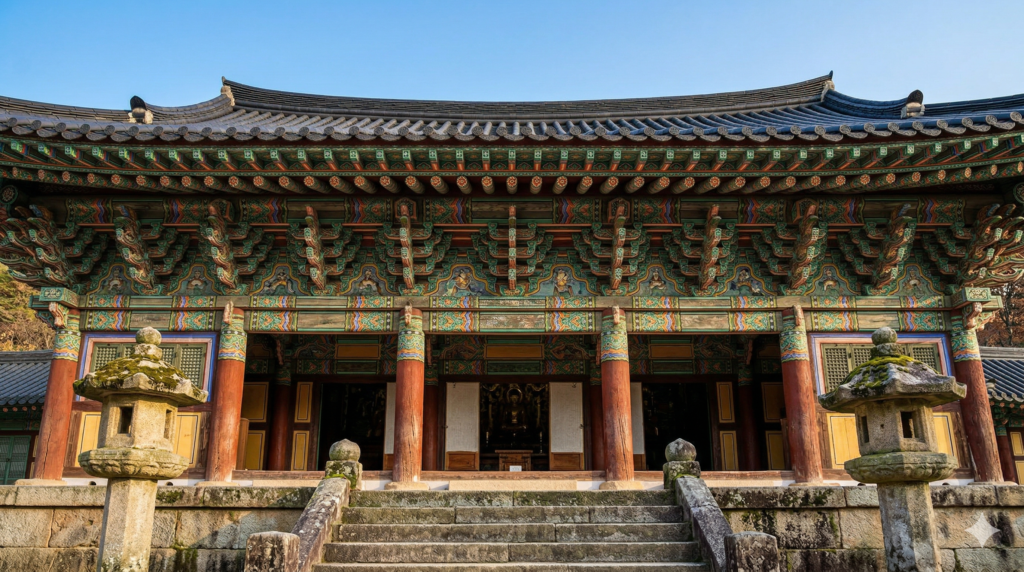
The architectural elements themselves carry deep symbolic meaning. The four heavenly kings that guard the entrance gate (Cheonwangmun) represent protection against evil. The wooden dancheong paintwork — those extraordinary patterns of red, blue, green, and gold that cover every beam and bracket — are not mere decoration. Each color carries cosmic significance, representing the five elements and the cyclical nature of existence.
Even the stone pagodas that rise from the courtyards are not simply artistic expressions. They are objects of veneration, believed to house sacred relics, and their tiered forms represent the stages of Buddhist enlightenment.
This is architecture with a purpose — one that speaks to the spirit rather than just the eye.
A Living, Breathing Cultural Institution
What truly separates the temple of Korea from many other ancient sacred sites around the world is that it has never stopped being used.
These are not ruins. They are not museums with velvet ropes. Korean temples are living institutions where monks wake before dawn to meditate and chant, where incense burns continuously throughout the day, where the rhythms of practice remain largely unchanged from what they were a thousand years ago.
This living continuity is something visitors feel immediately and profoundly. There is a different quality of silence inside a place that is still genuinely sacred — not the silence of a place that was sacred once, but the silence of a place where something real and ongoing is happening right now, just beyond the next corridor or behind the next wooden door.
Korean temples also serve their communities in deeply practical ways. They have historically functioned as schools, hospitals, and places of refuge during times of war and poverty. Even today, many temples run social welfare programs, host meditation retreats for stressed urban professionals, and conduct educational programs for children.
This combination — architectural genius, philosophical depth, and living cultural function — is precisely what sets the Korean Buddhist temple apart from any other sacred site in the world.
A Brief History of the Temple of Korea — From Ancient Kingdoms to Modern Times
To truly appreciate a Korean temple, you need to understand the extraordinary historical journey it has survived.
Buddhism’s Arrival in Korea (4th Century AD)
Buddhism arrived on the Korean peninsula during the Three Kingdoms Period, entering Goguryeo from China in 372 AD, Baekje in 384 AD, and finally the Silla kingdom — the most resistant to foreign religions — in the 5th century. The conversion of the Silla royal court, reportedly inspired by the martyrdom of the monk Ichadon in 527 AD, opened the floodgates for one of the most remarkable periods of temple construction in Korean history.
Under royal patronage, temples became centers of not just religious practice but of art, scholarship, and political legitimacy. Kings built temples to pray for military victories, to honor deceased ancestors, and to demonstrate the divine favor that justified their rule. The greatest artistic achievements of the Silla period — including Bulguksa Temple and the nearby Seokguram Grotto — emerged from this era of fervent royal devotion.
Survival Through Invasions and War
The history of Korean temples is also a history of destruction and resilience.
The Japanese invasions of the late 16th century (the Imjin War, 1592–1598) devastated the Korean peninsula and left countless temples in ashes. The colonial period under Japanese rule (1910–1945) brought further suppression and forced transformation of Buddhist institutions. Then came the Korean War (1950–1953), which destroyed or severely damaged temples across the country, particularly in the contested central and northern regions.
And yet — the temples came back. Rebuilt stone by stone, beam by beam, by communities that understood they were not simply restoring buildings. They were restoring identity. The persistence of Korean temple culture in the face of repeated destruction is one of the most compelling stories of cultural resilience in all of Asian history.
UNESCO Recognition and Global Awareness
The international community began formally recognizing the extraordinary value of Korean temple heritage in 1995, when Seokguram Grotto and Bulguksa Temple were inscribed on the UNESCO World Heritage List. Haeinsa Temple’s Janggyeong Panjeon — the repository of the Tripitaka Koreana woodblocks — received the same honor.
Then, in 2018, came an even broader recognition: seven Korean mountain monasteries (collectively called Sansa) were added to the UNESCO World Heritage List, celebrated for their role as “centers of everyday living Buddhism” that maintain their spiritual and cultural functions to the present day. The sites included Tongdosa, Beopjusa, Magoksa, Seonamsa, Daeheungsa, Bueoksa, and Seonamsa — a remarkable acknowledgment of living heritage rather than mere historical artifact.
The Most Iconic Temples of Korea You Need to Know
Korea is home to more than 900 registered Buddhist temples. Each one has its own character, its own history, and its own atmosphere. But certain temples have risen to a level of cultural and historical significance that places them in a category of their own.
Bulguksa Temple — The Crown Jewel of Korean Buddhism (Gyeongju)
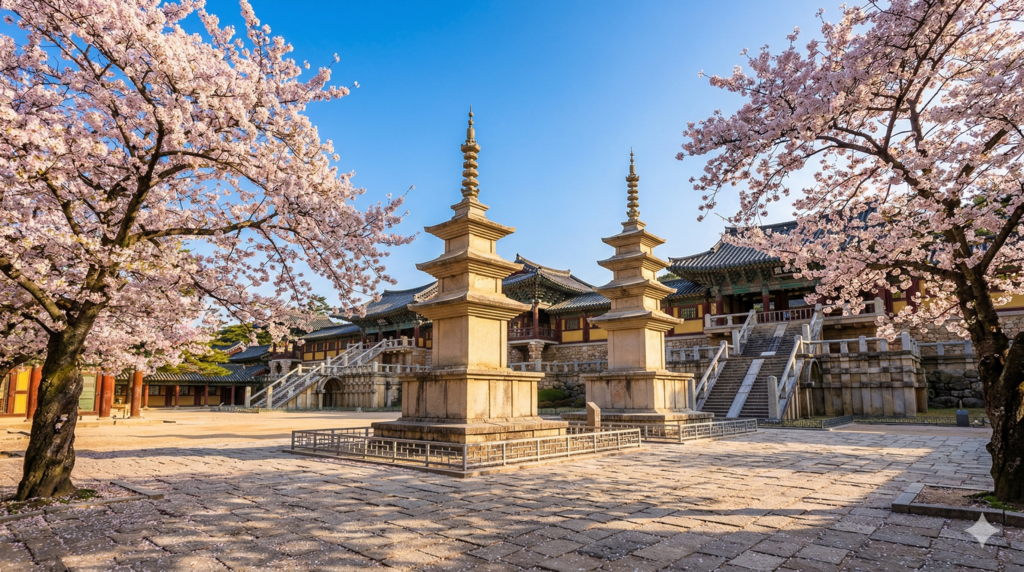
If there is one temple that every visitor to Korea should see at least once in their lifetime, most experts would say it is Bulguksa Temple in Gyeongju, the ancient capital of the Silla Dynasty.
Built in 528 AD and massively expanded in 751 AD under the direction of Prime Minister Kim Daeseong, Bulguksa represents the absolute pinnacle of Silla-era Buddhist art and architecture. The temple complex is a masterpiece of spatial design — a series of ascending terraces that lift visitors step by step from the mundane world into sacred space.
The two most celebrated structures within the complex are the Dabotap and Seokgatap pagodas, both carved from granite with a precision and elegance that continues to astonish architects and historians today. The Dabotap’s intricate lattice design was so beloved that it was featured on the South Korean 10-won coin. The Cheongungyo (Bridge of Blue Clouds) and Baengungyo (Bridge of White Clouds) — the stone stairway bridges that lead to the main gate — are among the most photographed architectural elements in all of Korea.
Visiting Bulguksa in spring, when cherry blossoms drift across the stone courtyards, is an experience that borders on the surreal.
Jogyesa Temple — A Sacred Oasis in the Heart of Seoul
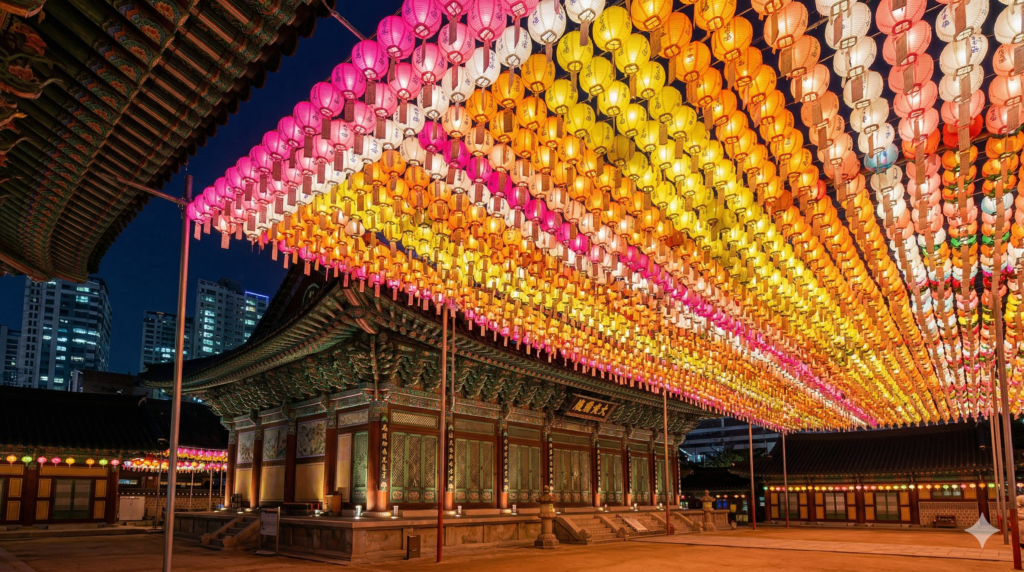
For those who cannot immediately make the journey to Gyeongju, Jogyesa Temple offers something extraordinary: a genuine encounter with living Korean Buddhism right in the middle of one of Asia’s most dynamic megacities.
Located in the Jongno district of Seoul, just minutes from the cultural hub of Insadong, Jogyesa is the headquarters of the Jogye Order of Korean Buddhism — the largest Buddhist order in Korea. The main hall, Daeungjeon, is designated as National Treasure No. 162 and houses three large golden Buddha statues of remarkable beauty.
What makes Jogyesa especially magical is the contrast between its serene, incense-filled courtyards and the buzzing urban energy of the streets immediately outside its walls. It is a genuine sanctuary — one that welcomes visitors of all backgrounds and beliefs.
Jogyesa is also the epicenter of Korea’s famous Lotus Lantern Festival (Yeondeunghoe), held each year in celebration of the Buddha’s birthday. Thousands of colorful lanterns transform the temple grounds and surrounding streets into a river of warm, glowing light — an event now recognized by UNESCO as an Intangible Cultural Heritage of Humanity.
Haeinsa Temple — Home of the Tripitaka Koreana (South Gyeongsang)
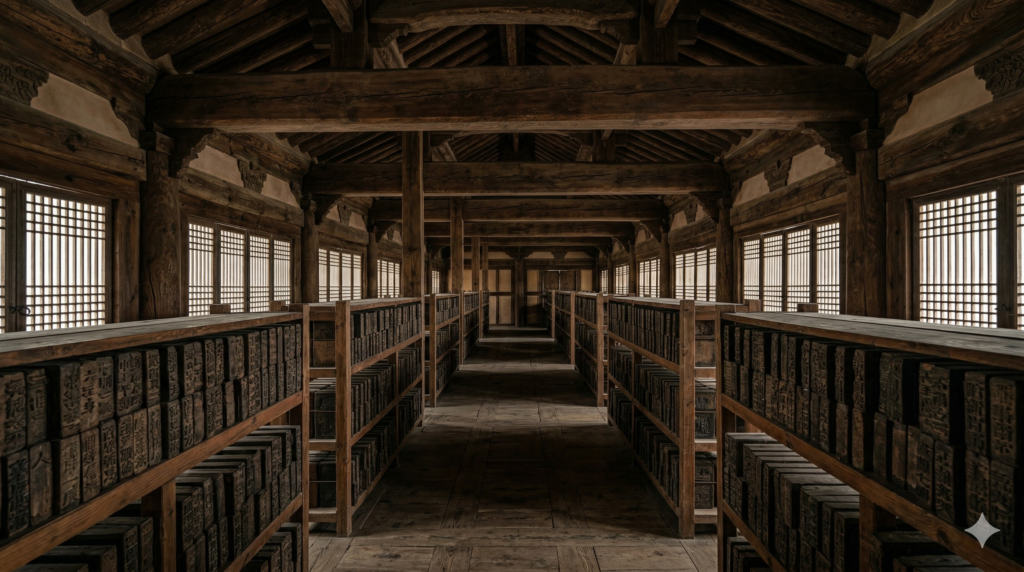
Deep within the forested ridges of Gayasan National Park, Haeinsa Temple holds what many consider the single most precious cultural artifact in Korea: the Tripitaka Koreana.
Carved onto more than 81,000 wooden printing blocks between 1237 and 1248, the Tripitaka Koreana is the most complete and accurate collection of Buddhist scripture in the world. It was created during the Goryeo Dynasty as a prayer for divine protection against the Mongol invasion — a massive, desperate act of devotion carried out over more than a decade. The blocks have survived fire, war, and the passage of nearly eight centuries in the remarkable Janggyeong Panjeon storage buildings, which were designed with such sophisticated natural ventilation and humidity control that they remain effective to this day without modern technology.
Haeinsa draws a particular kind of visitor — scholars, monks, historians, and those who feel the specific gravity of a place where human beings once poured everything they had into an act of faith.
Tongdosa Temple — The Temple Without a Buddha Statue (Why It’s Remarkable)
Among Korea’s so-called Three Jewel Temples (Sambo Sanchal), each of which embodies one of Buddhism’s three treasures, Tongdosa Temple in South Gyeongsang Province represents the Buddha himself. The paradox is that Tongdosa’s main hall contains no Buddha statue.
Instead, the altar faces a window — and through that window, the sacred Diamond Ordination Platform (Geumgang Gyedan) is visible outside. According to tradition, the relics of the historical Buddha are enshrined within this outdoor platform, making it the true object of veneration. A statue, in this context, would be redundant.
This theological sophistication — the idea that the Buddha’s actual presence makes representation unnecessary — makes Tongdosa one of the most intellectually and spiritually fascinating temples in all of East Asia.
Seoraksan’s Sinheungsa Temple — Where Nature Meets Devotion
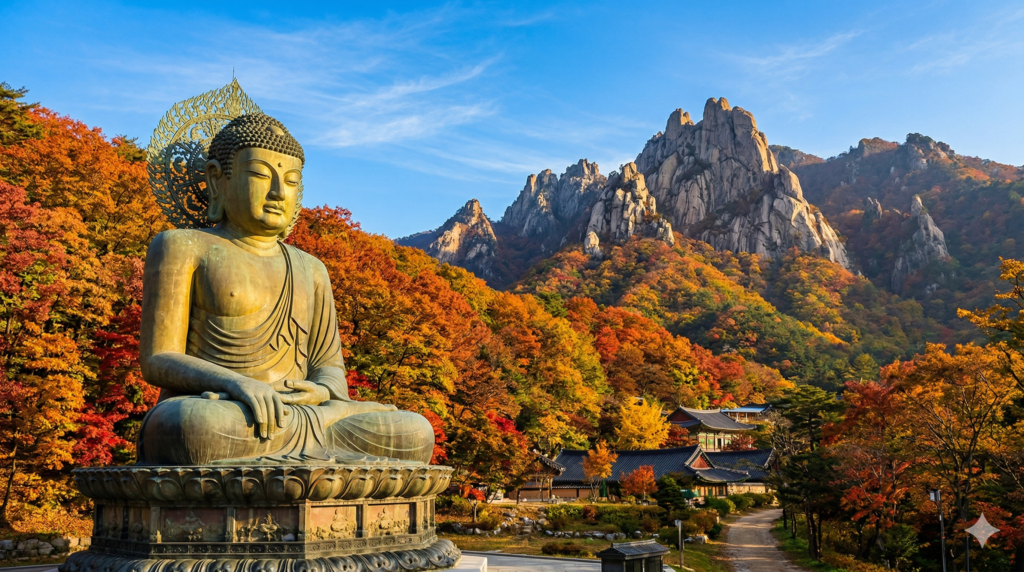
For those who love combining natural beauty with cultural exploration, Sinheungsa Temple at the entrance to Seoraksan National Park offers one of Korea’s most spectacular temple experiences.
The approach to Sinheungsa is already extraordinary — a trail through ancient forest with the dramatic granite peaks of Seoraksan rising above. The temple complex itself is home to a magnificent 15-meter bronze seated Buddha statue that greets visitors from a considerable distance, its serene expression framed against the mountains behind.
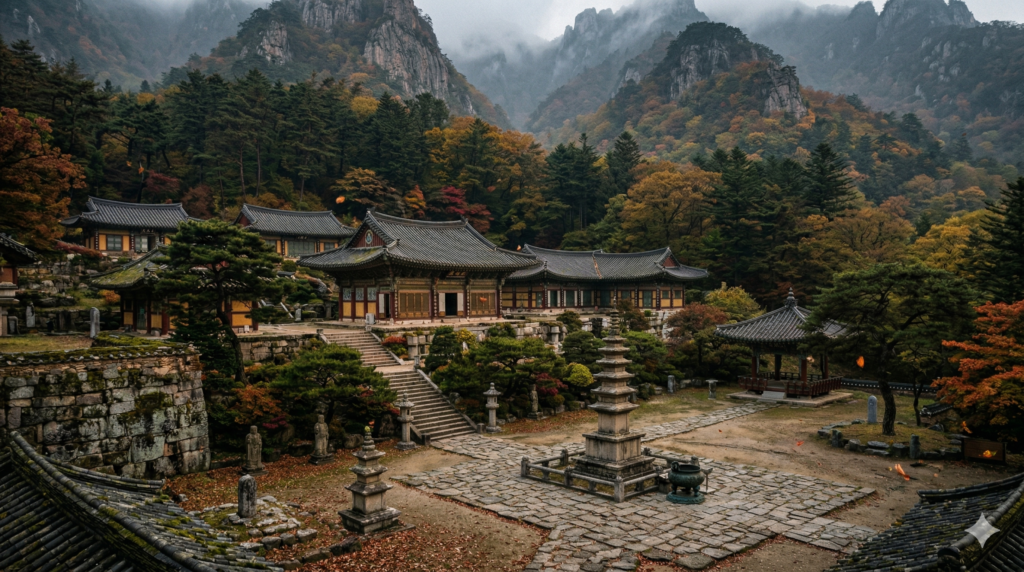
Sinheungsa is best visited in autumn, when the surrounding forests ignite in shades of crimson and gold, creating one of the most breathtaking visual combinations in Korean travel: ancient temple architecture wrapped in a landscape of burning seasonal color.
The Temple of Korea in K-Dramas — Where the Sacred Becomes Cinematic
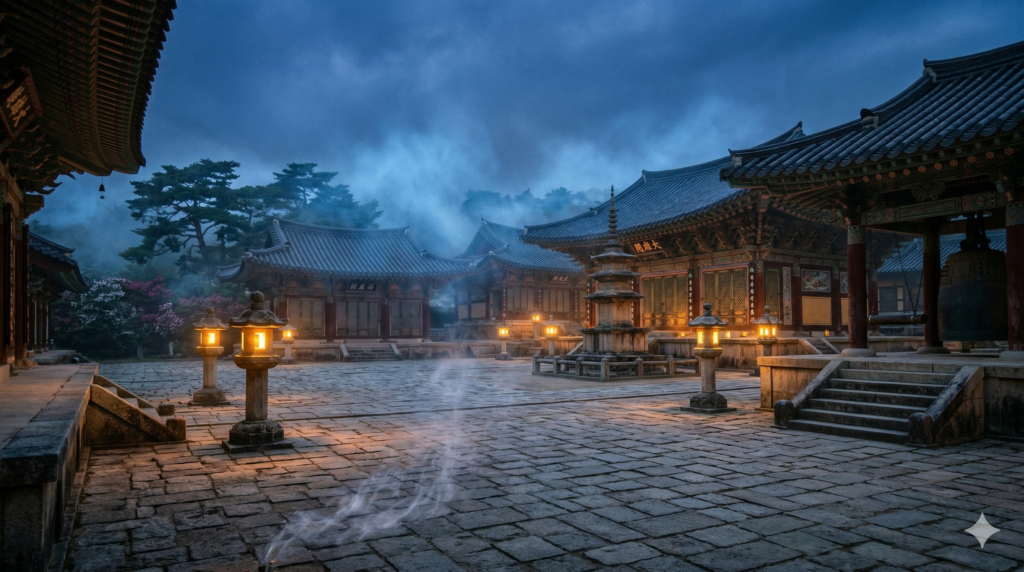
For a significant portion of the global audience now interested in Korean temples, the journey began with a drama scene.
This is not a coincidence. Korean temple settings offer filmmakers something that almost no other location in the country can provide: instant atmosphere. The layered wooden eaves, the moss-covered stone lanterns, the smoke drifting from bronze incense burners, the absolute quality of silence that settles over a mountain courtyard at dusk — these are elements that communicate depth, mystery, and emotional weight without a single line of dialogue.
Why K-Drama Directors Keep Coming Back to Temple Settings
In practical terms, Korean temples offer extraordinary production value at relatively low cost. The architecture is inherently cinematic — every angle provides a composition that looks intentional. The natural lighting at dawn and dusk, filtered through mountain forest, creates the kind of atmospheric quality that would cost a production team enormous resources to recreate artificially.
But beyond the practical, temples carry narrative weight that directors use deliberately. When a character enters a temple in a K-drama, the audience immediately understands that something significant is happening — a moment of reflection, a turning point, a confrontation with something larger than individual desire. Temples signal interiority. They tell the viewer: pay attention, because what happens here matters.
Famous K-Dramas Filmed at Korean Temple Locations
Goblin (도깨비, 2016) used temple settings masterfully to reinforce its central themes of immortality, fate, and the weight of living across centuries. The ancient stone and worn wood of Korean temple architecture communicated the texture of deep time in a way that no modern set could have replicated.
My Love from the Star (별에서 온 그대, 2013) drew on the spiritual associations of Korean temples to reinforce the otherworldly nature of its central character, an alien who has lived on Earth for four hundred years. Temple scenes in the drama function almost as memory spaces — locations outside of ordinary time.
Rookie Historian Goo Hae-ryung (신입사관 구해령, 2019) used real temple locations to achieve the kind of period authenticity that audiences of historical dramas increasingly demand, grounding its Joseon-era narrative in genuinely ancient spaces.
The King: Eternal Monarch (더 킹: 영원의 군주, 2020) used the contrast between modern Seoul’s glass towers and the ancient serenity of temple grounds to visually underscore its parallel-universe storyline.
How Fans Are Turning Drama Locations into Real Pilgrimages
The phenomenon of “drama tourism” — traveling to Korea specifically to visit locations featured in beloved K-dramas — has become one of the most significant drivers of cultural tourism to the country. The Korea Tourism Organization actively maps drama filming locations and publishes guides connecting specific scenes to real-world sites.
For temple locations, this means that visitors often arrive with a specific scene in mind — a particular courtyard, a specific gate, a recognizable stone staircase — and the experience of standing in that exact space, understanding now that it is real and ancient and meaningful, tends to be far more powerful than anything they anticipated.
The Korean Temple Stay Experience — Spend a Night Inside Living History
Of all the ways to experience a Korean temple, none is more transformative than Templestay — the government-supported program that allows visitors from all over the world to live temporarily within a working temple community.
What Is a Temple Stay (템플스테이)?
Launched in 2002 during the FIFA World Cup to provide accommodation for international visitors, Templestay has grown into one of Korea’s most celebrated cultural tourism programs. It is now available at more than 130 participating temples across the country, and its English-language booking platform (templestay.com) makes it accessible to international visitors with no Korean language ability required.
Programs range from brief day programs (3–4 hours) to full overnight and multi-day residential stays. Costs are extremely reasonable — typically between 50,000 and 100,000 Korean won (approximately $38–$76 USD) for an overnight program — and include accommodation, meals, and all guided activities.
What You Will Actually Do During a Temple Stay
The schedule of a typical overnight Templestay reflects the daily rhythm of the monks themselves, beginning long before dawn.
A 4 AM morning bell ceremony opens the day. The great wooden moktak (a wooden percussion instrument) is struck in a specific rhythmic pattern, and the bronze bell — sometimes weighing several tons — rings 28 times in the morning and 33 times in the evening, each number carrying Buddhist cosmological significance.
Morning meditation follows, typically in the main dharma hall, before Baru Gongyang — the formal monastic meal ceremony. This is one of the most striking experiences available to Templestay participants. Meals are eaten in complete silence, using a set of four bowls that are washed with a small amount of water and a cloth after every meal — the washing water then consumed as a final act of respect and zero-waste practice. Participants often describe Baru Gongyang as a profound meditation in itself.
The remainder of the day might include a traditional tea ceremony, 108 prostrations (a physically demanding but deeply meditative practice), prayer bead making, or walking meditation through the temple grounds and surrounding forest. Most programs also include free time for personal reflection — simply sitting in the courtyard, listening, existing within the space.
Is a Temple Stay Right for You?
Templestay is genuinely suitable for a remarkable range of people. It is ideal for solo travelers seeking deeper cultural immersion, for burned-out professionals in need of genuine mental decompression, for spiritual seekers of any or no faith tradition, and for K-drama fans who want to understand the Korea they have been watching at the most intimate level.
It is worth noting that Templestay does not require any commitment to Buddhism. Participants are invited to engage with practices respectfully, but no conversion, belief, or prior knowledge is expected or assumed.
The primary adjustment for most visitors involves the early schedule and the simplicity of the accommodations — ondol floor sleeping, shared bathrooms, and minimal connectivity. Those who require comfort amenities or who have significant mobility limitations should review individual temple programs carefully before booking.
People who have completed a Templestay consistently report it as the most memorable experience of their entire visit to Korea.
Practical Guide — How to Visit a Temple of Korea Respectfully and Memorably
Whether you are planning a brief visit to Jogyesa Temple on a Seoul afternoon or a multi-day journey to the mountain monasteries of the south, a few practical considerations will make your experience significantly more meaningful.
What to Wear and How to Behave
Korean temples welcome visitors of all backgrounds, but they ask — reasonably — for respectful behavior and modest dress. Shoulders and knees should be covered. Many temples offer wraps at the entrance for visitors who arrive in shorts or sleeveless tops.
Before entering the main worship halls, remove your shoes. Step over (not on) the raised threshold at the doorway — this threshold is considered a boundary between the ordinary and sacred worlds. Inside the hall, move quietly and avoid pointing your feet toward the altar or toward the Buddha statue. Photography is permitted in most areas but should be done with awareness — never photograph monks without permission, and never use flash inside worship halls.
When you encounter monks, a simple bow of the head is an appropriate greeting.
Best Time to Visit Korean Temples
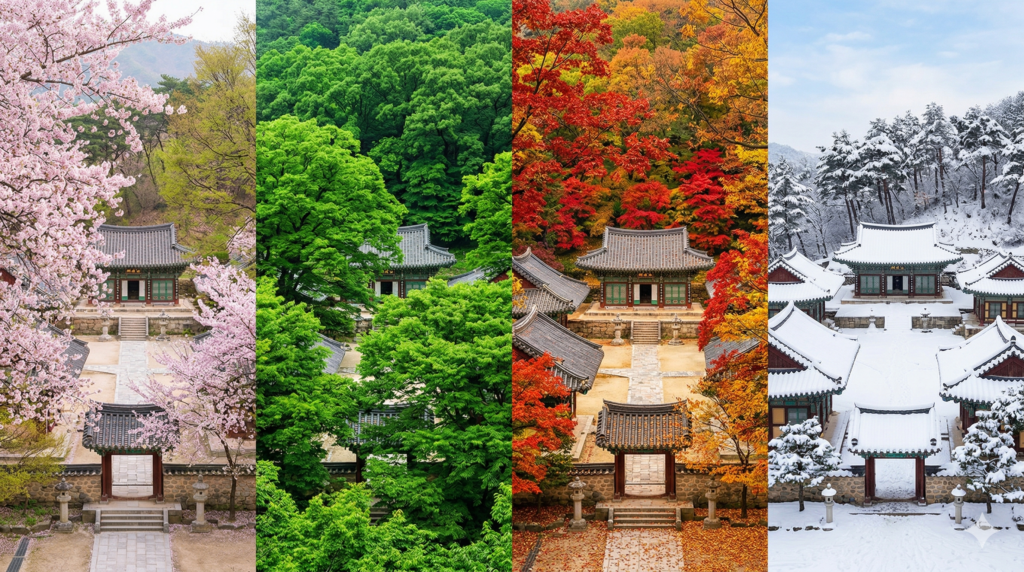
Each season offers a genuinely distinct temple experience, and the right choice depends on what you are seeking.
Spring (April–May) is arguably the most visually spectacular time to visit. Cherry blossoms and forsythia frame ancient stone walls in pink and gold, and the moderate temperatures make long walks through temple grounds thoroughly pleasant. This is also when the Lotus Lantern Festival transforms Jogyesa and central Seoul into something almost impossibly beautiful.
Summer (June–August) brings lush, intensely green mountain forests that surround mountain temples like Haeinsa and Sinheungsa in rich, saturated color. Visitor numbers at mountain temples tend to drop during summer, making this a good season for those who prefer a more solitary experience.
Autumn (October–November) is the season most associated with Korean temples in the popular imagination — and with good reason. The combination of crimson and amber foliage against ancient stone and dancheong paintwork creates some of the most visually extraordinary scenes in East Asian cultural travel. Seoraksan’s Sinheungsa and Naejangsan’s Naejangsa Temple are particularly renowned for their autumn displays.
Winter offers perhaps the most contemplative temple experience — particularly after snowfall, when white-covered rooftops and silent courtyards create an atmosphere of extraordinary stillness. Fewer visitors, sharper air, and the contrast of warm candlelight glowing through wooden lattice screens make winter visits to temples like Beopjusa or Tongdosa genuinely unforgettable.
How to Get to Major Temples from Seoul
Jogyesa Temple is the most accessible — take Seoul Subway Line 3 to Anguk Station (Exit 6) and walk five minutes. No reservation required; the temple is open daily.
Bulguksa Temple requires a journey to Gyeongju. Take the KTX express train from Seoul Station to Singyeongju Station (approximately 2 hours), then a local bus (Bus 700) directly to the temple entrance.
Haeinsa Temple is reached via Daegu. Take the KTX to Dongdaegu Station, then a local bus or taxi to Haeinsa (approximately 1 hour from Daegu).
Sinheungsa Temple at Seoraksan is accessed from the town of Sokcho, which is reachable by intercity bus from Seoul’s Express Bus Terminal (approximately 2.5–3 hours).
Expert Insight — What Korean Temples Teach the World About Balance and Beauty
There is a concept in Korean aesthetics called “Bihyeong” — a term that gestures toward irregularity, the beauty found in things that are not perfectly symmetrical, not machine-made, not forced into ideal forms. It is the beauty of a stone worn smooth by centuries of weather, of a rooftop curve that bends slightly differently on each end, of a courtyard that was not laid out on a perfect grid but rather allowed to settle into the contours of the land.
Scholars of Korean architecture and Buddhist studies have increasingly noted that this principle — the embrace of natural imperfection, the prioritization of harmony over uniformity — offers a philosophical counterpoint to the dominance of industrial aesthetics in contemporary life. Korean temples are not trying to conquer their landscape. They are trying to listen to it.
This is perhaps why so many visitors — including those with no particular interest in Buddhism and no prior knowledge of Korean history — report feeling something shift inside them when they step through a temple gate. It is not necessarily a religious experience. It is something more fundamental: the recognition of a different way of being in the world, encoded in stone and wood and the sound of a bell moving through mountain air.
For K-drama fans, this often comes as a revelation. The peace you felt watching those temple scenes — the sense that the story suddenly became deeper, more serious, more true — was not simply the effect of good cinematography. It was your recognition, however unconscious, of something genuinely present in those spaces. And that presence has been accumulating for more than a thousand years.
Frequently Asked Questions About the Temple of Korea
Q: What is the most famous temple in Korea? Bulguksa Temple in Gyeongju is widely considered the most iconic and historically significant Korean Buddhist temple, recognized as a UNESCO World Heritage Site since 1995.
Q: Can non-Buddhists visit Korean temples? Absolutely. Korean temples are open to respectful visitors of any religious background or none at all. The Templestay program was specifically designed with international, non-Buddhist visitors in mind.
Q: Are Korean temples free to enter? Most temples charge a modest admission fee, typically between ₩1,000 and ₩5,000 (less than $5 USD). Some temples in national parks charge slightly more. The Templestay program is priced separately and covers accommodation and all activities.
Q: Which K-drama has the best Korean temple scenes? Among fans, Goblin (2016) and My Love from the Star (2013) are most frequently cited for their atmospheric and emotionally resonant use of Korean temple settings.
Q: How do I book a Korean temple stay? The official booking platform is templestay.com, which offers full English-language functionality. Programs can be filtered by temple, duration, activity type, and region.
Q: Is it safe to visit remote mountain temples alone? Yes. Korean temples, including those in national parks and mountain locations, are generally very safe. Trails are well-marked and most temples have staff or monks present throughout the day.
The temple of Korea is many things at once. It is a UNESCO-recognized architectural marvel. It is a living center of Buddhist practice and community. It is a filming location that has moved millions of television viewers to feel something they could not quite name. It is a place where, against all historical odds, something ancient and true has been preserved and passed forward through centuries of invasion, destruction, and change.
But perhaps most importantly — it is a place you can actually go.
You do not need to be Buddhist. You do not need to be an architecture scholar or a history expert or even a particularly experienced traveler. You need only arrive with open eyes and a willingness to be quiet for a while. The rest, as countless visitors have discovered, takes care of itself.
Whether you first saw these sacred spaces in a drama scene or you are encountering them for the first time right now in these pages, the invitation is the same: step through the gate, remove your shoes, and let a thousand years of human devotion do what it has always done — remind you that there is more to the world, and to yourself, than the rush of ordinary days allows you to see.